
We are all compelled in our own different ways to find some time to think about what happened in our lives in the past months and have a moment to consider how we want to move forward. This applies not only to our personal lives, but also to the general direction we are following as a society. In this moment of transition from one year to the next, we have the chance to think about what we gained and what we lost, and about what we want to do next.
This selection of exhibitions to see in January in Berlin wants to provide us with various means to do that, and give us different perspectives and sources of inspiration.
The Akademie der Künste at Hanseatenweg is showing until January 25 a powerful exhibition on the life and work of Eslanda and Paul Robeson. Every Artist Must Take Sides, Resonances of Eslanda and Paul Robeson tells us about this inspiring couple, who decided to lead by example, spending their lives standing up for what they knew was right. Paul Robeson was mainly known for his impressive career as a singer, which he used to find resonance for a powerful message of activism.

“Every artist, every scientist, every writer must decide now where he stands. He has no alternative. … The artist must take sides. He must elect to fight for freedom or for slavery”.
The exhibition takes shape from this powerful statement that Robeson made in June 1937, addressing his public in London for support in the Spanish Civil War. Together with Eslanda, they spent their entire existence actively opposing racism, colonialism and fascism, both in the U.S. and all over the world, while creating the possibility of a real change in society.
The exhibition draws from their archive, kept at the Akademie der Künste, discussing the fundamental topic of Black history and its political impact. The exhibition also brings to light the important contribution of Eslanda, who was often less acknowledged than her husband, confronting the systemic sexism of the time.
Interweaving pieces of their archive, we encounter different artworks made by 13 contemporary artists, who engage with it while transposing the various topics to contemporary times and means. This interesting exhibition shows us the importance of standing up for what is right, of actively opposing injustice, and fighting for a better future, one that belongs to us all. In a time of rising populism and international conflict, their uncompromising bravery resounds louder and clearer, and inspires us to do more.


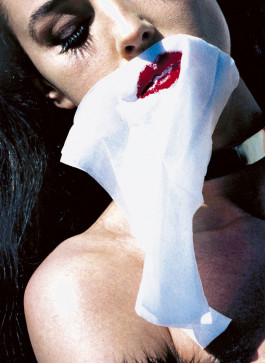
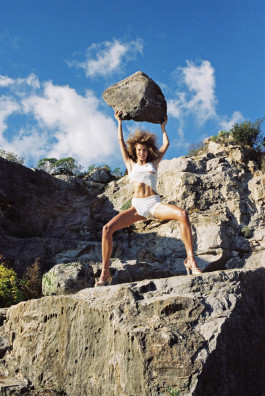
Helmut Newton Foundation is celebrating the career of its founder through two compelling exhibitions, focusing on his use of the photographic medium in a multifaceted way.
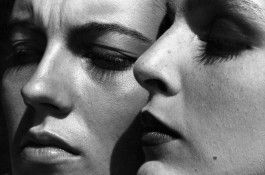
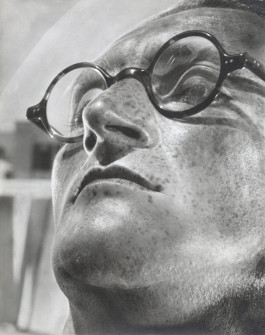
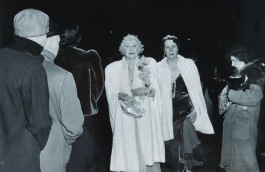
Dialogues. Collection FOTOGRAFIS x Helmut Newton matches the powerful work of the photographer with FOTOGRAFIS, the impressive archival collection of the Bank Austria Kunstforum Wien, which comprehends outstanding names of the history of photography such as Diane Arbus, Margaret Bourke-White, Duane Michals and Man Ray among others.
The exhibition is organized in pairs, presenting all the leitmotifs of photography through the eyes of Newton and many of these acclaimed photographers. The themes are incredibly various, such as photography can be, and the connection between them is sometimes immediate, sometimes more metaphorical.
The result is a stunning dialogue between artists, times and the medium of photography in itself, showing us how powerful the bond we share as a species is, while embodying the changes we experience through time.
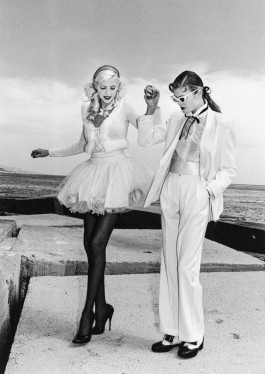
Newton, Riviera focuses instead on the relationship that the artist had with Monte Carlo and the French Riviera in general. Helmut and his wife June relocated there at the beginning of the 1980s, and their relationship to the area had a significant impact on his practice and inspiration as a photographer.
The stunning visual of the sea, of its bright light and beautiful sceneries is therefore celebrated in this exhibition, which presents many of the pictures he took in the region since the beginning of his career, up until the last photoshoot he did before his death in 2004.

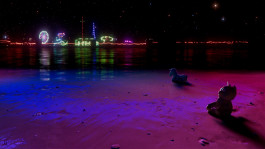
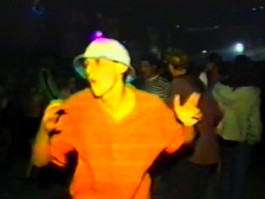
Julia Stoschek Foundation is showcasing a powerful exhibition on the work of Mark Leckey, developed on the three floors of their building. Marking the most comprehensive presentation of the artist's work in the last decade, Enter Thru Medieval Wounds is a very personal yet shared journey through the inconsistencies of our lives. The artist works on a deep interconnection between visual art, music, technology and common references, questioning our basic conception of reality. Growing up in England during the 70s and the 80s, Leckey witnessed a time of post-industrial decline and the rise of the rave, disco and post punk scenes. It all became part of his practice, which stands in a powerful balance between empowerment and unsettlement.
The exhibition presents historical artworks like Fiorucci Made Me Hardcore (1999), a beautiful homage to the rave scene of the time. Various pieces from that period are now part of the Julia Stoschek collection, which took this chance to show them to the public. Alongside them, we also see his most recent artworks, which deal with the role of technology in our society. We witness a refrigerator expressing its own feelings, puppets and balloons exploring the universe and a biblical saint talking to us through his wounds. Very interesting is the connection with Medieval times, a theme very close to the artist, and an interesting thread in the exhibition. Particularly charming is the idea, taken from that era, that images don’t serve as mere representations, but as portals to connect to each other and to the divine, creating an interesting view of society both in the past and in contemporary times. The artist therefore creates a controlled chaos, perfectly representing the multifaceted reality we live in.


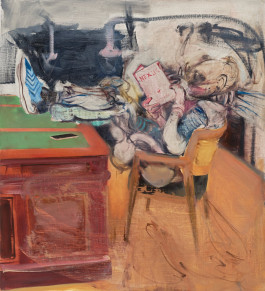
Galerie Judin is hosting two powerful exhibitions, connecting painting to the impact of technology in our society and lives.
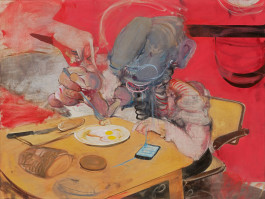
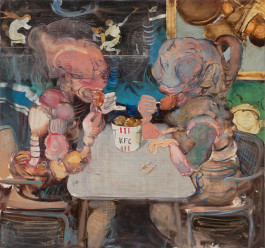
At Die Tankstelle they are showing the powerful pictorial work of acclaimed artist Adrian Ghenie. Titled Cloud Fever, the exhibition is a brilliant and unsettling analysis on our general relationship with social media, which seems to have clouded and overshadowed almost everything else. His eerie figures are alone – even when in company – eating breakfast or fast food on their tables, but often haunted by these small yet hypnotic screens.
The artist has become preoccupied with this issue for some years now, ever since the Covid pandemic, and approaches the topic as an outsider. He is a person who in fact refuses the use of social media, while also acknowledging their specific utility in some cases. This perspective gives us a really interesting take on what might seem usual to many of us, but actually feels disturbing. His stunning and unsettling painting technique delivers it in the most powerful way, and gives us a possible way out of this nightmarish condition we often take for granted.
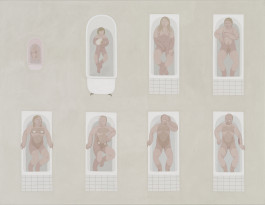
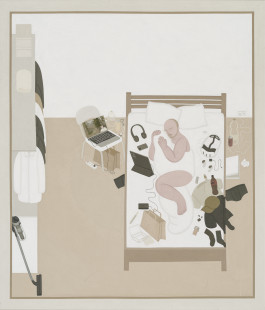
Their gallery at Mercator Höfe is presenting at the same time Alexander Basil, with Error 404.
The title itself is a direct reference to the imagery of technology, citing the pages which cannot be found or connected to a server. This becomes a powerful thread to address a biographical journey, depicted in his very recognizable pictorial language made of temporal sequences. We see the artist from his birth to the present day, his life at home and his relationship with technology.
This is also one of the first stances where the artist discusses explicitly the physical and intimate aspects of transmasculine transition, showing glimpses of it in these new series of paintings. The power of his practice lies in his ability to always stay in between: he is both being looked at and directly gazing back at the viewer, he discusses bodies as both physical and mental spaces, his presence travels from one painting to the next, his face appropriates various other figures and objects in a delicate yet impactful way. His work is here to remind us that the relationship with our environment is totalizing, “for here there is no place that does not see you”. (Rainer Maria Rilke).

In cooperation with Magnum Photos, f³ – freiraum für fotografie is presenting the powerful work of the renowned photographer Eve Arnold. Capturing Compassion explores the ability of an artist who always looked beyond and documented the deeper selves of the individuals she encountered. “If a photographer cares about the people before the lens and is compassionate, much is given. It is the photographer, not the camera, that is the instrument.”, stated Arnold, and this citation sums up her whole practice. This simple yet powerful concept allowed her to portray people from different backgrounds and places in such an intimate way we remain stunned. She therefore enabled us to recognize the shared humanity of those who might feel distant from us.
Particularly impressive was her relationship with Marilyn Monroe, who she was able to depict with a completely different aura. Her empathetic eyes showed her inner essence, stripped of all the fuss around her, giving us some of the most honest and beautiful images of a seemingly unreachable icon. She was also able to portrait other prominent figures of the time, such as Malcolm X, Marlene Dietrich and Joan Crawford, always maintaining an intimate insight regardless of the facade of fame. The exhibition is a journey on her whole practice and also presents her beautiful first series, like the ones taken in Harlem in the 1950s, and then all over the world. In her art lies a powerful lesson: no matter who, everyone was equal in front of her lenses.


Dorothée Nilsson Gallery is showing a solo exhibition by Swedish artist Martina Hoogland Ivanow, her third with the gallery. Shadow Works, Living the Dream is a beautiful summary of her whole practice, from her studying years at Parsons in New York, to her most recent publication, which was presented at the gallery on December 13. Her work focuses on the role of shadows in photography, seeing it as a powerful metaphor of the inconsistency of our society and of the fragility of human life.
Her images process different ways of dealing with this, and poetically make us reflect on our role and the impact we have in the world we live in. Particularly stunning are her pictures which present the same scene, but with completely different coefficients of light or darkness in them. They make us question our perspective, our way of seeing and reality as a whole. As the artist said: “How your eye is drawn to the lightest point, and then you find other things in the darkness – forming narratives with the surreal and the gruesome". Her work makes us realize the importance of shadows in our lives, and how a change of perspective might be pivotal to our relationship with the world and the people who surround us.


Related Articles:

We are all compelled in our own different ways to find some time to think about what happened in our lives in the past months and have a moment to consider how we want to move forward. This applies not only to our personal lives, but also to the general direction we are following as a society. In this moment of transition from one year to the next, we have the chance to think about what we gained and what we lost, and about what we want to do next.
This selection of exhibitions to see in January in Berlin wants to provide us with various means to do that, and give us different perspectives and sources of inspiration.
The Akademie der Künste at Hanseatenweg is showing until January 25 a powerful exhibition on the life and work of Eslanda and Paul Robeson. Every Artist Must Take Sides, Resonances of Eslanda and Paul Robeson tells us about this inspiring couple, who decided to lead by example, spending their lives standing up for what they knew was right. Paul Robeson was mainly known for his impressive career as a singer, which he used to find resonance for a powerful message of activism.
“Every artist, every scientist, every writer must decide now where he stands. He has no alternative. … The artist must take sides. He must elect to fight for freedom or for slavery”.
The exhibition takes shape from this powerful statement that Robeson made in June 1937, addressing his public in London for support in the Spanish Civil War. Together with Eslanda, they spent their entire existence actively opposing racism, colonialism and fascism, both in the U.S. and all over the world, while creating the possibility of a real change in society.
The exhibition draws from their archive, kept at the Akademie der Künste, discussing the fundamental topic of Black history and its political impact. The exhibition also brings to light the important contribution of Eslanda, who was often less acknowledged than her husband, confronting the systemic sexism of the time.
Interweaving pieces of their archive, we encounter different artworks made by 13 contemporary artists, who engage with it while transposing the various topics to contemporary times and means. This interesting exhibition shows us the importance of standing up for what is right, of actively opposing injustice, and fighting for a better future, one that belongs to us all. In a time of rising populism and international conflict, their uncompromising bravery resounds louder and clearer, and inspires us to do more.


Helmut Newton Foundation is celebrating the career of its founder through two compelling exhibitions, focusing on his use of the photographic medium in a multifaceted way.
Dialogues. Collection FOTOGRAFIS x Helmut Newton matches the powerful work of the photographer with FOTOGRAFIS, the impressive archival collection of the Bank Austria Kunstforum Wien, which comprehends outstanding names of the history of photography such as Diane Arbus, Margaret Bourke-White, Duane Michals and Man Ray among others.
The exhibition is organized in pairs, presenting all the leitmotifs of photography through the eyes of Newton and many of these acclaimed photographers. The themes are incredibly various, such as photography can be, and the connection between them is sometimes immediate, sometimes more metaphorical.
The result is a stunning dialogue between artists, times and the medium of photography in itself, showing us how powerful the bond we share as a species is, while embodying the changes we experience through time.
Newton, Riviera focuses instead on the relationship that the artist had with Monte Carlo and the French Riviera in general. Helmut and his wife June relocated there at the beginning of the 1980s, and their relationship to the area had a significant impact on his practice and inspiration as a photographer.
The stunning visual of the sea, of its bright light and beautiful sceneries is therefore celebrated in this exhibition, which presents many of the pictures he took in the region since the beginning of his career, up until the last photoshoot he did before his death in 2004.


Julia Stoschek Foundation is showcasing a powerful exhibition on the work of Mark Leckey, developed on the three floors of their building. Marking the most comprehensive presentation of the artist's work in the last decade, Enter Thru Medieval Wounds is a very personal yet shared journey through the inconsistencies of our lives. The artist works on a deep interconnection between visual art, music, technology and common references, questioning our basic conception of reality. Growing up in England during the 70s and the 80s, Leckey witnessed a time of post-industrial decline and the rise of the rave, disco and post punk scenes. It all became part of his practice, which stands in a powerful balance between empowerment and unsettlement.
The exhibition presents historical artworks like Fiorucci Made Me Hardcore (1999), a beautiful homage to the rave scene of the time. Various pieces from that period are now part of the Julia Stoschek collection, which took this chance to show them to the public. Alongside them, we also see his most recent artworks, which deal with the role of technology in our society. We witness a refrigerator expressing its own feelings, puppets and balloons exploring the universe and a biblical saint talking to us through his wounds. Very interesting is the connection with Medieval times, a theme very close to the artist, and an interesting thread in the exhibition. Particularly charming is the idea, taken from that era, that images don’t serve as mere representations, but as portals to connect to each other and to the divine, creating an interesting view of society both in the past and in contemporary times. The artist therefore creates a controlled chaos, perfectly representing the multifaceted reality we live in.


Galerie Judin is hosting two powerful exhibitions, connecting painting to the impact of technology in our society and lives.
At Die Tankstelle they are showing the powerful pictorial work of acclaimed artist Adrian Ghenie. Titled Cloud Fever, the exhibition is a brilliant and unsettling analysis on our general relationship with social media, which seems to have clouded and overshadowed almost everything else. His eerie figures are alone – even when in company – eating breakfast or fast food on their tables, but often haunted by these small yet hypnotic screens.
The artist has become preoccupied with this issue for some years now, ever since the Covid pandemic, and approaches the topic as an outsider. He is a person who in fact refuses the use of social media, while also acknowledging their specific utility in some cases. This perspective gives us a really interesting take on what might seem usual to many of us, but actually feels disturbing. His stunning and unsettling painting technique delivers it in the most powerful way, and gives us a possible way out of this nightmarish condition we often take for granted.


Their gallery at Mercator Höfe is presenting at the same time Alexander Basil, with Error 404.
The title itself is a direct reference to the imagery of technology, citing the pages which cannot be found or connected to a server. This becomes a powerful thread to address a biographical journey, depicted in his very recognizable pictorial language made of temporal sequences. We see the artist from his birth to the present day, his life at home and his relationship with technology.
This is also one of the first stances where the artist discusses explicitly the physical and intimate aspects of transmasculine transition, showing glimpses of it in these new series of paintings. The power of his practice lies in his ability to always stay in between: he is both being looked at and directly gazing back at the viewer, he discusses bodies as both physical and mental spaces, his presence travels from one painting to the next, his face appropriates various other figures and objects in a delicate yet impactful way. His work is here to remind us that the relationship with our environment is totalizing, “for here there is no place that does not see you”. (Rainer Maria Rilke).


In cooperation with Magnum Photos, f³ – freiraum für fotografie is presenting the powerful work of the renowned photographer Eve Arnold. Capturing Compassion explores the ability of an artist who always looked beyond and documented the deeper selves of the individuals she encountered. “If a photographer cares about the people before the lens and is compassionate, much is given. It is the photographer, not the camera, that is the instrument.”, stated Arnold, and this citation sums up her whole practice. This simple yet powerful concept allowed her to portray people from different backgrounds and places in such an intimate way we remain stunned. She therefore enabled us to recognize the shared humanity of those who might feel distant from us.
Particularly impressive was her relationship with Marilyn Monroe, who she was able to depict with a completely different aura. Her empathetic eyes showed her inner essence, stripped of all the fuss around her, giving us some of the most honest and beautiful images of a seemingly unreachable icon. She was also able to portrait other prominent figures of the time, such as Malcolm X, Marlene Dietrich and Joan Crawford, always maintaining an intimate insight regardless of the facade of fame. The exhibition is a journey on her whole practice and also presents her beautiful first series, like the ones taken in Harlem in the 1950s, and then all over the world. In her art lies a powerful lesson: no matter who, everyone was equal in front of her lenses.


Dorothée Nilsson Gallery is showing a solo exhibition by Swedish artist Martina Hoogland Ivanow, her third with the gallery. Shadow Works, Living the Dream is a beautiful summary of her whole practice, from her studying years at Parsons in New York, to her most recent publication, which was presented at the gallery on December 13. Her work focuses on the role of shadows in photography, seeing it as a powerful metaphor of the inconsistency of our society and of the fragility of human life.
Her images process different ways of dealing with this, and poetically make us reflect on our role and the impact we have in the world we live in. Particularly stunning are her pictures which present the same scene, but with completely different coefficients of light or darkness in them. They make us question our perspective, our way of seeing and reality as a whole. As the artist said: “How your eye is drawn to the lightest point, and then you find other things in the darkness – forming narratives with the surreal and the gruesome". Her work makes us realize the importance of shadows in our lives, and how a change of perspective might be pivotal to our relationship with the world and the people who surround us.


Related Articles:
You need to load content from reCAPTCHA to submit the form. Please note that doing so will share data with third-party providers.
More InformationYou need to load content from Turnstile to submit the form. Please note that doing so will share data with third-party providers.
More InformationYou are currently viewing a placeholder content from Facebook. To access the actual content, click the button below. Please note that doing so will share data with third-party providers.
More InformationYou are currently viewing a placeholder content from Instagram. To access the actual content, click the button below. Please note that doing so will share data with third-party providers.
More InformationYou need to load content from hCaptcha to submit the form. Please note that doing so will share data with third-party providers.
More InformationYou need to load content from reCAPTCHA to submit the form. Please note that doing so will share data with third-party providers.
More InformationYou are currently viewing a placeholder content from Turnstile. To access the actual content, click the button below. Please note that doing so will share data with third-party providers.
More InformationYou are currently viewing a placeholder content from X. To access the actual content, click the button below. Please note that doing so will share data with third-party providers.
More Information