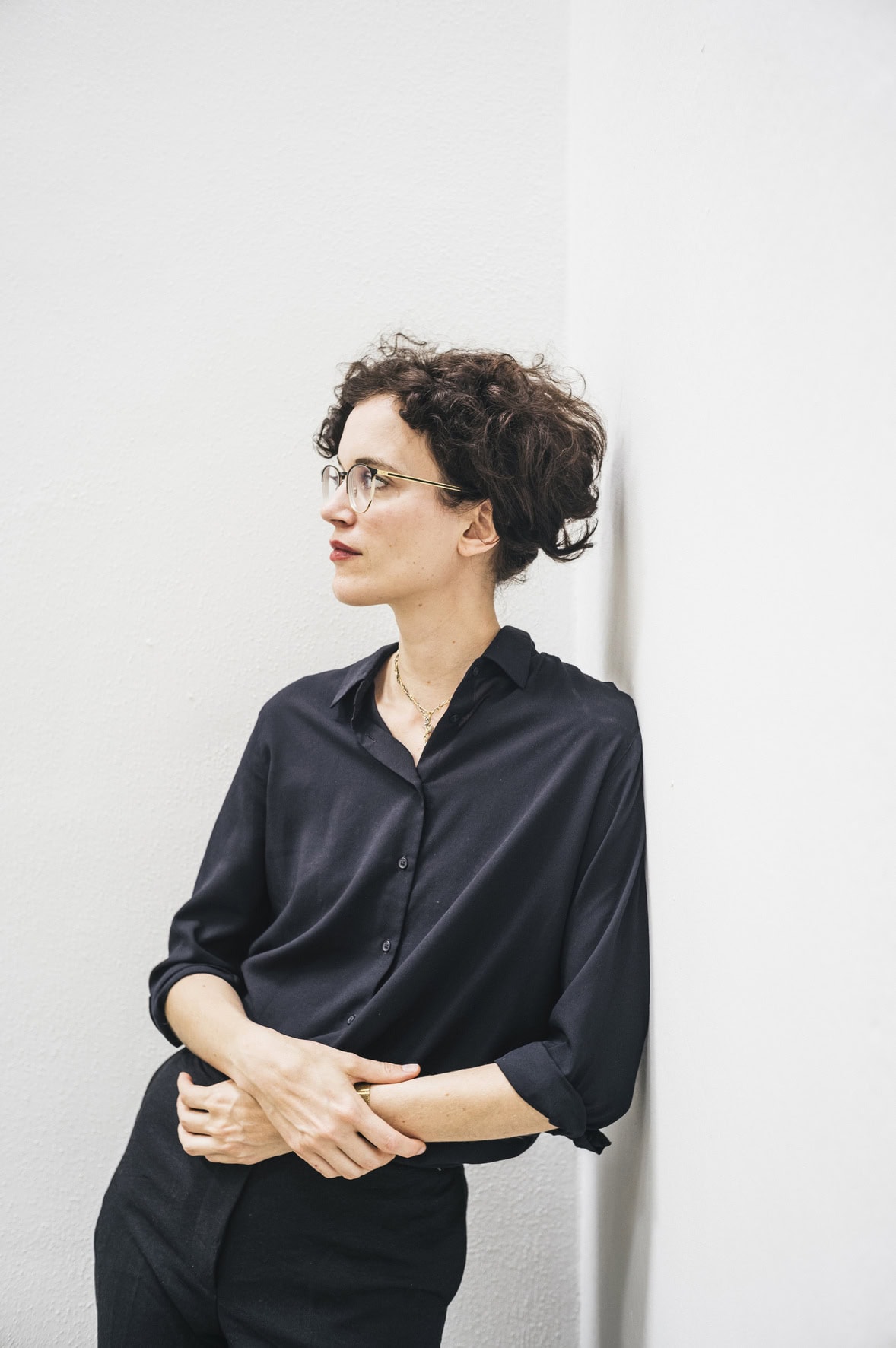

A legendary figure in contemporary art, the German artist has based her practice on exploring the friction beneath it all. Through her large-scale self-portraits and video works, Sieverding analyzed relevant topics of our time, long before they entered the mainstream. She became widely known in the mid-1970s as one of the first to introduce monumental, large-scale photographs and iconic close-ups of her own face to the art world.
From the role of technology and the impact of racism to the nuances of gender fluidity, her practice acts as a vital framework for understanding the challenges of today’s world. In the face of numerous global crises, her work is now more contemporary than ever. Galerie Thomas Schulte will open her remarkable exhibition Life–Death on September 10th, presenting for the occasion her 1969 eponymous film and a series of her outstanding photographic works.


ㅤ
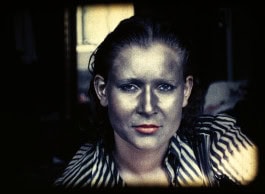
— Life–Death has never lost its actuality for me. The film deals with polarities that are fundamental to human existence — life and death, masculine and feminine, appearance and transformation. These are not questions that belong to 1969. The historical and social conditions change, but the tensions remain.
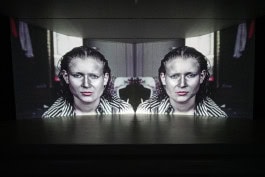
I was never interested in fixing the work in its original moment. For the present exhibition, Life–Death undergoes another transformation: the film is mirrored and shown as a double projection. Returning to my own material, putting it into a new constellation and allowing it to produce another image is a basic principle of my work. So Life–Death is not simply being shown again — it is activated again under present conditions

— Technology is not interesting to me simply as technology. It becomes interesting when it changes what an image can be. Photography still needs something from outside — a material that is exposed and the moment in which I release the shutter. I never considered the photograph to be reality, but there is an encounter with reality. With AI, that relation can disappear completely: images can be generated without that encounter. So the question for me is what this does to the concept of art, to authorship and to responsibility. The fascination with new technology is always there; the critical question is who uses it, for what, and what kind of perception it produces. The scale and speed are new, but the fundamental questions are not.
— I would not have used today’s terminology at the time. But the distinction between masculine and feminine was very consciously at stake. In Transformer, superimposed en face portraits of Klaus Mettig and myself merge into a kind of “third” portrait, a complex image that carries both feminine and masculine features. In that sense, the symbolic gender order is suspended. I wasn’t interested in replacing one fixed identity with another, but in the ambiguities of one’s own identity and that of the other — in identity as something relational, multiple and not finally fixed. Experiments with the self can really only be embodied by oneself. The other sex is also something one encounters within oneself.

— It was not a choice from the very beginning. With Eigenbewegung I was pointing the camera outward, as a witness to what was happening at the Academy and in the street. Around 1969 I turned the camera toward myself. But likeness and recognizability never interested me. My face was the most immediate material for an experiment in transformation — it could be solarized, mirrored, layered, enlarged or combined with other images. In that sense it can function like a mirror rather than as a classical self-portrait. The image is not there to tell you who I am.
— “Deutschland wird deutscher” was never an affirmative slogan. When the work appeared in public space, it was read in completely opposite ways — some people even understood it as right-wing propaganda, while for others it was clearly a warning. I have always found that ambiguity important: an image should not merely confirm what you already think. Today the phrase has acquired another, perhaps even more disturbing actuality. When belonging is again defined through nationality, borders and exclusion, the question is: who defines what “German” or “European” means, and who is excluded by that definition? National identity cannot be fixed; it has to reconstruct and question itself continuously.
— At the moment I am preparing several exhibitions that bring different periods of the work into new constellations. In October, Museum Schloss Moyland opens Katharina Sieverding in Dialogue with Joseph Beuys. It returns to the Academy years, to Eigenbewegung and also to my earlier work in theatre; a selection of drawings from the 1960s will be exhibited for the first time. And in 2027, a retrospective at the Neue Nationalgalerie in Berlin is being prepared. For me, returning to earlier material is never simply retrospective. The question is what becomes visible in it now.
Related Articles:

A legendary figure in contemporary art, the German artist has based her practice on exploring the friction beneath it all. Through her large-scale self-portraits and video works, Sieverding analyzed relevant topics of our time, long before they entered the mainstream. She became widely known in the mid-1970s as one of the first to introduce monumental, large-scale photographs and iconic close-ups of her own face to the art world.
From the role of technology and the impact of racism to the nuances of gender fluidity, her practice acts as a vital framework for understanding the challenges of today’s world. In the face of numerous global crises, her work is now more contemporary than ever. Galerie Thomas Schulte will open her remarkable exhibition Life–Death on September 10th, presenting for the occasion her 1969 eponymous film and a series of her outstanding photographic works.


ㅤ
— Life–Death has never lost its actuality for me. The film deals with polarities that are fundamental to human existence — life and death, masculine and feminine, appearance and transformation. These are not questions that belong to 1969. The historical and social conditions change, but the tensions remain.
I was never interested in fixing the work in its original moment. For the present exhibition, Life–Death undergoes another transformation: the film is mirrored and shown as a double projection. Returning to my own material, putting it into a new constellation and allowing it to produce another image is a basic principle of my work. So Life–Death is not simply being shown again — it is activated again under present conditions

— Technology is not interesting to me simply as technology. It becomes interesting when it changes what an image can be. Photography still needs something from outside — a material that is exposed and the moment in which I release the shutter. I never considered the photograph to be reality, but there is an encounter with reality. With AI, that relation can disappear completely: images can be generated without that encounter. So the question for me is what this does to the concept of art, to authorship and to responsibility. The fascination with new technology is always there; the critical question is who uses it, for what, and what kind of perception it produces. The scale and speed are new, but the fundamental questions are not.
— I would not have used today’s terminology at the time. But the distinction between masculine and feminine was very consciously at stake. In Transformer, superimposed en face portraits of Klaus Mettig and myself merge into a kind of “third” portrait, a complex image that carries both feminine and masculine features. In that sense, the symbolic gender order is suspended. I wasn’t interested in replacing one fixed identity with another, but in the ambiguities of one’s own identity and that of the other — in identity as something relational, multiple and not finally fixed. Experiments with the self can really only be embodied by oneself. The other sex is also something one encounters within oneself.

— It was not a choice from the very beginning. With Eigenbewegung I was pointing the camera outward, as a witness to what was happening at the Academy and in the street. Around 1969 I turned the camera toward myself. But likeness and recognizability never interested me. My face was the most immediate material for an experiment in transformation — it could be solarized, mirrored, layered, enlarged or combined with other images. In that sense it can function like a mirror rather than as a classical self-portrait. The image is not there to tell you who I am.
— “Deutschland wird deutscher” was never an affirmative slogan. When the work appeared in public space, it was read in completely opposite ways — some people even understood it as right-wing propaganda, while for others it was clearly a warning. I have always found that ambiguity important: an image should not merely confirm what you already think. Today the phrase has acquired another, perhaps even more disturbing actuality. When belonging is again defined through nationality, borders and exclusion, the question is: who defines what “German” or “European” means, and who is excluded by that definition? National identity cannot be fixed; it has to reconstruct and question itself continuously.
— At the moment I am preparing several exhibitions that bring different periods of the work into new constellations. In October, Museum Schloss Moyland opens Katharina Sieverding in Dialogue with Joseph Beuys. It returns to the Academy years, to Eigenbewegung and also to my earlier work in theatre; a selection of drawings from the 1960s will be exhibited for the first time. And in 2027, a retrospective at the Neue Nationalgalerie in Berlin is being prepared. For me, returning to earlier material is never simply retrospective. The question is what becomes visible in it now.
Related Articles:
You need to load content from reCAPTCHA to submit the form. Please note that doing so will share data with third-party providers.
More InformationYou need to load content from Turnstile to submit the form. Please note that doing so will share data with third-party providers.
More InformationYou are currently viewing a placeholder content from Facebook. To access the actual content, click the button below. Please note that doing so will share data with third-party providers.
More InformationYou are currently viewing a placeholder content from Instagram. To access the actual content, click the button below. Please note that doing so will share data with third-party providers.
More InformationYou need to load content from hCaptcha to submit the form. Please note that doing so will share data with third-party providers.
More InformationYou need to load content from reCAPTCHA to submit the form. Please note that doing so will share data with third-party providers.
More InformationYou are currently viewing a placeholder content from Turnstile. To access the actual content, click the button below. Please note that doing so will share data with third-party providers.
More InformationYou are currently viewing a placeholder content from X. To access the actual content, click the button below. Please note that doing so will share data with third-party providers.
More Information