
Sign up here to subscribe to The Columbist newsletter.
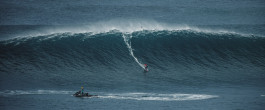
Portugal may be synonymous with surfing, but if you actually want to learn or improve your skills without starting with a 20-metre wall of water where should you go?
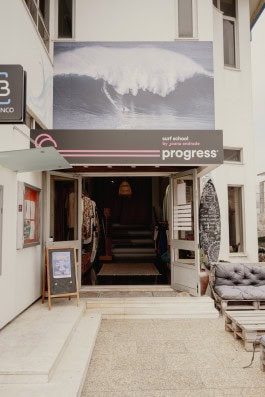
This summer, The Columbist travelled to Ericeira, a small coastal town less than an hour from Lisbon and one of Europe’s great surf destinations. It’s the kind of place where surfing is not simply an activity you book for an afternoon; it is part of everyday life. Beginners come to catch their first wave, experienced surfers come to progress, and locals have built an entire culture around the Atlantic. There are plenty of surf schools to choose from, but we ended up at Progress Surf School and that is how we met Joana Andrade.
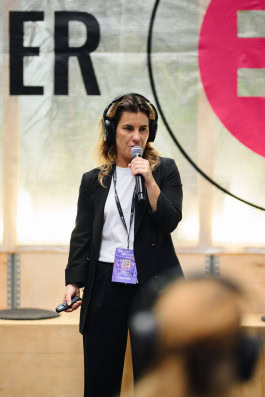
Professional surfer, teacher and entrepreneur, Joana is the founder of Progress Surf School and describes herself as the first Portuguese woman to surf the big waves of Nazaré. She entered the world of tow-in big-wave surfing and was nominated for the Billabong XXL Awards. Her earlier competitive career included fourth place at the European Junior Championships, becoming Portuguese vice-champion and representing Portugal internationally. She later brought all that experience into teaching and building her own surf school. Many of the people who come to Joana aren’t aspiring professional surfers. Some arrive simply wanting to learn something new. Others come carrying a fear of the ocean, sometimes having barely had any contact with the sea at all. Joana is also a speaker and fear coach and that was exactly what made our conversation particularly interesting.
Joana’s approach is as much about confidence and understanding your own limits as it is about learning how to stand on a board. We sat down with Joana in Ericeira to talk about the ocean, courage, intuition, surfing as therapy, being a woman in the world of big-wave surfing and what happens when, instead of running away from fear, you decide to face it.

ㅤ
— Yes. When I was young, I struggled a lot with dyslexia and ADHD. At school, I wasn’t very concentrated, and one of my teachers told my mother, “Joana needs to do some sport.” They tried all kinds of sports, and surfing was actually the one they initially said no to. At that time, surfing didn’t have the image it has today. It was seen as more of a rebellious sport.
But from the moment I went into the water, I felt completely at peace with myself. My mind suddenly didn’t have so many thoughts. It was calm. And I thought: this is what I want to do.
— It was more of a consistent feeling. I started with regular surfing and competed, and then around ten years ago I became a big-wave surfer. It wasn’t one sudden transition. It developed over time.
— How to deal with my emotions, my fears and my doubts. When you’re in the water, you face a lot of questions. And especially in big-wave surfing, you deal with a lot of fear and doubt.
— My mother. And all the people and friends around me who are trying to do something meaningful in this world.
I don’t really have idols. I like being around people who can teach me something. But of course, Kelly Slater is Kelly Slater.
— Find a good surf school and try it. When you learn with a school, you can progress safely. And it isn’t only about surfing. You connect with people and you connect with the ocean. If you’ve never surfed before, being with a school is important because the ocean can be dangerous.
— They try to do everything at the same time. I’ve been teaching for almost 20 years, and it’s funny: we explain everything on land, and then people enter the water and forget everything. But that’s okay. The bigger problem is when you enter the water already thinking, “There are rocks. I’m going to fall.” If you choose an extreme sport, you have to embrace some fear and go for it.
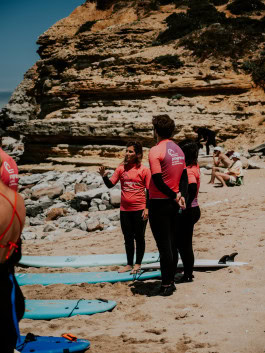
— It depends on the person how athletic you are, your age, your body and so on. But with the evolution of boards, teaching and surf schools, I think many people can stand up during their first lesson. Surfing is a little like riding a bicycle. You fall and fall, and then one time you stand up and you never forget. The difficult part isn’t actually standing up. The difficult part comes later, when you go into the line-up and have to start choosing your own waves.
— It’s okay to be afraid. If overcoming that fear is something you really want, challenge yourself. Sometimes in life we need to challenge ourselves with things that make us uncomfortable.
— No. Not at all. We need fear. You have to be humble and understand that fear is there. The important thing is learning how to deal with that emotion and how to keep it under control. If fear doesn’t exist at all, that’s when things can become dangerous. Big-wave surfing has taught me how to manage fear and make it my best friend instead of my enemy.
— You have to learn to listen to your inner voice. When you practise extreme sports, you listen to it a lot. Fear is something you can analyse. You understand the danger, you feel the fear, and sometimes you do it anyway. But there’s also an important difference between fear and panic. Fear can be good. It makes you aware and brings you into the present moment. Panic blocks you. Everyone experiences fear in life. The question is how you manage it and which tools you have to deal with it.
— Panic, no. Fear, yes. I’ve learned how to manage panic.
— Have a conversation with yourself. Tell yourself that everything is okay and under control. Accept what you’re feeling and start breathing. The truth is that many of us don’t really know how to breathe properly. Anxiety, stress and panic often start with sensations in the body, and then the body sends those signals to the brain. For me, understanding that relationship is very important. Panic paralyses you. Fear doesn’t necessarily do that.
— In big waves, fear is always there. One of the moments when I was really scared was when three huge waves came down on me one after another. After the third one, I thought, “Okay, I’m not coming back.” That’s the moment when you have to surrender. You realise: I’m here, and I cannot fight the ocean. You have to let go and trust the process. Trust all the training you have done. If you start fighting against those waves, it’s impossible. That’s one of the biggest things I’ve learned: surrender, trust the ocean and trust yourself.
— Of course. Many times.
— For me, the right voice comes softly. It’s light. It isn’t the loud voice screaming, “Yes! You should do this!”It’s the quieter one saying, “Joana, be careful.” The louder voice is often excitement. The softer one gives you direction.
— I think maybe you’re born with a little rebel and some courage inside you. But courage is also something you conquer over time, through training and through the tools you learn in life.
— For sure. Surfing is much more than a sport. It can be therapy. It can be medicine. First, you’re connected with the ocean. And when you’re surfing, you actually spend a lot of time waiting for the perfect wave. It becomes almost like meditation. I always say surfing is like my church. More and more, I realise how therapeutic it can be because you forget everything else. You are completely in the moment. There is no space to think about anything else. And today it’s so difficult for people to really be here, right now, in the present.
— You have to accept that it’s part of the process.If you practise an extreme sport, things can happen. You need to be aware of that. But if your brain is constantly sounding an alarm “I’m going to fall, I’m going to fall”, then you are already creating that situation in your mind. You acknowledge that the possibility exists, but you don’t have to focus on it.
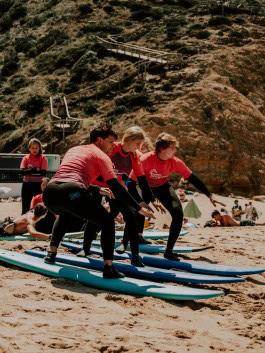
— Because you connect with yourself. The ocean gives you so many lessons: about progress, purification and calmness. For me, it has always been therapy. That’s one of the reasons I started surfing so young. With dyslexia and ADHD, the ocean was the one place where my mind could become calm and stay in the moment.
— You wait for the perfect wave and the perfect wave never comes. You make the wave perfect. There are always many waves coming, but you have to understand which one is yours. I believe life is like catching waves. You cannot catch every wave. You need to choose the good ones.
— All kinds of people. But increasingly we see entrepreneurs and people who are very stressed with business and work. They want to switch off their minds, get into the water and relax. Because I’m a big-wave rider, we also get people who have a fear of the ocean. At our school, we try to work through that fear step by step. A lot of people carry some kind of trauma or fear related to the ocean. And I think that’s understandable. We come from the ocean; there is something very strong connecting us to it.
— People release fear. They release the stress of everyday life.
— Much more mental. Of course, physically you need training, especially if you want to progress or surf big waves. But mentally there is so much happening. You need to connect with the ocean. If you’re in the water constantly thinking, “There are too many people, I’m going to fall,” the ocean will throw you away. The ocean teaches you a lot. And it teaches you trust.
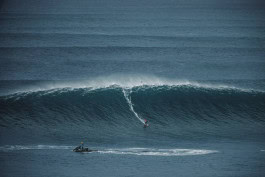
— At the time, I didn’t think so much about what it meant. But now I realise that maybe I opened doors for a new generation. It showed female surfers that we have a place there too. Big-wave surfing isn’t only for men.
— First, you can’t simply paddle into waves like that. You need a jet ski and a team. But I think it’s about pushing your limits and discovering what is on the other side. You want to understand your own capacity. Big-wave surfing is also very much about teamwork. In normal surfing, you put on your wetsuit, take your board and go into the water by yourself. In big waves, I depend completely on my team and my jet-ski pilots. I don’t even choose the wave alone. There’s a mystery to it. And some people simply like taking risks.I like taking risks in life.
— It can be. It’s a mixture of adrenaline, fear and many different emotions at the same time. When you catch a big wave, you want another one and maybe an even bigger one. But you also have to remain humble enough to say, “For now, I’ve conquered this. It’s okay.”
— A little bit.
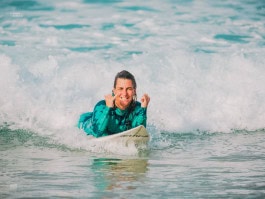
— Nothing. That’s actually one of the reasons I love big waves. My mind is 100 percent there. Completely focused. It’s almost like living in the Matrix. You’re there, fully present. You feel everything and hear everything almost in slow motion. And when you drop into the wave, there’s this incredible feeling of freedom and adrenaline. So many things happen at the same time. It’s difficult to describe. It’s beautiful and scary at the same time.
— My first wave in Nazaré. I was there with Garrett McNamara and Hugo Vau. They pushed me into a huge wave, and I didn’t even realise how big it was. Afterwards they picked me up on the jet ski and told me, “Joana, you caught an amazing wave. You caught the Big Mama.” With waves like that, you need some luck. You need to be in the right place at the right moment.And I think I was in exactly the right place at the right moment. Mother Nature gave me that present.
— I’m proud. I think perhaps I opened doors not only for women, but also for people who have fears and want to challenge themselves. Maybe part of my mission is to open those doors.
— Of course. In business and in the waves. There is still machismo in sport. And as a woman who is also an entrepreneur running a surf school, I work in an environment that has traditionally been dominated by men. I remember the first times I went into big waves and guys would say, “Be careful today, it’s big. Maybe it’s not for you girls,” or, “Better not go to that wave — it’s too big for you.” You have to learn how to deal with comments like that. But things are changing.
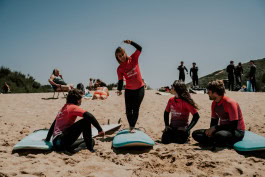
— Go for it. If you really like it, go. Don’t be afraid and don’t feel ashamed to go to the beach and try.There’s a beautiful community around surfing, the ocean and the beach. It’s better to be there than spending all your time on your phone.
— Maybe what needs to change is our mentality. Sometimes it’s good in life to take risks and do something that makes you uncomfortable. Our bodies need to be active, and sometimes we need to challenge ourselves.
— For me, it’s one of the best places to surf in the world. Within a relatively small area, we have so many different kinds of waves. And the village itself is beautiful. That combination makes it special.
— Because the waves are incredible. We have Coxos, Ribeira d’Ilhas and so many other amazing spots. I’ve travelled a lot around the world, and I’ve rarely seen anything like Ericeira. In winter, when it’s really good, it’s magic. Ericeira is also a World Surfing Reserve because of the quality of the waves, the environment and the whole atmosphere around surfing here.
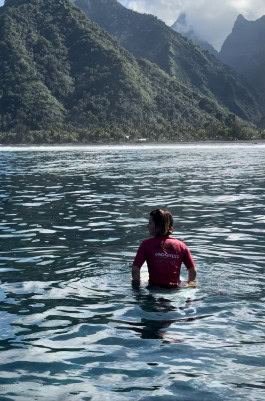
— Surfing with friends, watching a beautiful sunset and enjoying this beautiful place.
— It always depends on the conditions because our boss is the ocean.The tides, swell and direction of the waves all matter. But Ribeira d’Ilhas can be a very good place to learn because the waves tend to break consistently in the same areas. People sometimes worry about the rocks, but a beach break can actually be more confusing because the waves constantly break in different places.
— Summer is great, through September and into October.
— We depend on the tides and the conditions. But mornings can be great because there are fewer crowds. Afternoons can also be beautiful because you get the sunset.
— At my school, we work a lot with both beginners and intermediates. I want people to have the freedom to progress according to their own ability. You might technically be a beginner, but if you can stand up and feel comfortable going farther out, you can start progressing quickly. The next challenge isn’t necessarily about changing beaches. It’s about changing waves. That’s also why surfing becomes so addictive: every day is different. Every wave is different.
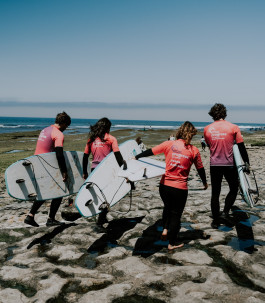
— Coxos, Ribeira d’Ilhas and São Lourenço.
— The cliffs between Ribeira d’Ilhas and Coxos.
— From Ribeira d’Ilhas towards Coxos, or along the coast towards the village.
— I’m not telling you! But if you walk and explore the coast, you’ll find many beautiful wild beaches.
— Go to Ribamar. There are some great seafood restaurants there, including Rochedo and Marisqueira de Ribamar.
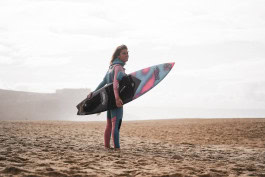
There is something deeply inspiring about meeting people who dare to go after their dreams particularly when those dreams require them to move beyond what feels comfortable or safe.
Our conversation with Joana started with surfing, but somewhere along the way it became a conversation about something much more universal: fear, trust, patience, intuition and knowing when to push yourself and when to surrender. Perhaps that is also why experiences like this are some of the happiest moments for us at The Columbist. As a Constantly Curious team, we love having the opportunity to step for a moment into someone else’s world. To discover cities and countries not only through hotels, restaurants and lists of things to do, but through the eyes of the people who actually live there, the locals who shape a place, know its stories and can show us something we would never discover on our own.
This time, Ericeira brought us into the Atlantic and into Joana’s world. And yes, we got on the surfboards ourselves. More from our summer in Ericeira, where to stay, where to eat, what to discover and, of course, where to surf is coming soon on The Columbist.
Until then, I will keep one thing Joana told us: Fear doesn’t always have to be the thing that stops you. Sometimes, if you learn how to manage it, it can become your best friend.
Sign up here to subscribe to The Columbist newsletter.
Related Articles:

Sign up here to subscribe to The Columbist newsletter.
Portugal may be synonymous with surfing, but if you actually want to learn or improve your skills without starting with a 20-metre wall of water where should you go?
This summer, The Columbist travelled to Ericeira, a small coastal town less than an hour from Lisbon and one of Europe’s great surf destinations. It’s the kind of place where surfing is not simply an activity you book for an afternoon; it is part of everyday life. Beginners come to catch their first wave, experienced surfers come to progress, and locals have built an entire culture around the Atlantic. There are plenty of surf schools to choose from, but we ended up at Progress Surf School and that is how we met Joana Andrade.
Professional surfer, teacher and entrepreneur, Joana is the founder of Progress Surf School and describes herself as the first Portuguese woman to surf the big waves of Nazaré. She entered the world of tow-in big-wave surfing and was nominated for the Billabong XXL Awards. Her earlier competitive career included fourth place at the European Junior Championships, becoming Portuguese vice-champion and representing Portugal internationally. She later brought all that experience into teaching and building her own surf school. Many of the people who come to Joana aren’t aspiring professional surfers. Some arrive simply wanting to learn something new. Others come carrying a fear of the ocean, sometimes having barely had any contact with the sea at all. Joana is also a speaker and fear coach and that was exactly what made our conversation particularly interesting.
Joana’s approach is as much about confidence and understanding your own limits as it is about learning how to stand on a board. We sat down with Joana in Ericeira to talk about the ocean, courage, intuition, surfing as therapy, being a woman in the world of big-wave surfing and what happens when, instead of running away from fear, you decide to face it.
ㅤ
— Yes. When I was young, I struggled a lot with dyslexia and ADHD. At school, I wasn’t very concentrated, and one of my teachers told my mother, “Joana needs to do some sport.” They tried all kinds of sports, and surfing was actually the one they initially said no to. At that time, surfing didn’t have the image it has today. It was seen as more of a rebellious sport.
But from the moment I went into the water, I felt completely at peace with myself. My mind suddenly didn’t have so many thoughts. It was calm. And I thought: this is what I want to do.
— It was more of a consistent feeling. I started with regular surfing and competed, and then around ten years ago I became a big-wave surfer. It wasn’t one sudden transition. It developed over time.
— How to deal with my emotions, my fears and my doubts. When you’re in the water, you face a lot of questions. And especially in big-wave surfing, you deal with a lot of fear and doubt.
— My mother. And all the people and friends around me who are trying to do something meaningful in this world.
I don’t really have idols. I like being around people who can teach me something. But of course, Kelly Slater is Kelly Slater.
— Find a good surf school and try it. When you learn with a school, you can progress safely. And it isn’t only about surfing. You connect with people and you connect with the ocean. If you’ve never surfed before, being with a school is important because the ocean can be dangerous.
— They try to do everything at the same time. I’ve been teaching for almost 20 years, and it’s funny: we explain everything on land, and then people enter the water and forget everything. But that’s okay. The bigger problem is when you enter the water already thinking, “There are rocks. I’m going to fall.” If you choose an extreme sport, you have to embrace some fear and go for it.

— It depends on the person how athletic you are, your age, your body and so on. But with the evolution of boards, teaching and surf schools, I think many people can stand up during their first lesson. Surfing is a little like riding a bicycle. You fall and fall, and then one time you stand up and you never forget. The difficult part isn’t actually standing up. The difficult part comes later, when you go into the line-up and have to start choosing your own waves.
— It’s okay to be afraid. If overcoming that fear is something you really want, challenge yourself. Sometimes in life we need to challenge ourselves with things that make us uncomfortable.
— No. Not at all. We need fear. You have to be humble and understand that fear is there. The important thing is learning how to deal with that emotion and how to keep it under control. If fear doesn’t exist at all, that’s when things can become dangerous. Big-wave surfing has taught me how to manage fear and make it my best friend instead of my enemy.
— You have to learn to listen to your inner voice. When you practise extreme sports, you listen to it a lot. Fear is something you can analyse. You understand the danger, you feel the fear, and sometimes you do it anyway. But there’s also an important difference between fear and panic. Fear can be good. It makes you aware and brings you into the present moment. Panic blocks you. Everyone experiences fear in life. The question is how you manage it and which tools you have to deal with it.
— Panic, no. Fear, yes. I’ve learned how to manage panic.
— Have a conversation with yourself. Tell yourself that everything is okay and under control. Accept what you’re feeling and start breathing. The truth is that many of us don’t really know how to breathe properly. Anxiety, stress and panic often start with sensations in the body, and then the body sends those signals to the brain. For me, understanding that relationship is very important. Panic paralyses you. Fear doesn’t necessarily do that.

— In big waves, fear is always there. One of the moments when I was really scared was when three huge waves came down on me one after another. After the third one, I thought, “Okay, I’m not coming back.” That’s the moment when you have to surrender. You realise: I’m here, and I cannot fight the ocean. You have to let go and trust the process. Trust all the training you have done. If you start fighting against those waves, it’s impossible. That’s one of the biggest things I’ve learned: surrender, trust the ocean and trust yourself.
— Of course. Many times.
— For me, the right voice comes softly. It’s light. It isn’t the loud voice screaming, “Yes! You should do this!”It’s the quieter one saying, “Joana, be careful.” The louder voice is often excitement. The softer one gives you direction.
— I think maybe you’re born with a little rebel and some courage inside you. But courage is also something you conquer over time, through training and through the tools you learn in life.
— For sure. Surfing is much more than a sport. It can be therapy. It can be medicine. First, you’re connected with the ocean. And when you’re surfing, you actually spend a lot of time waiting for the perfect wave. It becomes almost like meditation. I always say surfing is like my church. More and more, I realise how therapeutic it can be because you forget everything else. You are completely in the moment. There is no space to think about anything else. And today it’s so difficult for people to really be here, right now, in the present.
— You have to accept that it’s part of the process.If you practise an extreme sport, things can happen. You need to be aware of that. But if your brain is constantly sounding an alarm “I’m going to fall, I’m going to fall”, then you are already creating that situation in your mind. You acknowledge that the possibility exists, but you don’t have to focus on it.

— Because you connect with yourself. The ocean gives you so many lessons: about progress, purification and calmness. For me, it has always been therapy. That’s one of the reasons I started surfing so young. With dyslexia and ADHD, the ocean was the one place where my mind could become calm and stay in the moment.
— You wait for the perfect wave and the perfect wave never comes. You make the wave perfect. There are always many waves coming, but you have to understand which one is yours. I believe life is like catching waves. You cannot catch every wave. You need to choose the good ones.
— All kinds of people. But increasingly we see entrepreneurs and people who are very stressed with business and work. They want to switch off their minds, get into the water and relax. Because I’m a big-wave rider, we also get people who have a fear of the ocean. At our school, we try to work through that fear step by step. A lot of people carry some kind of trauma or fear related to the ocean. And I think that’s understandable. We come from the ocean; there is something very strong connecting us to it.
— People release fear. They release the stress of everyday life.
— Much more mental. Of course, physically you need training, especially if you want to progress or surf big waves. But mentally there is so much happening. You need to connect with the ocean. If you’re in the water constantly thinking, “There are too many people, I’m going to fall,” the ocean will throw you away. The ocean teaches you a lot. And it teaches you trust.

— At the time, I didn’t think so much about what it meant. But now I realise that maybe I opened doors for a new generation. It showed female surfers that we have a place there too. Big-wave surfing isn’t only for men.
— First, you can’t simply paddle into waves like that. You need a jet ski and a team. But I think it’s about pushing your limits and discovering what is on the other side. You want to understand your own capacity. Big-wave surfing is also very much about teamwork. In normal surfing, you put on your wetsuit, take your board and go into the water by yourself. In big waves, I depend completely on my team and my jet-ski pilots. I don’t even choose the wave alone. There’s a mystery to it. And some people simply like taking risks.I like taking risks in life.
— It can be. It’s a mixture of adrenaline, fear and many different emotions at the same time. When you catch a big wave, you want another one and maybe an even bigger one. But you also have to remain humble enough to say, “For now, I’ve conquered this. It’s okay.”
— A little bit.

— Nothing. That’s actually one of the reasons I love big waves. My mind is 100 percent there. Completely focused. It’s almost like living in the Matrix. You’re there, fully present. You feel everything and hear everything almost in slow motion. And when you drop into the wave, there’s this incredible feeling of freedom and adrenaline. So many things happen at the same time. It’s difficult to describe. It’s beautiful and scary at the same time.
— My first wave in Nazaré. I was there with Garrett McNamara and Hugo Vau. They pushed me into a huge wave, and I didn’t even realise how big it was. Afterwards they picked me up on the jet ski and told me, “Joana, you caught an amazing wave. You caught the Big Mama.” With waves like that, you need some luck. You need to be in the right place at the right moment.And I think I was in exactly the right place at the right moment. Mother Nature gave me that present.
— I’m proud. I think perhaps I opened doors not only for women, but also for people who have fears and want to challenge themselves. Maybe part of my mission is to open those doors.
— Of course. In business and in the waves. There is still machismo in sport. And as a woman who is also an entrepreneur running a surf school, I work in an environment that has traditionally been dominated by men. I remember the first times I went into big waves and guys would say, “Be careful today, it’s big. Maybe it’s not for you girls,” or, “Better not go to that wave — it’s too big for you.” You have to learn how to deal with comments like that. But things are changing.

— Go for it. If you really like it, go. Don’t be afraid and don’t feel ashamed to go to the beach and try.There’s a beautiful community around surfing, the ocean and the beach. It’s better to be there than spending all your time on your phone.
— Maybe what needs to change is our mentality. Sometimes it’s good in life to take risks and do something that makes you uncomfortable. Our bodies need to be active, and sometimes we need to challenge ourselves.
— For me, it’s one of the best places to surf in the world. Within a relatively small area, we have so many different kinds of waves. And the village itself is beautiful. That combination makes it special.
— Because the waves are incredible. We have Coxos, Ribeira d’Ilhas and so many other amazing spots. I’ve travelled a lot around the world, and I’ve rarely seen anything like Ericeira. In winter, when it’s really good, it’s magic. Ericeira is also a World Surfing Reserve because of the quality of the waves, the environment and the whole atmosphere around surfing here.

— Surfing with friends, watching a beautiful sunset and enjoying this beautiful place.
— It always depends on the conditions because our boss is the ocean.The tides, swell and direction of the waves all matter. But Ribeira d’Ilhas can be a very good place to learn because the waves tend to break consistently in the same areas. People sometimes worry about the rocks, but a beach break can actually be more confusing because the waves constantly break in different places.
— Summer is great, through September and into October.
— We depend on the tides and the conditions. But mornings can be great because there are fewer crowds. Afternoons can also be beautiful because you get the sunset.
— At my school, we work a lot with both beginners and intermediates. I want people to have the freedom to progress according to their own ability. You might technically be a beginner, but if you can stand up and feel comfortable going farther out, you can start progressing quickly. The next challenge isn’t necessarily about changing beaches. It’s about changing waves. That’s also why surfing becomes so addictive: every day is different. Every wave is different.

— Coxos, Ribeira d’Ilhas and São Lourenço.
— The cliffs between Ribeira d’Ilhas and Coxos.
— From Ribeira d’Ilhas towards Coxos, or along the coast towards the village.
— I’m not telling you! But if you walk and explore the coast, you’ll find many beautiful wild beaches.
— Go to Ribamar. There are some great seafood restaurants there, including Rochedo and Marisqueira de Ribamar.

There is something deeply inspiring about meeting people who dare to go after their dreams particularly when those dreams require them to move beyond what feels comfortable or safe.
Our conversation with Joana started with surfing, but somewhere along the way it became a conversation about something much more universal: fear, trust, patience, intuition and knowing when to push yourself and when to surrender. Perhaps that is also why experiences like this are some of the happiest moments for us at The Columbist. As a Constantly Curious team, we love having the opportunity to step for a moment into someone else’s world. To discover cities and countries not only through hotels, restaurants and lists of things to do, but through the eyes of the people who actually live there, the locals who shape a place, know its stories and can show us something we would never discover on our own.
This time, Ericeira brought us into the Atlantic and into Joana’s world. And yes, we got on the surfboards ourselves. More from our summer in Ericeira, where to stay, where to eat, what to discover and, of course, where to surf is coming soon on The Columbist.
Until then, I will keep one thing Joana told us: Fear doesn’t always have to be the thing that stops you. Sometimes, if you learn how to manage it, it can become your best friend.

Sign up here to subscribe to The Columbist newsletter.
Related Articles:
You need to load content from reCAPTCHA to submit the form. Please note that doing so will share data with third-party providers.
More InformationYou need to load content from Turnstile to submit the form. Please note that doing so will share data with third-party providers.
More InformationYou are currently viewing a placeholder content from Facebook. To access the actual content, click the button below. Please note that doing so will share data with third-party providers.
More InformationYou are currently viewing a placeholder content from Instagram. To access the actual content, click the button below. Please note that doing so will share data with third-party providers.
More InformationYou need to load content from hCaptcha to submit the form. Please note that doing so will share data with third-party providers.
More InformationYou need to load content from reCAPTCHA to submit the form. Please note that doing so will share data with third-party providers.
More InformationYou are currently viewing a placeholder content from Turnstile. To access the actual content, click the button below. Please note that doing so will share data with third-party providers.
More InformationYou are currently viewing a placeholder content from X. To access the actual content, click the button below. Please note that doing so will share data with third-party providers.
More Information