



‘Gelbe Briefe’ wins the Golden Bear for Best Film, filmed across Germany, France, and Turkey (2026) in German and English. However, there are movies that resonated with people living across different time periods. Here we have ten of the must-watch Berlinale films since its origins, each with a memorable story that transcends time and language.
Golden Bear for Best Film
Drømmer (Eng: Dreams)
Director: Dag Johan Haugerud
Producers: Yngve Sæther, Hege Hauff Hvattum
Cast: Ella Øverbye, Selome Emnetu, Ane Dahl Torp, Anne Marit Jacobsen
Country: Norway (2024)
Language: Norwegian
Berlinale Link: https://www.berlinale.de/en/2025/programme/202516839.html
The Berlinale winners 2025, ‘Drømmer’, brings together teenage infatuation, the possibility of same-sex love, and feminism through the eyes of high-schooler Johanne. Her love is shown as natural and healthy, not highlighting the queer aspect of the story. Her family is surprised but supportive of her love and her wish to publish her romantic memoir, a theme not readily seen even in mainstream queer cinema. This was well-accepted at the Berlinale film festival 2025.
Haugerud ensures that the young protagonist is not made out to be a victim because of her age, but the decision-maker of her own life. ‘Drømmer’ is said to be similar to Lukas Moodysson’s ‘Show Me Love’ in theme and treatment, and has won several awards in other Norwegian award shows. After a theatrical release in May 2025 in Germany, this Berlinale films can be found on Amazon Prime Video, Apple TV, and Magenta TV.

ㅤ
Golden Bear for Best Film
Dahomey
Director: Mati Diop
Producers: Eve Robin, Judith Lou Lévy, Mati Diop
Country: France, Senegal, Benin (2024)
Languages: French, Fon, English
Berlinale Link: https://www.berlinale.de/en/2024/programme/202414781.html
A must-watch film for history aficionados, this Berlinale winners 2024 documentary is about twenty-six royal treasures to be brought back to the Kingdom of Dahomey from Paris. The students of the University of Abomey-Calavi allege that only twenty-six of the 7000 treasures have been returned since their looting in 1892.
‘Dahomey’ brings together art, culture, and history using a decolonialist lens. It depicts how these artefacts returned to the now modern-day Benin, and the reactions of the local people. The objects themselves are all shown by ‘the smart use of a subjective camera by DP Joséphine Drouin-Viallard’ (sic critic David Rooney), making them as important as the people themselves. The Berlinale films premiered at Berlinale 2024 and were shown across other film festivals around the world, receiving critical acclaim. It is available on MUBI.
Golden Bear for Best Film
Alcarràs
Director and Screenplay: Carla Simón
Screenplay: Arnau Vilaró
Cast: Jordi Pujol Dolcet, Anna Otin, Xènia Roset, Albert Bosch, Ainet Jounou, Josep Abad, Montse Oró, Carles Cabós, and Berta Pipó
Country: Spain and Italy (2022)
Language: Catalan
Berlinale Link: https://www.berlinale.de/en/2022/programme/202209519.html
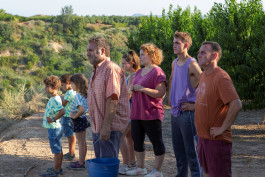
One of the first Catalan-language films to win the Berlinale 2022 Golden Bear, this drama film has a non-professional cast of Catalan-speaking actors. The Solé family has been traditionally involved in peach harvesting on their orchards since the Spanish Civil War, which is now under danger of being reclaimed to install solar panels by a new landowner. Through its characters and subplots, Simón tries to show the different ways humans cope with unforeseen circumstances.
Despite the grim ending, the domestic drama incorporates family bonding, a deep connection to nature, and the impact of industrialisation on rural life. Critic Tim Robey says, “…of an ending, with each one of these faces turned in collective mourning, that I'll never forget.” Premiered at the Berlinale 2022, ‘Alcarràs’ was screened out of the competition after a discussion between the film and festival producers. One can watch the Berlinale films on Netflix, MUBI, Amazon Prime Video, SBS, Apple TV, Amazon Video, DVD/Blu-ray, and Fandango at Home (Vudu).

Golden Bear for Best Film
Taxi
Director: Jafar Panahi
Country: Iran (2015)
Language: Persian
Berlinale Link: https://www.berlinale.de/en/2015/programme/201511112.html
The director himself, Jafar Panahi, drives a taxi on Tehran’s colorful streets but refuses to take payments. Instead, he is eager to hear stories about and from his diverse group of passengers. His niece, Hana, wants to make a short film in Iran for a school project with unforeseen consequences. Made as a docufilm in Panahi’s mobile film studio, the camera is placed on his taxi's dashboard. The passengers themselves are non-professional actors, and their identities remain anonymous.
Critic Jean-Michel Frodon discusses the diversity of commuters in Panahi’s taxi, “Men and women, young and old, rich and poor, traditionalists and modernists, pirated video vendors, and advocates of human rights in the passenger seat of the inexperienced driver Harayé Panahi or Aghaye Panahi.”
This Berlinale winners docufilm focuses on the ongoing human rights crisis in Iran, bringing in the human rights lawyer Nasrin Sotoudeh, and referring to the 2014 detention of Ghoncheh Ghavami. Given the twenty-year ban on Panahi to make films, this is the first film that he filmed in the streets on Iranian streets to showcase human rights, totalitarianism and freedom of speech in Iran.
Panahi’s quote on the Berlinale website reads, “I’m a filmmaker. I can’t do anything else but make films. Cinema is my expression and the meaning of my life. Nothing can prevent me from making films.” One will find the Berlinale films on Kanopy, The Criterion Channel, Prime Video, Google Play, and Kino Lorber Blu-ray.

Golden Bear for Best Film
Grbavica
by Jasmila Zbanic
Cast: Mirjana Karanovic, Luna Mijovic, and Leon Lucev
Countries: Austria, Bosnia and Herzegovina, Germany, and Croatia (2005)
Language: Bosnian
Berlinale Link: https://www.berlinale.de/en/2006/programme/20060133.html
The movie begins with young Sara living with her single mother Esma in post-war Sarajevo, whose father has apparently died as a war hero. After the mandatory requirement by the school to take the students on a school picnic, she finds out that she was a child born of violence and her biological father was a Serbian soldier.
Though a difficult watch, themes of sexual violence, identity, truth, and consequences of war are seen in these Berlinale films. It also talks about how today’s everyday life is still a result of the Bosnian War of the 1990s, especially in Sarajevo, which was the most affected neighborhood. There is a reference to Kemal Monteno’s popular 1970s song, ‘Sarajevo, ljubavi moja’ (Eng: Sarajevo, My Love). ‘Grbavica’ was released in the United Kingdom as Esma's Secret: Grbavica, and in the US as Grbavica: Land of My Dreams. It also received funding from the German television companies, Arte and ZDF.
Zbanic says, “...in 1992 everything changed, and I realized that I was living in a war in which sex was used as part of a war strategy to humiliate women and thereby cause the destruction of an ethnic group. 20,000 women were systematically raped in Bosnia during the war.” The movie is available on Hoopla, Netflix, Amazon Prime Video, Fandango at Home, and MUBI.
Golden Bear for Best Film
Skrivánci na nítich (Eng: Larks on a String)
Director: Jiri Menzel
Cast: Rudolf Hrusinsky, Václav Neckár, Leos Sucharípa, J.Zelenohorská
Country: Czechoslovakia (1969)
Language: Czech
Berlinale Link: https://www.berlinale.de/en/1990/programme/19900644.html
Winning a Berlinale Award more than thirty years after the film was made, ‘Skrivánci na nítich’ is about a group of people who are considered bourgeois by the Czechoslovakian government in the 1950s. Living in the communist regime, they have been forced to work in a junkyard for re-educational purposes. A group of female labourers dismantles and melts crucifixes and typewriters to make ‘peaceful steel’ for socialist ideals.
Menzel brings in a romantic element despite the strict segregation between men and women, between a labourer and a cook. Following the Theatre of the Absurd, the satiric film uses comic relief to counter state regimentation and the communist government.
‘Skrivánci na nítich’ was banned in the country due to the Soviet and Warsaw Pact, and not publicly screened until after the Velvet Revolution in 1989. This Berlinale film is commonly referred to as a Czechoslovak New Wave movie, and can be watched on Amazon Prime, Just Watch, Eastern European Movies with English Subtitles, and MUBI.
Golden Bear (Short Film)
History of the World in Three Minutes Flat (German: Weltgeschichte in genau drei Minuten)
Director: Michael Mills
Animation: Bill Speers, John Gaug, Jim Hiltz, and Rick Bowan
Narration: Vlasta Vrána
Canada (1981)
Language: English
Berlinale Link: https://www.berlinale.de/en/1981/programme/19810009.html
One of the best Berlinale short films made in the 1980s, ‘History of the World in Three Minutes Flat’ is a short-animated film taking us through the history of life on Earth. Taking reference from the Old Testament, the movie begins with God creating the world in seven days. He has wasted the first six days and put together the world on the seventh day.
We watch the Biblical times, the Dark Ages, the World Wars, and finally the modern day where the modern man is arguing among themselves. The team has chosen a unique but well-known topic, the creation of the world as in the Bible and history, and made it humorous and slightly blasphemous. Despite the long name, the Berlinale film is three minutes and 24 seconds long. It is available on YouTube.

Golden Bear for Best Film
David
Director: Peter Lilienthal
Country: Federal Republic of Germany (1979)
Berlinale: https://www.berlinale.de/en/1979/programme/19790001.html
Listed as one of the best West German Berlinale films, ‘David’ opens in pre-war Germany but is set in Nazi Berlin. David Singer is a rabbi’s son and is conflicted between his Jewish identity and the escalating tensions in Germany due to Adolf Hitler’s Nazi policies. He says to his brother Leo, “Father says we must be proud of being Jewish, especially now,” while wearing a Nazi uniform despite his Jewish identity and the Star of David that he wears.
The Berlinale films use the themes of war, identity, and survival of the young Non-Jews in Europe during World War II and the Holocaust. We see the impact of Adolf Hitler’s policies on everyday life in Berlin, bullying by schoolchildren due to identity, and the changing relations between the Jews and non-Jews. Despite the grim situation, the movie compares the war with the love and devotion between the Singer family members, who also dread loss and separation.
The rabbi watches his synagogue set aflame by the Nazi and returns home with a swastika marked on his head. He gives thanks that his family is alive and well. The Holocaust is depicted in an understated manner, but its terrible consequences are shown and felt equally.
The movie won three Berlinale awards at the Berlinale 1979 - Golden Bear: Peter Lilienthal; Interfilm Award: Peter Lilienthal and OCIC Award - Peter Lilienthal. One can watch this socio-political-cultural must-watch on MUBI, Amazon, and the Deutsche Kinemathek (German Cinematheque) archives in Berlin.

Golden Bear
A Kind of Loving (German: Nur ein Hauch Glückseligkeit)
Director: John Schlesinger
Country: United Kingdom (1962)
Language: English
Berlinale Link: https://www.berlinale.de/en/1962/programme/19620001.html
‘A Kind of Loving’ is a classic Berlinale film, as it uses the format of the contemporary kitchen sink drama that was highly popular in 1960s Britain. It is adapted from Stan Barstow’s novel of the same name, which was later adapted into a television series in 1982. The film is about Victor Brown and Ingrid Rothwell living in Lancashire, who plan to get married and move in with the latter’s mother. It belongs to the British New Wave movement with its typical black-and-white coloring, filming in a pseudo-documentary style, and done so with spontaneity. The New Wave movement was very similar to the Angry Young Man theme, also common in Britain, which was inspired by the everyday reality of working-class families in Northern England.
‘A Kind of Loving’ was the sixth most popular film at the British box office in 1962, with references of sexuality as per 1962 standards and urban and suburban life. Critic Michael Brooke writes in ‘Sight and Sound’, “former (and then very recent) documentarist Schlesinger gives the film immense lasting value in its pitch-perfect presentation of the fine detail of northern working-class life — the football, the pubs, the brass-band concerts, the 'mucky books', the works dos with their fake bonhomie, and above all the finely calibrated snobbery.”
The film remains relevant even in the 21st century due to the ongoing problems with housing, even as a well-employed married couple. Interested people can find the film on Tubi (1962 film), Apple TV, Amazon Prime Video, and BFI Player.
Die Ratten (Eng: The Rats)
Director: Robert Siodmak
Country: Federal Republic of Germany (1955)
Language: German
Berlinale Link: http://berlinale.de/en/1955/programme/19550001.html
‘Die Ratten’ was one of the first German Berlinale films to win the Golden Bear in 1955. Pauline is an impoverished Polish woman who sells her illegitimate baby to Anna John. The story is an adaptation of the play, ‘The Rats’ by Gerhart Hauptmann, but the film is set after the Second World War. Though the TV versions from 1969 and 1977 are available, one can watch the original 1955 version on Amazon Prime.
You can find the complete list of movies at the Berlinale International Film Festival here.
Related Articles:

‘Gelbe Briefe’ wins the Golden Bear for Best Film, filmed across Germany, France, and Turkey (2026) in German and English. However, there are movies that resonated with people living across different time periods. Here we have ten of the must-watch Berlinale films since its origins, each with a memorable story that transcends time and language.
Golden Bear for Best Film
Drømmer (Eng: Dreams)
Director: Dag Johan Haugerud
Producers: Yngve Sæther, Hege Hauff Hvattum
Cast: Ella Øverbye, Selome Emnetu, Ane Dahl Torp, Anne Marit Jacobsen
Country: Norway (2024)
Language: Norwegian
Berlinale Link: https://www.berlinale.de/en/2025/programme/202516839.html
The Berlinale winners 2025, ‘Drømmer’, brings together teenage infatuation, the possibility of same-sex love, and feminism through the eyes of high-schooler Johanne. Her love is shown as natural and healthy, not highlighting the queer aspect of the story. Her family is surprised but supportive of her love and her wish to publish her romantic memoir, a theme not readily seen even in mainstream queer cinema. This was well-accepted at the Berlinale film festival 2025.
Haugerud ensures that the young protagonist is not made out to be a victim because of her age, but the decision-maker of her own life. ‘Drømmer’ is said to be similar to Lukas Moodysson’s ‘Show Me Love’ in theme and treatment, and has won several awards in other Norwegian award shows. After a theatrical release in May 2025 in Germany, this Berlinale films can be found on Amazon Prime Video, Apple TV, and Magenta TV.

ㅤ
Golden Bear for Best Film
Dahomey
Director: Mati Diop
Producers: Eve Robin, Judith Lou Lévy, Mati Diop
Country: France, Senegal, Benin (2024)
Languages: French, Fon, English
Berlinale Link: https://www.berlinale.de/en/2024/programme/202414781.html
A must-watch film for history aficionados, this Berlinale winners 2024 documentary is about twenty-six royal treasures to be brought back to the Kingdom of Dahomey from Paris. The students of the University of Abomey-Calavi allege that only twenty-six of the 7000 treasures have been returned since their looting in 1892.
‘Dahomey’ brings together art, culture, and history using a decolonialist lens. It depicts how these artefacts returned to the now modern-day Benin, and the reactions of the local people. The objects themselves are all shown by ‘the smart use of a subjective camera by DP Joséphine Drouin-Viallard’ (sic critic David Rooney), making them as important as the people themselves. The Berlinale films premiered at Berlinale 2024 and were shown across other film festivals around the world, receiving critical acclaim. It is available on MUBI.


Golden Bear for Best Film
Alcarràs
Director and Screenplay: Carla Simón
Screenplay: Arnau Vilaró
Cast: Jordi Pujol Dolcet, Anna Otin, Xènia Roset, Albert Bosch, Ainet Jounou, Josep Abad, Montse Oró, Carles Cabós, and Berta Pipó
Country: Spain and Italy (2022)
Language: Catalan
Berlinale Link: https://www.berlinale.de/en/2022/programme/202209519.html
One of the first Catalan-language films to win the Berlinale 2022 Golden Bear, this drama film has a non-professional cast of Catalan-speaking actors. The Solé family has been traditionally involved in peach harvesting on their orchards since the Spanish Civil War, which is now under danger of being reclaimed to install solar panels by a new landowner. Through its characters and subplots, Simón tries to show the different ways humans cope with unforeseen circumstances.
Despite the grim ending, the domestic drama incorporates family bonding, a deep connection to nature, and the impact of industrialisation on rural life. Critic Tim Robey says, “…of an ending, with each one of these faces turned in collective mourning, that I'll never forget.” Premiered at the Berlinale 2022, ‘Alcarràs’ was screened out of the competition after a discussion between the film and festival producers. One can watch the Berlinale films on Netflix, MUBI, Amazon Prime Video, SBS, Apple TV, Amazon Video, DVD/Blu-ray, and Fandango at Home (Vudu).

Golden Bear for Best Film
Taxi
Director: Jafar Panahi
Country: Iran (2015)
Language: Persian
Berlinale Link: https://www.berlinale.de/en/2015/programme/201511112.html
The director himself, Jafar Panahi, drives a taxi on Tehran’s colorful streets but refuses to take payments. Instead, he is eager to hear stories about and from his diverse group of passengers. His niece, Hana, wants to make a short film in Iran for a school project with unforeseen consequences. Made as a docufilm in Panahi’s mobile film studio, the camera is placed on his taxi's dashboard. The passengers themselves are non-professional actors, and their identities remain anonymous.
Critic Jean-Michel Frodon discusses the diversity of commuters in Panahi’s taxi, “Men and women, young and old, rich and poor, traditionalists and modernists, pirated video vendors, and advocates of human rights in the passenger seat of the inexperienced driver Harayé Panahi or Aghaye Panahi.”
This Berlinale winners docufilm focuses on the ongoing human rights crisis in Iran, bringing in the human rights lawyer Nasrin Sotoudeh, and referring to the 2014 detention of Ghoncheh Ghavami. Given the twenty-year ban on Panahi to make films, this is the first film that he filmed in the streets on Iranian streets to showcase human rights, totalitarianism and freedom of speech in Iran.
Panahi’s quote on the Berlinale website reads, “I’m a filmmaker. I can’t do anything else but make films. Cinema is my expression and the meaning of my life. Nothing can prevent me from making films.” One will find the Berlinale films on Kanopy, The Criterion Channel, Prime Video, Google Play, and Kino Lorber Blu-ray.

Golden Bear for Best Film
Grbavica
by Jasmila Zbanic
Cast: Mirjana Karanovic, Luna Mijovic, and Leon Lucev
Countries: Austria, Bosnia and Herzegovina, Germany, and Croatia (2005)
Language: Bosnian
Berlinale Link: https://www.berlinale.de/en/2006/programme/20060133.html
The movie begins with young Sara living with her single mother Esma in post-war Sarajevo, whose father has apparently died as a war hero. After the mandatory requirement by the school to take the students on a school picnic, she finds out that she was a child born of violence and her biological father was a Serbian soldier.
Though a difficult watch, themes of sexual violence, identity, truth, and consequences of war are seen in these Berlinale films. It also talks about how today’s everyday life is still a result of the Bosnian War of the 1990s, especially in Sarajevo, which was the most affected neighborhood. There is a reference to Kemal Monteno’s popular 1970s song, ‘Sarajevo, ljubavi moja’ (Eng: Sarajevo, My Love). ‘Grbavica’ was released in the United Kingdom as Esma's Secret: Grbavica, and in the US as Grbavica: Land of My Dreams. It also received funding from the German television companies, Arte and ZDF.
Zbanic says, “...in 1992 everything changed, and I realized that I was living in a war in which sex was used as part of a war strategy to humiliate women and thereby cause the destruction of an ethnic group. 20,000 women were systematically raped in Bosnia during the war.” The movie is available on Hoopla, Netflix, Amazon Prime Video, Fandango at Home, and MUBI.

Golden Bear for Best Film
Skrivánci na nítich (Eng: Larks on a String)
Director: Jiri Menzel
Cast: Rudolf Hrusinsky, Václav Neckár, Leos Sucharípa, J.Zelenohorská
Country: Czechoslovakia (1969)
Language: Czech
Berlinale Link: https://www.berlinale.de/en/1990/programme/19900644.html
Winning a Berlinale Award more than thirty years after the film was made, ‘Skrivánci na nítich’ is about a group of people who are considered bourgeois by the Czechoslovakian government in the 1950s. Living in the communist regime, they have been forced to work in a junkyard for re-educational purposes. A group of female labourers dismantles and melts crucifixes and typewriters to make ‘peaceful steel’ for socialist ideals.
Menzel brings in a romantic element despite the strict segregation between men and women, between a labourer and a cook. Following the Theatre of the Absurd, the satiric film uses comic relief to counter state regimentation and the communist government.
‘Skrivánci na nítich’ was banned in the country due to the Soviet and Warsaw Pact, and not publicly screened until after the Velvet Revolution in 1989. This Berlinale film is commonly referred to as a Czechoslovak New Wave movie, and can be watched on Amazon Prime, Just Watch, Eastern European Movies with English Subtitles, and MUBI.
Golden Bear (Short Film)
History of the World in Three Minutes Flat (German: Weltgeschichte in genau drei Minuten)
Director: Michael Mills
Animation: Bill Speers, John Gaug, Jim Hiltz, and Rick Bowan
Narration: Vlasta Vrána
Canada (1981)
Language: English
Berlinale Link: https://www.berlinale.de/en/1981/programme/19810009.html
One of the best Berlinale short films made in the 1980s, ‘History of the World in Three Minutes Flat’ is a short-animated film taking us through the history of life on Earth. Taking reference from the Old Testament, the movie begins with God creating the world in seven days. He has wasted the first six days and put together the world on the seventh day.
We watch the Biblical times, the Dark Ages, the World Wars, and finally the modern day where the modern man is arguing among themselves. The team has chosen a unique but well-known topic, the creation of the world as in the Bible and history, and made it humorous and slightly blasphemous. Despite the long name, the Berlinale film is three minutes and 24 seconds long. It is available on YouTube.

Golden Bear for Best Film
David
Director: Peter Lilienthal
Country: Federal Republic of Germany (1979)
Berlinale: https://www.berlinale.de/en/1979/programme/19790001.html
Listed as one of the best West German Berlinale films, ‘David’ opens in pre-war Germany but is set in Nazi Berlin. David Singer is a rabbi’s son and is conflicted between his Jewish identity and the escalating tensions in Germany due to Adolf Hitler’s Nazi policies. He says to his brother Leo, “Father says we must be proud of being Jewish, especially now,” while wearing a Nazi uniform despite his Jewish identity and the Star of David that he wears.
The Berlinale films use the themes of war, identity, and survival of the young Non-Jews in Europe during World War II and the Holocaust. We see the impact of Adolf Hitler’s policies on everyday life in Berlin, bullying by schoolchildren due to identity, and the changing relations between the Jews and non-Jews. Despite the grim situation, the movie compares the war with the love and devotion between the Singer family members, who also dread loss and separation.
The rabbi watches his synagogue set aflame by the Nazi and returns home with a swastika marked on his head. He gives thanks that his family is alive and well. The Holocaust is depicted in an understated manner, but its terrible consequences are shown and felt equally.
The movie won three Berlinale awards at the Berlinale 1979 - Golden Bear: Peter Lilienthal; Interfilm Award: Peter Lilienthal and OCIC Award - Peter Lilienthal. One can watch this socio-political-cultural must-watch on MUBI, Amazon, and the Deutsche Kinemathek (German Cinematheque) archives in Berlin.
Golden Bear
A Kind of Loving (German: Nur ein Hauch Glückseligkeit)
Director: John Schlesinger
Country: United Kingdom (1962)
Language: English
Berlinale Link: https://www.berlinale.de/en/1962/programme/19620001.html
‘A Kind of Loving’ is a classic Berlinale film, as it uses the format of the contemporary kitchen sink drama that was highly popular in 1960s Britain. It is adapted from Stan Barstow’s novel of the same name, which was later adapted into a television series in 1982. The film is about Victor Brown and Ingrid Rothwell living in Lancashire, who plan to get married and move in with the latter’s mother. It belongs to the British New Wave movement with its typical black-and-white coloring, filming in a pseudo-documentary style, and done so with spontaneity. The New Wave movement was very similar to the Angry Young Man theme, also common in Britain, which was inspired by the everyday reality of working-class families in Northern England.
‘A Kind of Loving’ was the sixth most popular film at the British box office in 1962, with references of sexuality as per 1962 standards and urban and suburban life. Critic Michael Brooke writes in ‘Sight and Sound’, “former (and then very recent) documentarist Schlesinger gives the film immense lasting value in its pitch-perfect presentation of the fine detail of northern working-class life — the football, the pubs, the brass-band concerts, the 'mucky books', the works dos with their fake bonhomie, and above all the finely calibrated snobbery.”
The film remains relevant even in the 21st century due to the ongoing problems with housing, even as a well-employed married couple. Interested people can find the film on Tubi (1962 film), Apple TV, Amazon Prime Video, and BFI Player.
Die Ratten (Eng: The Rats)
Director: Robert Siodmak
Country: Federal Republic of Germany (1955)
Language: German
Berlinale Link: http://berlinale.de/en/1955/programme/19550001.html
‘Die Ratten’ was one of the first German Berlinale films to win the Golden Bear in 1955. Pauline is an impoverished Polish woman who sells her illegitimate baby to Anna John. The story is an adaptation of the play, ‘The Rats’ by Gerhart Hauptmann, but the film is set after the Second World War. Though the TV versions from 1969 and 1977 are available, one can watch the original 1955 version on Amazon Prime.
You can find the complete list of movies at the Berlinale International Film Festival here.
Related Articles:
You need to load content from reCAPTCHA to submit the form. Please note that doing so will share data with third-party providers.
More InformationYou need to load content from Turnstile to submit the form. Please note that doing so will share data with third-party providers.
More InformationYou are currently viewing a placeholder content from Facebook. To access the actual content, click the button below. Please note that doing so will share data with third-party providers.
More InformationYou are currently viewing a placeholder content from Instagram. To access the actual content, click the button below. Please note that doing so will share data with third-party providers.

More InformationYou need to load content from hCaptcha to submit the form. Please note that doing so will share data with third-party providers.
More InformationYou need to load content from reCAPTCHA to submit the form. Please note that doing so will share data with third-party providers.
More InformationYou are currently viewing a placeholder content from Turnstile. To access the actual content, click the button below. Please note that doing so will share data with third-party providers.
More InformationYou are currently viewing a placeholder content from X. To access the actual content, click the button below. Please note that doing so will share data with third-party providers.
More Information