
Sign up here to subscribe to The Columbist newsletter.
Berlin Art Week always turns the city into one sprawling art route. Everyone plans their own itinerary, moving from museums to galleries, project spaces and unexpected locations in search of the exhibitions and encounters that feel truly special.
This year, one of those destinations was not a museum or gallery at all. It was an embassy.
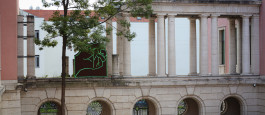
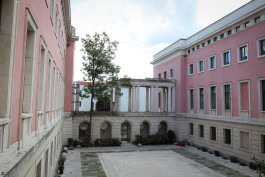
For the first time, the Embassy of Italy in Berlin joined the Berlin Art Week programme, opening the doors of its monumental Tiergarten building not only as a diplomatic institution, but as a space for contemporary culture. The exhibition was featured in Berlin Art Week’s official programme.Â
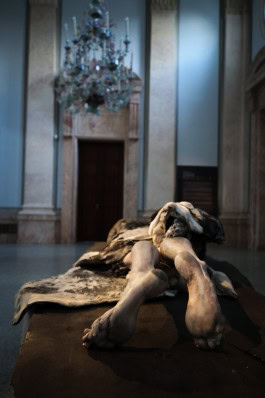
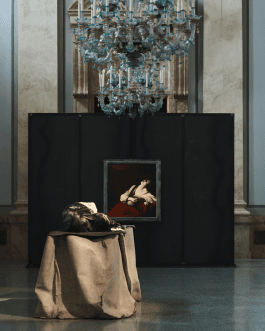
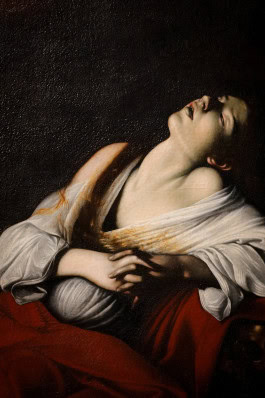
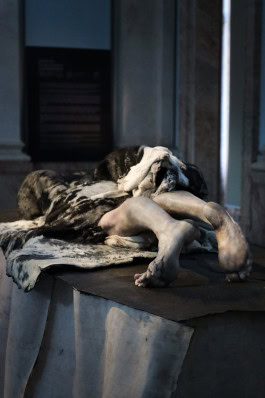
At its centre is Caravaggio × Berlinde De Bruyckere, presented by Offsite Arts in partnership with the Embassy of Italy in Berlin. The exhibition brings Michelangelo Merisi da Caravaggio’s Mary Magdalene in Ecstasy (c. 1606) to Germany for its first public showing, placing it in dialogue with Berlinde De Bruyckere’s newly commissioned M.M. MMXXVI, 2026. Curated by Tjioe Meyer-Hecken and Felipe Schwager, it marks the inaugural edition of a new international exhibition series pairing rare historical masterpieces with acclaimed living artists in extraordinary locations. Offsite Arts is an independent, nomadic art institution that transforms unexpected and otherwise inaccessible spaces into temporary settings for exhibitions, performances and discourse, with previous projects featuring artists including Salomé Chatriot, Göksu Kunak, Young Boy Dancing Group, Nina Kraviz and LABOUR.
So what happens when a political institution becomes a cultural space? And what happens to art when it leaves the conventional museum environment?
The Columbist met Alfonso Tagliaferri, Counsellor and Head of the Cultural Office at the Embassy of Italy in Berlin, and Tjioe Meyer-Hecken and Felipe Schwager, founders and curators of Offsite Arts, to explore two sides of the same experiment.


Â
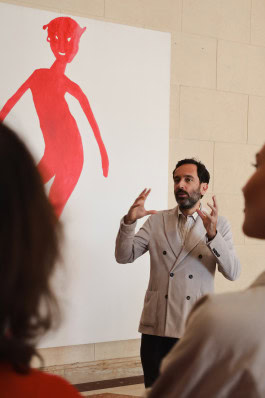
— We believe that art is another medium, another way of bringing people together and one of the most effective ones. Since Ambassador Bucci arrived about a year and a half ago, we have been working on opening the Embassy more to Berlin. First of all, because this is a historical building in Berlin, and we believe that, in a way, it belongs to Berliners and to the people who visit the city. We wanted to change this perception of an embassy as a closed, overly protected space and open it to the public. But once you open the doors, you also want to bring in some fresh air and contemporary energy.
So we gradually started moving from our traditional collection of antique art towards more contemporary art, collaborating with galleries, museums and cultural institutions. The ultimate goal is to position the Embassy as an open, free space where artists, museums, galleries and cultural institutions can meet, discuss and perhaps brainstorm together.
Â
— This is the first time the Italian Embassy has officially participated in Berlin Art Week. Why now and what would you like the Embassy to become culturally?
— Ambassador Bucci has been here for around a year and a half, and I arrived about a year ago. Last year was probably a little too soon for us to reach the level we wanted. We already organised many art events, but this year we wanted to officially enter Berlin Art Week for the first time. And to do that, we wanted to aim high. At the same time, we don’t want to act as a museum. We are not a museum. This is a working space, and we work every day in these beautiful ballrooms. Instead, we would like to act as a free platform for people in the cultural world to meet and discuss. We are very happy to collaborate with everyone in Berlin, not only with Italian artists or Italian galleries. We are open to international art because we believe that artists and art have no passports.
— Sometimes people think that for a country with such a strong heritage, it is difficult to stay current. But I don’t think that’s the case. Italy has been at the forefront of cultural innovation during many different periods. Think about Futurism in the 1920s, for example, or the enormous amount of innovation in the 1960s. The challenge for us is to blend these things, to show what Italy is and was, but also what Italy will be. That is why we also bring contemporary Italian art here. Having such a strong tradition gives you grounding. It gives you somewhere to stand while looking ahead. I think that heritage is actually a gift rather than a burden.
Â
— It’s both a blessing and a challenge. I think the Caravaggio looks incredibly fitting in this place. The Embassy is particularly monumental, and our main ballroom looks and feels a little like a chapel. You notice it as soon as people enter the room: everybody starts whispering because it really feels almost sacred. On the other hand, we are not a museum. It is difficult for us to be open all day, every day, because we have many other things happening here. We work on politics, trade, science and everything else an embassy does.
But the energy the exhibition brings into the building is wonderful. Watching people step inside, look around and sometimes simply feel overwhelmed is very special. As for Berlinde De Bruyckere, again, we believe that art and artists come without passports. Of course, we have a core of art here that is traditionally Italian, particularly the historical works. But at the same time, we want to inject energy and dialogue from other countries. Simply presenting the art and culture of your own country like a window display feels a little old-fashioned to us. We want to blend things. We want to put Italian culture and art into conversation with Berlin and with the world.
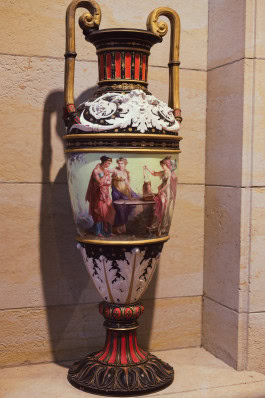
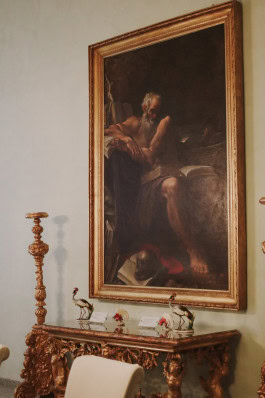
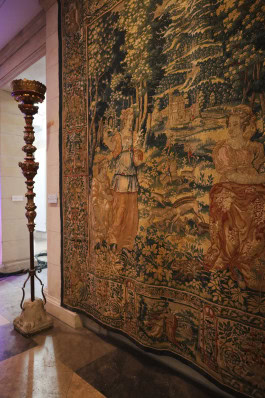
— There are several layers. The building was constructed at the end of the 1930s, but it was bombed during the war and subsequently remained closed for around 50 years. After reunification, the building was restored and filled with antique art on loan from Italian museums: tapestries, antique vases and beautiful furniture. Some of that is still here. Over time, however, we wanted to modernise both the furniture and the art, so we started a programme of loans in collaboration with galleries, foundations and museums.
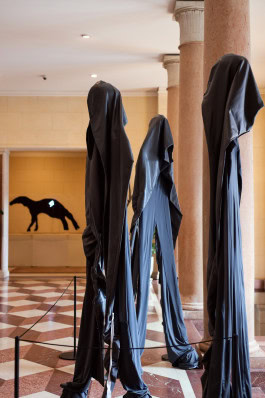
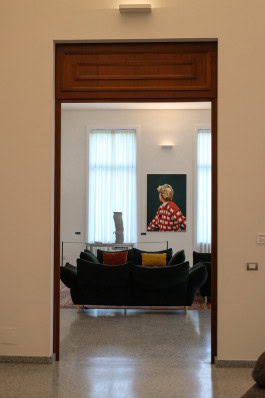
Today, you have antique art alongside contemporary works on long-term loan. For example, we have a beautiful series of paintings by Emilio Vedova. We also have works by artists including Monica Bonvicini, Rosa Barba and Edi Rama, as well as representatives of Arte Povera such as Mario Merz. Then we have medium-term and shorter exhibitions. We recently had an exhibition with Fondazione Sandretto Re Rebaudengo from Turin for three months, featuring Italian and international artists.And finally, we have shorter exhibitions such as Caravaggio Ă— Berlinde De Bruyckere.Â
All of this has to coexist with our everyday working life. We have meetings and delegations coming through the building. It’s complicated, but it’s also fun. One of our next projects is the underground bunker. It has essentially been abandoned for decades and first needs to be made safe and restored. After that, perhaps we can think about doing something there. We already have a few ideas.
Â
— What can a space like an embassy give to art that a traditional museum or gallery sometimes cannot?
— Freedom. And a different framework. Art, like people, doesn’t live separately from its surroundings. It is very different to put an artwork in your home, in a gallery, at an art fair, in a museum or inside an embassy. The dynamics are different. In a gallery, you know that the art may be there to be sold. In a museum, the work has been selected within a particular curatorial context or collection. Here, the context is much wider. We don’t want to be only Italian. Of course, perhaps there is an Italian point of view behind the curation, but we hope that freedom is the main asset.
Â
— Berlin has an offer that is unmatched. Sometimes it is almost too much to try to follow everything. What is beautiful is how you can mix the “high” and “low” not in terms of quality, but in terms of structure. During Art Week, for example, I went to Hamburger Bahnhof and Neue Nationalgalerie, but I also visited artist collectives working in very small spaces on the outskirts of the city. And they were just as interesting as the major shows.What you really need in Berlin is a lot of curiosity and a good bike to zoom left and right.
As for the Embassy, I think we are already starting to become part of the cultural conversation. At the beginning, you are always the one proposing things. Now ideas and proposals are increasingly coming back to us. For me, that already shows that we are being considered one of the hubs in a city full of hubs. Of course, we hope it will be happening even more. We have raised the bar now, so we have to aim higher and higher. It’s going to be tough but it’s going to be fun.
Â
If Alfonso explains why an embassy would open itself to art, the second part of the story approaches the same encounter from the opposite direction: why would art want to enter an embassy?
Â
— The idea developed quite organically. We have been working with art in different contexts for years, including at Wehrmuehle outside Berlin, where emerging and established artists, both international and local, come together. But we are also city people. We love discovering unexpected places whether it’s a construction site, an embassy or an old building and seeing what happens when art enters those spaces.We started developing projects in Berlin, including performances and contemporary music in the former Tacheles area on Friedrichstraße, and later exhibitions, studio projects, talks and literary programmes in Brunnenstraße.
Offsite Arts grew out of these experiences. At its core is the idea of being a nomadic institution: we don’t have one permanent location. Instead, we are guests in special places and create projects specifically for those environments.The vision is to present incredible art and artists seriously, but outside the conventional museum context and to create special moments that perhaps you would normally have to travel internationally to experience.
Â
— It was really the result of many different relationships coming together. Over the years, we have built trust with artists, collectors and institutions. We have worked with Berlinde for years, and that existing relationship made it possible to develop something of this scale and on relatively short notice. The same is true of the Embassy. Friends of ours who are art collectors suggested that we speak with the Ambassador. And Alfonso knows so much about art and understands when it is the right moment to suggest something. When we began discussing an exhibition in this beautiful ballroom, Alfonso essentially said, “Maybe we can find a Caravaggio.” Suddenly, something that had sounded almost impossible became a real possibility. A project like this can only happen because there is trust on all sides.
Â
— We had been thinking for some time about moments when contemporary artistic positions can work particularly well in dialogue with Baroque or historical painting. One inspiration came from seeing contemporary work responding to Caravaggio and his use of light. It made us think about how a contemporary artist could enter into a genuine conversation with a historical master rather than simply being exhibited alongside them.When this particular Caravaggio became a possibility, we immediately thought of Berlinde De Bruyckere. Her work has long engaged with religious iconography, the human body and vulnerability. We already had a relationship with her and had followed her work closely for years, so the conversation felt very natural. We called Berlinde and asked whether she could imagine showing in dialogue with this Caravaggio. Her reaction was immediate: “That’s a match made in heaven.”
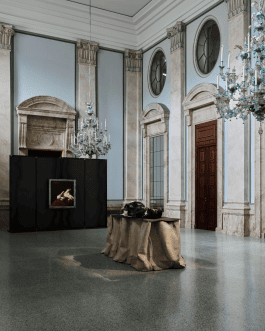
— Berlinde really immersed herself in the painting. She downloaded and printed details of it and stayed in close contact with us about the dimensions of the room, the conditions of the space and the painting itself. There were different works and directions discussed along the way, but we had already seen how powerfully her work could function in a spiritual context. During the Venice Biennale, she created an installation at the Basilica of San Giorgio Maggiore. Seeing her work there was incredibly impactful. There is something similar happening here. People enter this room and instinctively start whispering. We didn’t deliberately create that reaction, but somehow the combination of the works and the space produces this very particular moment.
Â
— There are several conversations happening across those four centuries. Caravaggio had an important influence on Flemish painting, and now, centuries later, a Flemish artist enters into conversation with Caravaggio again. But Berlinde also approaches the story of Mary Magdalene from the perspective of a contemporary woman and artist. Her work was created specifically in response to the painting, and she also called it Maria Magdalena. What connects the works very strongly is vulnerability. Both confront us with the human body in a way that can be fragile and powerful at the same time. So there isn’t only one conversation in the room. There are conversations between centuries, artistic traditions, the historical and contemporary, male and female perspectives, spirituality, the body and vulnerability.
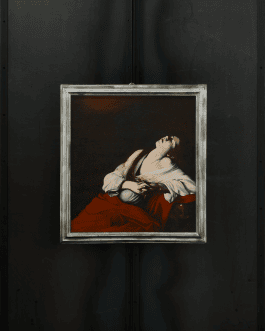
— We were extremely fortunate that this particular painting became available to us and that we were given the opportunity to develop an exhibition around it. There is an enormous amount of trust involved. There are security requirements, conservation conditions and many practical considerations that have to be taken into account. In that sense, the Embassy has actually been an ideal partner because everyone here helped us find solutions. But the location is also fundamental to the Offsite Arts idea. We are interested in what happens when art enters a place that wasn’t originally created as an exhibition space. Being a guest in a special location in this case, an embassy changes the way you encounter the work.
Â
— Flexibility is a big part of it. We are very interested in the question of what an art institution can be today and what an institution of the future might look like. An institution can be porous. It can be different things for different people. It can create spaces where people discover something new, feel represented and find community. For us, one of the most important things is that we don’t only talk about building bridges we actually try to build them. We bring art to people and bring very different worlds together. That also comes with responsibility, because projects like this depend on people and institutions giving us their trust.Â
As for what comes next, we are already in conversations about future projects and other locations. It doesn’t necessarily have to be Berlin. The nomadic character is part of Offsite Arts, so the idea can travel. Berlin is home and an important part of what we do, but our backgrounds, friendships and professional relationships are international. The next chapter could happen somewhere completely different.
Â
What makes Caravaggio Ă— Berlinde De Bruyckere particularly fitting is that the two sides came to the project from almost opposite directions. The Italian Embassy is asking how a diplomatic institution can become more open, more contemporary and more connected to the cultural life of the city. Offsite Arts is asking how an art institution can become more flexible, more nomadic and less dependent on the conventional museum space. One wants to open its doors. The other deliberately looks for unexpected doors to enter. And for a few weeks in Berlin, those ideas meet in the same ballroom around two works separated by more than four centuries.
For a city constantly looking for new ways to experience art, this may be one of the more interesting legacies of Berlin Art Week, not simply another exhibition, but a question about where art belongs, who gets to encounter it, and what can happen when normally separate worlds share the same room.
Caravaggio × Berlinde De Bruyckere is on view at the Embassy of Italy in Berlin until 25 September 2026. Admission is free with advance registration, and visitors must bring a valid photo ID. The dedicated Offsite Arts visitor information lists the final public slot on 25 September from 11:00–12:00.
Sign up here to subscribe to The Columbist newsletter.
Related Articles:

Sign up here to subscribe to The Columbist newsletter.
Berlin Art Week always turns the city into one sprawling art route. Everyone plans their own itinerary, moving from museums to galleries, project spaces and unexpected locations in search of the exhibitions and encounters that feel truly special.
This year, one of those destinations was not a museum or gallery at all. It was an embassy.
For the first time, the Embassy of Italy in Berlin joined the Berlin Art Week programme, opening the doors of its monumental Tiergarten building not only as a diplomatic institution, but as a space for contemporary culture. The exhibition was featured in Berlin Art Week’s official programme.Â
At its centre is Caravaggio × Berlinde De Bruyckere, presented by Offsite Arts in partnership with the Embassy of Italy in Berlin. The exhibition brings Michelangelo Merisi da Caravaggio’s Mary Magdalene in Ecstasy (c. 1606) to Germany for its first public showing, placing it in dialogue with Berlinde De Bruyckere’s newly commissioned M.M. MMXXVI, 2026. Curated by Tjioe Meyer-Hecken and Felipe Schwager, it marks the inaugural edition of a new international exhibition series pairing rare historical masterpieces with acclaimed living artists in extraordinary locations. Offsite Arts is an independent, nomadic art institution that transforms unexpected and otherwise inaccessible spaces into temporary settings for exhibitions, performances and discourse, with previous projects featuring artists including Salomé Chatriot, Göksu Kunak, Young Boy Dancing Group, Nina Kraviz and LABOUR.
So what happens when a political institution becomes a cultural space? And what happens to art when it leaves the conventional museum environment?
The Columbist met Alfonso Tagliaferri, Counsellor and Head of the Cultural Office at the Embassy of Italy in Berlin, and Tjioe Meyer-Hecken and Felipe Schwager, founders and curators of Offsite Arts, to explore two sides of the same experiment.


Â
— We believe that art is another medium, another way of bringing people together and one of the most effective ones. Since Ambassador Bucci arrived about a year and a half ago, we have been working on opening the Embassy more to Berlin. First of all, because this is a historical building in Berlin, and we believe that, in a way, it belongs to Berliners and to the people who visit the city. We wanted to change this perception of an embassy as a closed, overly protected space and open it to the public. But once you open the doors, you also want to bring in some fresh air and contemporary energy.
So we gradually started moving from our traditional collection of antique art towards more contemporary art, collaborating with galleries, museums and cultural institutions. The ultimate goal is to position the Embassy as an open, free space where artists, museums, galleries and cultural institutions can meet, discuss and perhaps brainstorm together.
Â
— This is the first time the Italian Embassy has officially participated in Berlin Art Week. Why now and what would you like the Embassy to become culturally?
— Ambassador Bucci has been here for around a year and a half, and I arrived about a year ago. Last year was probably a little too soon for us to reach the level we wanted. We already organised many art events, but this year we wanted to officially enter Berlin Art Week for the first time. And to do that, we wanted to aim high. At the same time, we don’t want to act as a museum. We are not a museum. This is a working space, and we work every day in these beautiful ballrooms. Instead, we would like to act as a free platform for people in the cultural world to meet and discuss. We are very happy to collaborate with everyone in Berlin, not only with Italian artists or Italian galleries. We are open to international art because we believe that artists and art have no passports.

— Sometimes people think that for a country with such a strong heritage, it is difficult to stay current. But I don’t think that’s the case. Italy has been at the forefront of cultural innovation during many different periods. Think about Futurism in the 1920s, for example, or the enormous amount of innovation in the 1960s. The challenge for us is to blend these things, to show what Italy is and was, but also what Italy will be. That is why we also bring contemporary Italian art here. Having such a strong tradition gives you grounding. It gives you somewhere to stand while looking ahead. I think that heritage is actually a gift rather than a burden.
Â
— It’s both a blessing and a challenge. I think the Caravaggio looks incredibly fitting in this place. The Embassy is particularly monumental, and our main ballroom looks and feels a little like a chapel. You notice it as soon as people enter the room: everybody starts whispering because it really feels almost sacred. On the other hand, we are not a museum. It is difficult for us to be open all day, every day, because we have many other things happening here. We work on politics, trade, science and everything else an embassy does.
But the energy the exhibition brings into the building is wonderful. Watching people step inside, look around and sometimes simply feel overwhelmed is very special. As for Berlinde De Bruyckere, again, we believe that art and artists come without passports. Of course, we have a core of art here that is traditionally Italian, particularly the historical works. But at the same time, we want to inject energy and dialogue from other countries. Simply presenting the art and culture of your own country like a window display feels a little old-fashioned to us. We want to blend things. We want to put Italian culture and art into conversation with Berlin and with the world.

— There are several layers. The building was constructed at the end of the 1930s, but it was bombed during the war and subsequently remained closed for around 50 years. After reunification, the building was restored and filled with antique art on loan from Italian museums: tapestries, antique vases and beautiful furniture. Some of that is still here. Over time, however, we wanted to modernise both the furniture and the art, so we started a programme of loans in collaboration with galleries, foundations and museums.
Today, you have antique art alongside contemporary works on long-term loan. For example, we have a beautiful series of paintings by Emilio Vedova. We also have works by artists including Monica Bonvicini, Rosa Barba and Edi Rama, as well as representatives of Arte Povera such as Mario Merz. Then we have medium-term and shorter exhibitions. We recently had an exhibition with Fondazione Sandretto Re Rebaudengo from Turin for three months, featuring Italian and international artists.And finally, we have shorter exhibitions such as Caravaggio Ă— Berlinde De Bruyckere.Â
All of this has to coexist with our everyday working life. We have meetings and delegations coming through the building. It’s complicated, but it’s also fun. One of our next projects is the underground bunker. It has essentially been abandoned for decades and first needs to be made safe and restored. After that, perhaps we can think about doing something there. We already have a few ideas.
Â
— What can a space like an embassy give to art that a traditional museum or gallery sometimes cannot?
— Freedom. And a different framework. Art, like people, doesn’t live separately from its surroundings. It is very different to put an artwork in your home, in a gallery, at an art fair, in a museum or inside an embassy. The dynamics are different. In a gallery, you know that the art may be there to be sold. In a museum, the work has been selected within a particular curatorial context or collection. Here, the context is much wider. We don’t want to be only Italian. Of course, perhaps there is an Italian point of view behind the curation, but we hope that freedom is the main asset.
Â
— Berlin has an offer that is unmatched. Sometimes it is almost too much to try to follow everything. What is beautiful is how you can mix the “high” and “low” not in terms of quality, but in terms of structure. During Art Week, for example, I went to Hamburger Bahnhof and Neue Nationalgalerie, but I also visited artist collectives working in very small spaces on the outskirts of the city. And they were just as interesting as the major shows.What you really need in Berlin is a lot of curiosity and a good bike to zoom left and right.
As for the Embassy, I think we are already starting to become part of the cultural conversation. At the beginning, you are always the one proposing things. Now ideas and proposals are increasingly coming back to us. For me, that already shows that we are being considered one of the hubs in a city full of hubs. Of course, we hope it will be happening even more. We have raised the bar now, so we have to aim higher and higher. It’s going to be tough but it’s going to be fun.


Â
If Alfonso explains why an embassy would open itself to art, the second part of the story approaches the same encounter from the opposite direction: why would art want to enter an embassy?
Â
— The idea developed quite organically. We have been working with art in different contexts for years, including at Wehrmuehle outside Berlin, where emerging and established artists, both international and local, come together. But we are also city people. We love discovering unexpected places whether it’s a construction site, an embassy or an old building and seeing what happens when art enters those spaces.We started developing projects in Berlin, including performances and contemporary music in the former Tacheles area on Friedrichstraße, and later exhibitions, studio projects, talks and literary programmes in Brunnenstraße.
Offsite Arts grew out of these experiences. At its core is the idea of being a nomadic institution: we don’t have one permanent location. Instead, we are guests in special places and create projects specifically for those environments.The vision is to present incredible art and artists seriously, but outside the conventional museum context and to create special moments that perhaps you would normally have to travel internationally to experience.
Â
— It was really the result of many different relationships coming together. Over the years, we have built trust with artists, collectors and institutions. We have worked with Berlinde for years, and that existing relationship made it possible to develop something of this scale and on relatively short notice. The same is true of the Embassy. Friends of ours who are art collectors suggested that we speak with the Ambassador. And Alfonso knows so much about art and understands when it is the right moment to suggest something. When we began discussing an exhibition in this beautiful ballroom, Alfonso essentially said, “Maybe we can find a Caravaggio.” Suddenly, something that had sounded almost impossible became a real possibility. A project like this can only happen because there is trust on all sides.
Â
— We had been thinking for some time about moments when contemporary artistic positions can work particularly well in dialogue with Baroque or historical painting. One inspiration came from seeing contemporary work responding to Caravaggio and his use of light. It made us think about how a contemporary artist could enter into a genuine conversation with a historical master rather than simply being exhibited alongside them.When this particular Caravaggio became a possibility, we immediately thought of Berlinde De Bruyckere. Her work has long engaged with religious iconography, the human body and vulnerability. We already had a relationship with her and had followed her work closely for years, so the conversation felt very natural. We called Berlinde and asked whether she could imagine showing in dialogue with this Caravaggio. Her reaction was immediate: “That’s a match made in heaven.”

— Berlinde really immersed herself in the painting. She downloaded and printed details of it and stayed in close contact with us about the dimensions of the room, the conditions of the space and the painting itself. There were different works and directions discussed along the way, but we had already seen how powerfully her work could function in a spiritual context. During the Venice Biennale, she created an installation at the Basilica of San Giorgio Maggiore. Seeing her work there was incredibly impactful. There is something similar happening here. People enter this room and instinctively start whispering. We didn’t deliberately create that reaction, but somehow the combination of the works and the space produces this very particular moment.
Â
— There are several conversations happening across those four centuries. Caravaggio had an important influence on Flemish painting, and now, centuries later, a Flemish artist enters into conversation with Caravaggio again. But Berlinde also approaches the story of Mary Magdalene from the perspective of a contemporary woman and artist. Her work was created specifically in response to the painting, and she also called it Maria Magdalena. What connects the works very strongly is vulnerability. Both confront us with the human body in a way that can be fragile and powerful at the same time. So there isn’t only one conversation in the room. There are conversations between centuries, artistic traditions, the historical and contemporary, male and female perspectives, spirituality, the body and vulnerability.

— We were extremely fortunate that this particular painting became available to us and that we were given the opportunity to develop an exhibition around it. There is an enormous amount of trust involved. There are security requirements, conservation conditions and many practical considerations that have to be taken into account. In that sense, the Embassy has actually been an ideal partner because everyone here helped us find solutions. But the location is also fundamental to the Offsite Arts idea. We are interested in what happens when art enters a place that wasn’t originally created as an exhibition space. Being a guest in a special location in this case, an embassy changes the way you encounter the work.
Â
— Flexibility is a big part of it. We are very interested in the question of what an art institution can be today and what an institution of the future might look like. An institution can be porous. It can be different things for different people. It can create spaces where people discover something new, feel represented and find community. For us, one of the most important things is that we don’t only talk about building bridges we actually try to build them. We bring art to people and bring very different worlds together. That also comes with responsibility, because projects like this depend on people and institutions giving us their trust.Â
As for what comes next, we are already in conversations about future projects and other locations. It doesn’t necessarily have to be Berlin. The nomadic character is part of Offsite Arts, so the idea can travel. Berlin is home and an important part of what we do, but our backgrounds, friendships and professional relationships are international. The next chapter could happen somewhere completely different.

Â
What makes Caravaggio Ă— Berlinde De Bruyckere particularly fitting is that the two sides came to the project from almost opposite directions. The Italian Embassy is asking how a diplomatic institution can become more open, more contemporary and more connected to the cultural life of the city. Offsite Arts is asking how an art institution can become more flexible, more nomadic and less dependent on the conventional museum space. One wants to open its doors. The other deliberately looks for unexpected doors to enter. And for a few weeks in Berlin, those ideas meet in the same ballroom around two works separated by more than four centuries.
For a city constantly looking for new ways to experience art, this may be one of the more interesting legacies of Berlin Art Week, not simply another exhibition, but a question about where art belongs, who gets to encounter it, and what can happen when normally separate worlds share the same room.
Caravaggio × Berlinde De Bruyckere is on view at the Embassy of Italy in Berlin until 25 September 2026. Admission is free with advance registration, and visitors must bring a valid photo ID. The dedicated Offsite Arts visitor information lists the final public slot on 25 September from 11:00–12:00.

Sign up here to subscribe to The Columbist newsletter.
Related Articles:
 ABOUT         CONTACT         INSTAGRAM         DATA PRIVACY         IMPRINT
You need to load content from reCAPTCHA to submit the form. Please note that doing so will share data with third-party providers.
More InformationYou need to load content from Turnstile to submit the form. Please note that doing so will share data with third-party providers.
More InformationYou are currently viewing a placeholder content from Facebook. To access the actual content, click the button below. Please note that doing so will share data with third-party providers.
More InformationYou are currently viewing a placeholder content from Instagram. To access the actual content, click the button below. Please note that doing so will share data with third-party providers.
More InformationYou need to load content from hCaptcha to submit the form. Please note that doing so will share data with third-party providers.
More InformationYou need to load content from reCAPTCHA to submit the form. Please note that doing so will share data with third-party providers.
More InformationYou are currently viewing a placeholder content from Turnstile. To access the actual content, click the button below. Please note that doing so will share data with third-party providers.
More InformationYou are currently viewing a placeholder content from X. To access the actual content, click the button below. Please note that doing so will share data with third-party providers.
More Information