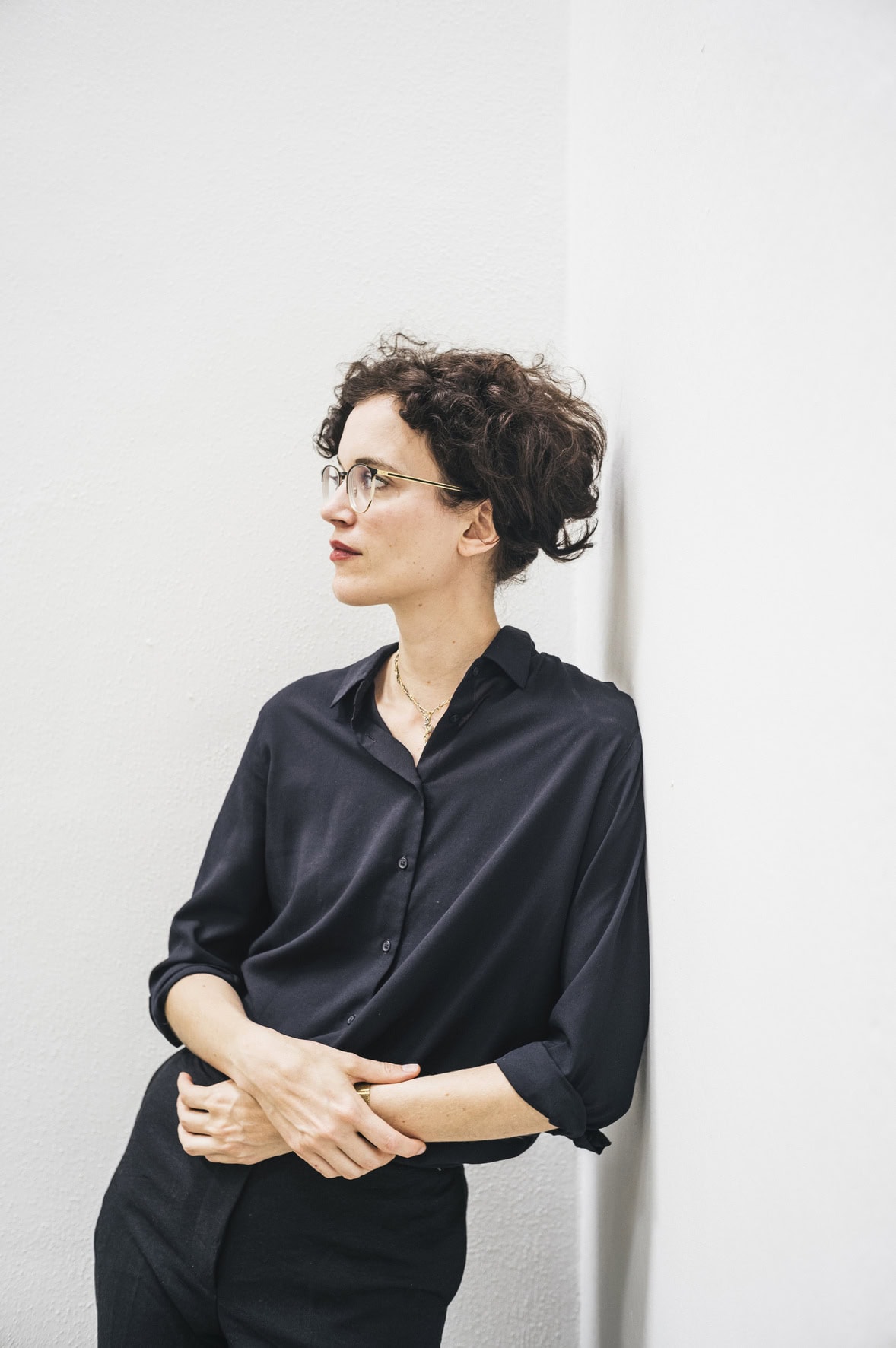

A cultural scientist, a green activist, a writer – These are few of the titles that define Nike Wessel. However, one of them comes before all, and it is the fact that she is a Berliner*in. Nike is someone who truly embodies the free-spirited, self-confident, and fully creative energy of this city. Her way of writing, speaking, or even walking screams “Berlin!” in many ways.
How do we know? It’s a snowy morning in January when we are on my way to meet her. Honestly, we are quiet excited, too – it has been only two days since we read her book, Sex in Berlin – Guide to Love, and finished it in just two hours. Instant obsession!
Wessel’s investment in narrating the sex-positive scene of this city is surely three-dimensional: It is physical, because most of the chapters are based on her own sex-positive experiences. It is mental, because lots of details in the book unveil the sacred connection between body, movement, and the mind. Lastly, it is intellectual – because Sex in Berlin is far from just being a funny, sexy, playful compilation of stories. It is a queer-feminist archive, and a witness of how Berlin changed, how it is currently changing, and how it will keep changing.

Sex in Berlin is not your typical coffee table book – it is a de facto map of the corners in the city that enlighten one’s journey towards sexual freedom, body consciousness, and falling in love with Berlin. From naked tea parties that connect body to mind, to sex shops seeking to openly discuss women’s sexuality, and from hardcore BDSM-parties to romantic love-making spaces, Wessel is a reflector on the many colors of Berlin.
Supported with historical contextualizationsü, and interviews with influential women over culture, the book is here to offer a tour of Berlin that explores a layer where we all experience but usually avoid talking about: Intimacy in every form – within one’s self to another one, to multiple, eventually ending up in intimacy shared with the city.
When we finally meet Nike over a coffee, words drop like water. Suddenly, we are discussing old-school LGBTQ+ spaces of Berlin that need some reform, must-visit saunas with incredibly high capacities, habitable neighborhoods in the city for the elderly, gentrification, Margaret Atwood, and Edouard Louis. Talking with her is already a 360-degree brainstorming over the realities of life, literature, and surely Berlin – interviewing her over Sex in Berlin? Well, here is the answer to this question.

— How did you find yourself writing Sex in Berlin? How did the idea appear, and what were the main sources of inspiration?
— I grew up here, in Berlin. Then when I grew a little older, I discovered the wonderful party scene in the city. So I went out a lot, and I enjoyed it very much. Later, the scene (maybe for me) changed a little bit. It was still interesting and nice, but only going out to dance and to have a wonderful night out wasn't enough anymore. In a way, I recognized that there had to be more interesting places around sex. This was a kind of a second discovery: “What can Berlin bring to you? What is special here in the city?” I was very curious. Eventually, I discovered so many different things, and I thought, maybe I should tell others about these things, too.
— One can easily tell that you have an intense connection with Berlin. I wonder, how does Nike spend a regular day in Berlin?
— I live in Kreuzberg. If it is a Saturday, then I would get up and go to La Maison and have a nice coffee and maybe a croissant. Sometimes I go for a walk along the canal later. Then I go shopping at some bookshops, for example, to the She Said Bookstore. It is a nice thing to do. Afterwards, I meet friends usually, or sometimes I do workshops.
I really enjoy learning new things. I go to the IKSK at Holzmarkt a lot – it is a place where you can learn everything: how to flirt, how to kiss, how to wrap someone up with special things… I can say that learning something new is one part of Berlin that I really like. In the evening, you can go for a nice dinner and then maybe to a show, for example, to Cabaret Cravache, to have a sexy dance show. Or now, in winter, I go to a cozy cinema. This is the winter mode.

— Is there a keyword that defines your relationship with Berlin?
— It is home, it is adventure, and it is freedom. I can be very free here. I meet people on the streets, but not too many. I can go to a party and maybe meet someone new. Honestly, this is freedom for me, because I can always discover new things and new people, and I can behave as if I'm a new person every day. So I think freedom is the essential word for it.
— You’ve mentioned all these sex positive organizations, parties, and events in your book. I want to learn your take on the contribution of sex-positivity to the city. In your opinion, what does sex-positivity bring to Berlin’s sociocultural identity?
— I think sex positivity has different good impacts here. Firstly, it makes Berlin very open for different kinds of how to love and whom. So it's quite free for all genders, all kinds of love – whether it is queer, or it is an open relationship, or the way you love and who.
The other thing I really like is that it fuels creativity. Sex-positive venues are full of different kinds of art. Some people paint the body, some sing. Some are writing poems. Some do perform on the stage, and there's the music part… So it is a nice mixture of a feminist, very political statement that it is good that you can love in a very free way. But it is also combined with nice things, like it tastes good, and it looks good. And I think this mixture is very interesting about the sex-positive scene.

— What would we be missing if Berlin weren’t that sex-positive?
— Sometimes I'm a little afraid that Berlin will get more boring from year to year when I see how new buildings are arriving in former places where you could go out. We had a lot of festivals in the cities for years, and they are all gone. I mean, you used to be able to party at Ostbahnhof for three days, and now you have three more shopping malls there. I think if you have less space, and less space especially for sex-positive venues, then you will lose some kind of signature from Berlin, which the city has had for years.
Berlin had it in the 1930s: People could be, especially in the sex wave, very free and live how they really want to. Then we lost it a little in the Second World War. But after the war and the 60s, 70s, both in West Berlin and in East Berlin, it was a very free city for lots of… weirdos. I would say all these so-called weirdos brought so many nice things. So if you lose the sex-positive ideas and venues, you will lose lots of good things and interesting things. You will lose what makes Berlin exactly different from other cities.
— I think the book is not only a guide to love, but it is also a feminist archive in many ways, especially with the interviews that you've included. They encompass the themes of death, breakups, and beyond in the eyes of women*. Still, the question appears as if Berlin is safe for them, for you. How do you think we can provide women* a safer Berlin, especially in terms of sex-positive spaces?
— During my research, I always looked for nice places that I could recommend to my friends. Most of the people I introduce are women or FLINTA+ people. All the few men I interview are very kind and very good in a lot of ways. So I think it is important to look at the people who provide venues and parties. And if you go to a very well-made party, it is a safe place. So it is important for me not to show only the big clubs and the big parties, but also to show the nice places where they have a very good concept for consent.
For example, they really think about how a play space can be safe. How do you deal with other people? What kind of idea is behind providing a sex-positive space? It shouldn't be about only the money. It should be about the interest in connecting people. I want to have an event where people can meet and can do it in the safest way, so one can really learn something from this small scene.

— You mentioned that you explored the sex-positive scene first, and then started writing the book, which means that something you personally enjoyed suddenly became a topic of research. Did it feel like a job in the process to enjoy sex-positive spaces and experiences?
— I'm very curious, and I love to learn, and I always love to learn more about this whole topic. So it isn't becoming a job. What really changed for me is, in the beginning, I was more observant, and sometimes it's also weird and strange. But now more and more, I like to tell really good stories about it, and I don't make fun of any scenes.
There are some things I wouldn't do myself, but the most important thing for me is that I don't judge what other people do in this sense. So if you want to tie yourself up and hang in a room, you could totally do it, and I will not judge. This is the center of my work. It is getting more important that I don't go somewhere, observe, and then say, “Ah, how could they do it?” or something. I stay open, and I love more and more, how unique every experience is, and what you could feel there.
— How long did it take to write you the book?
— It was more or less a year. We need a year because I wrote some questions to some places, and they are more or less well organized, because most of them don't earn so much money, so it's a second or third job for them. They have to do it in their free time to answer questions or to send pictures. So sometimes I had to wait a long time to get an answer.

— Would you add or remove anything from the current version of the book? Or do you think it is perfectly telling everything that you needed to?
— Oh, I would add a lot more. And I would only change one thing, because one venue closed in a strange way. So maybe I would change it a little bit. And there you see it, that scene, it's moving like every year, it's different. And this is the power of it, that there are so many new things coming up, and the others develop. They have a new concept. They have new ideas. And this is nice to see and nice to document.
— Do you think there is a next step for Sex in Berlin?
— Yeah, I’d like to do Sex in Europe, because sex-positivity is present on the European and international scene. I think you could also do things like Sex Around the World. But for me, the next step will be Sex in Europe, because the people who come to Berlin or work here, they also work in Sweden and London and Paris, also in Turkey. So it's an international scene, and it should be held. And this is the power of it, that the people come from different countries and they bring different perspectives.

— For those who never had a sex-positive experience here in Berlin, and are possibly ashamed of having one, what would you advise? What would you like to say to them?
— I think everyone could try, because there are very small and soft entrances and steps. And you can always take someone with you. You can come with a partner. You can choose something very soft for the beginning. We also have a Sexomat on our website, where you type in what you like to experience, and in the end, you find the best venue for you. Doesn’t matter whether you want to go to a sex shop and attend a small workshop, or go to a very soft party, or to a hardcore BDSM event. There are different kinds of ideas where you could go, and a small beginning is always very nice.
There's a reason why you should discover sex positivity, because I think sex is a power you have in yourself, and when you're not free and unable to find what's really there, you lose a part of your power for everything. To have a nice connection with other people,to discover a way of expressing your body, and to be held and touched – these are very good things to experience. Especially nowadays. Because everyone is working online, and then they go to the gym, and then they go home again. It's so important that we still get touched, and have a good spot to meet ourselves and others in new ways.

— I listened to your TEDx talk, too. I remember your emphasis on shame among women when it comes to sex. What would you recommend to them to break that constructed shame? Why and how could they break the ice?
— A nice first step is a flirting workshop. It's a very soft beginning. Just being naked for a dinner or for a party is also a good idea, because when you're naked, you have to show your whole body as the way it is: No makeup, no high heels, no nice outfit, so you have to come as you are. And this is so liberating, because then you feel that you can still connect only with what you have. And this is very, very nice. It strips away all these layers you normally have around yourself, where you try to show who you are, and then you are in the moment, and you're very present. And this is a big gift you can take for yourself, just to be naked, and you don't have to interact in any kind of sexual way. Just to show yourself.
— Fashion is always connected to subtexts. A piece of clothing, or jewelry, can easily signify the wearer’s class, gender, political stance, or something totally different. That’s where getting naked could be a game-changer in social settings, I guess. Do you think that there's a political act in being naked with other people? Do you think prejudice disappears hand-in-hand with the clothes in sex-positive venues?
— Yes, it totally has. It's also very fun, like everyone is looking a little strange. We all have things that are not super perfect. It's good to see, and it's very liberating. It's fun. It's something new. There's this sentence in Berlin, it's not so much about what you work, it's more about how you play. I don't know if it's really true, because we all have to live with some money, but when you have this kind of event, you can, like… Let it rest for a short time, and it doesn't matter so much.
Related Articles:

A cultural scientist, a green activist, a writer – These are few of the titles that define Nike Wessel. However, one of them comes before all, and it is the fact that she is a Berliner*in. Nike is someone who truly embodies the free-spirited, self-confident, and fully creative energy of this city. Her way of writing, speaking, or even walking screams “Berlin!” in many ways.
How do we know? It’s a snowy morning in January when we are on my way to meet her. Honestly, we are quiet excited, too – it has been only two days since we read her book, Sex in Berlin – Guide to Love, and finished it in just two hours. Instant obsession!
Wessel’s investment in narrating the sex-positive scene of this city is surely three-dimensional: It is physical, because most of the chapters are based on her own sex-positive experiences. It is mental, because lots of details in the book unveil the sacred connection between body, movement, and the mind. Lastly, it is intellectual – because Sex in Berlin is far from just being a funny, sexy, playful compilation of stories. It is a queer-feminist archive, and a witness of how Berlin changed, how it is currently changing, and how it will keep changing.
Sex in Berlin is not your typical coffee table book – it is a de facto map of the corners in the city that enlighten one’s journey towards sexual freedom, body consciousness, and falling in love with Berlin. From naked tea parties that connect body to mind, to sex shops seeking to openly discuss women’s sexuality, and from hardcore BDSM-parties to romantic love-making spaces, Wessel is a reflector on the many colors of Berlin.
Supported with historical contextualizationsü, and interviews with influential women over culture, the book is here to offer a tour of Berlin that explores a layer where we all experience but usually avoid talking about: Intimacy in every form – within one’s self to another one, to multiple, eventually ending up in intimacy shared with the city.
When we finally meet Nike over a coffee, words drop like water. Suddenly, we are discussing old-school LGBTQ+ spaces of Berlin that need some reform, must-visit saunas with incredibly high capacities, habitable neighborhoods in the city for the elderly, gentrification, Margaret Atwood, and Edouard Louis. Talking with her is already a 360-degree brainstorming over the realities of life, literature, and surely Berlin – interviewing her over Sex in Berlin? Well, here is the answer to this question.

— How did you find yourself writing Sex in Berlin? How did the idea appear, and what were the main sources of inspiration?
— I grew up here, in Berlin. Then when I grew a little older, I discovered the wonderful party scene in the city. So I went out a lot, and I enjoyed it very much. Later, the scene (maybe for me) changed a little bit. It was still interesting and nice, but only going out to dance and to have a wonderful night out wasn't enough anymore. In a way, I recognized that there had to be more interesting places around sex. This was a kind of a second discovery: “What can Berlin bring to you? What is special here in the city?” I was very curious. Eventually, I discovered so many different things, and I thought, maybe I should tell others about these things, too.
— One can easily tell that you have an intense connection with Berlin. I wonder, how does Nike spend a regular day in Berlin?
— I live in Kreuzberg. If it is a Saturday, then I would get up and go to La Maison and have a nice coffee and maybe a croissant. Sometimes I go for a walk along the canal later. Then I go shopping at some bookshops, for example, to the She Said Bookstore. It is a nice thing to do. Afterwards, I meet friends usually, or sometimes I do workshops.
I really enjoy learning new things. I go to the IKSK at Holzmarkt a lot – it is a place where you can learn everything: how to flirt, how to kiss, how to wrap someone up with special things… I can say that learning something new is one part of Berlin that I really like. In the evening, you can go for a nice dinner and then maybe to a show, for example, to Cabaret Cravache, to have a sexy dance show. Or now, in winter, I go to a cozy cinema. This is the winter mode.

— Is there a keyword that defines your relationship with Berlin?
— It is home, it is adventure, and it is freedom. I can be very free here. I meet people on the streets, but not too many. I can go to a party and maybe meet someone new. Honestly, this is freedom for me, because I can always discover new things and new people, and I can behave as if I'm a new person every day. So I think freedom is the essential word for it.
— You’ve mentioned all these sex positive organizations, parties, and events in your book. I want to learn your take on the contribution of sex-positivity to the city. In your opinion, what does sex-positivity bring to Berlin’s sociocultural identity?
— I think sex positivity has different good impacts here. Firstly, it makes Berlin very open for different kinds of how to love and whom. So it's quite free for all genders, all kinds of love – whether it is queer, or it is an open relationship, or the way you love and who.
The other thing I really like is that it fuels creativity. Sex-positive venues are full of different kinds of art. Some people paint the body, some sing. Some are writing poems. Some do perform on the stage, and there's the music part… So it is a nice mixture of a feminist, very political statement that it is good that you can love in a very free way. But it is also combined with nice things, like it tastes good, and it looks good. And I think this mixture is very interesting about the sex-positive scene.

— What would we be missing if Berlin weren’t that sex-positive?
— Sometimes I'm a little afraid that Berlin will get more boring from year to year when I see how new buildings are arriving in former places where you could go out. We had a lot of festivals in the cities for years, and they are all gone. I mean, you used to be able to party at Ostbahnhof for three days, and now you have three more shopping malls there. I think if you have less space, and less space especially for sex-positive venues, then you will lose some kind of signature from Berlin, which the city has had for years.
Berlin had it in the 1930s: People could be, especially in the sex wave, very free and live how they really want to. Then we lost it a little in the Second World War. But after the war and the 60s, 70s, both in West Berlin and in East Berlin, it was a very free city for lots of… weirdos. I would say all these so-called weirdos brought so many nice things. So if you lose the sex-positive ideas and venues, you will lose lots of good things and interesting things. You will lose what makes Berlin exactly different from other cities.
— I think the book is not only a guide to love, but it is also a feminist archive in many ways, especially with the interviews that you've included. They encompass the themes of death, breakups, and beyond in the eyes of women*. Still, the question appears as if Berlin is safe for them, for you. How do you think we can provide women* a safer Berlin, especially in terms of sex-positive spaces?
— During my research, I always looked for nice places that I could recommend to my friends. Most of the people I introduce are women or FLINTA+ people. All the few men I interview are very kind and very good in a lot of ways. So I think it is important to look at the people who provide venues and parties. And if you go to a very well-made party, it is a safe place. So it is important for me not to show only the big clubs and the big parties, but also to show the nice places where they have a very good concept for consent.
For example, they really think about how a play space can be safe. How do you deal with other people? What kind of idea is behind providing a sex-positive space? It shouldn't be about only the money. It should be about the interest in connecting people. I want to have an event where people can meet and can do it in the safest way, so one can really learn something from this small scene.

— You mentioned that you explored the sex-positive scene first, and then started writing the book, which means that something you personally enjoyed suddenly became a topic of research. Did it feel like a job in the process to enjoy sex-positive spaces and experiences?
— I'm very curious, and I love to learn, and I always love to learn more about this whole topic. So it isn't becoming a job. What really changed for me is, in the beginning, I was more observant, and sometimes it's also weird and strange. But now more and more, I like to tell really good stories about it, and I don't make fun of any scenes.
There are some things I wouldn't do myself, but the most important thing for me is that I don't judge what other people do in this sense. So if you want to tie yourself up and hang in a room, you could totally do it, and I will not judge. This is the center of my work. It is getting more important that I don't go somewhere, observe, and then say, “Ah, how could they do it?” or something. I stay open, and I love more and more, how unique every experience is, and what you could feel there.
— How long did it take to write you the book?
— It was more or less a year. We need a year because I wrote some questions to some places, and they are more or less well organized, because most of them don't earn so much money, so it's a second or third job for them. They have to do it in their free time to answer questions or to send pictures. So sometimes I had to wait a long time to get an answer.

— Would you add or remove anything from the current version of the book? Or do you think it is perfectly telling everything that you needed to?
— Oh, I would add a lot more. And I would only change one thing, because one venue closed in a strange way. So maybe I would change it a little bit. And there you see it, that scene, it's moving like every year, it's different. And this is the power of it, that there are so many new things coming up, and the others develop. They have a new concept. They have new ideas. And this is nice to see and nice to document.
— Do you think there is a next step for Sex in Berlin?
— Yeah, I’d like to do Sex in Europe, because sex-positivity is present on the European and international scene. I think you could also do things like Sex Around the World. But for me, the next step will be Sex in Europe, because the people who come to Berlin or work here, they also work in Sweden and London and Paris, also in Turkey. So it's an international scene, and it should be held. And this is the power of it, that the people come from different countries and they bring different perspectives.

— For those who never had a sex-positive experience here in Berlin, and are possibly ashamed of having one, what would you advise? What would you like to say to them?
— I think everyone could try, because there are very small and soft entrances and steps. And you can always take someone with you. You can come with a partner. You can choose something very soft for the beginning. We also have a Sexomat on our website, where you type in what you like to experience, and in the end, you find the best venue for you. Doesn’t matter whether you want to go to a sex shop and attend a small workshop, or go to a very soft party, or to a hardcore BDSM event. There are different kinds of ideas where you could go, and a small beginning is always very nice.
There's a reason why you should discover sex positivity, because I think sex is a power you have in yourself, and when you're not free and unable to find what's really there, you lose a part of your power for everything. To have a nice connection with other people,to discover a way of expressing your body, and to be held and touched – these are very good things to experience. Especially nowadays. Because everyone is working online, and then they go to the gym, and then they go home again. It's so important that we still get touched, and have a good spot to meet ourselves and others in new ways.

— I listened to your TEDx talk, too. I remember your emphasis on shame among women when it comes to sex. What would you recommend to them to break that constructed shame? Why and how could they break the ice?
— A nice first step is a flirting workshop. It's a very soft beginning. Just being naked for a dinner or for a party is also a good idea, because when you're naked, you have to show your whole body as the way it is: No makeup, no high heels, no nice outfit, so you have to come as you are. And this is so liberating, because then you feel that you can still connect only with what you have. And this is very, very nice. It strips away all these layers you normally have around yourself, where you try to show who you are, and then you are in the moment, and you're very present. And this is a big gift you can take for yourself, just to be naked, and you don't have to interact in any kind of sexual way. Just to show yourself.
— Fashion is always connected to subtexts. A piece of clothing, or jewelry, can easily signify the wearer’s class, gender, political stance, or something totally different. That’s where getting naked could be a game-changer in social settings, I guess. Do you think that there's a political act in being naked with other people? Do you think prejudice disappears hand-in-hand with the clothes in sex-positive venues?
— Yes, it totally has. It's also very fun, like everyone is looking a little strange. We all have things that are not super perfect. It's good to see, and it's very liberating. It's fun. It's something new. There's this sentence in Berlin, it's not so much about what you work, it's more about how you play. I don't know if it's really true, because we all have to live with some money, but when you have this kind of event, you can, like… Let it rest for a short time, and it doesn't matter so much.

Related Articles:
You need to load content from reCAPTCHA to submit the form. Please note that doing so will share data with third-party providers.
More InformationYou need to load content from Turnstile to submit the form. Please note that doing so will share data with third-party providers.
More InformationYou are currently viewing a placeholder content from Facebook. To access the actual content, click the button below. Please note that doing so will share data with third-party providers.
More InformationYou are currently viewing a placeholder content from Instagram. To access the actual content, click the button below. Please note that doing so will share data with third-party providers.
More InformationYou need to load content from hCaptcha to submit the form. Please note that doing so will share data with third-party providers.
More InformationYou need to load content from reCAPTCHA to submit the form. Please note that doing so will share data with third-party providers.
More InformationYou are currently viewing a placeholder content from Turnstile. To access the actual content, click the button below. Please note that doing so will share data with third-party providers.
More InformationYou are currently viewing a placeholder content from X. To access the actual content, click the button below. Please note that doing so will share data with third-party providers.
More Information