Sign up here to subscribe to The Columbist newsletter.
Precarity, fake news, political polarization, and social injustice were already relevant themes. A global pandemic and multiple wars throughout the last seven years have certainly proved them to be even more challenging and full of tensions. Art has always had the ability to highlight our issues, while at the same time providing potential solutions. This selection of exhibitions to see in November is here to show us how solidarity, proximity, and community might be the keys to facing them, bridging the distance between us, and acting for a positive change.
For its 30th anniversary, Hamburger Bahnhof has opened a series of impressive exhibitions to dive into our present and try to understand it. On October 9, it was the turn of Next Door, featuring acclaimed artists Tacita Dean, Thomas Demand, Olafur Eliasson, Henrik Håkansson, and Tomás Saraceno. The beauty of the exhibition lies in the connection between past and present. A section of Hamburger Bahnhof, the Rieckhallen, was in fact used in the early 2000s as a complex for artists’ studios. All these incredible artists crossed paths there, working in close proximity to one another. After twenty years, they reunite in the same, yet now transformed, space, bringing together artistic trajectories that have evolved far beyond the walls of their former studios.


Every artwork powerfully shows us the relevant themes of our past, and how they leaked into our present. Henrik Håkansson uses the forced path made by a butterfly inside an artificial environment to reflect on perception and ecology at large. Olafur Eliasson does so using light and sound within a permeating and deeply moving installation. Demand uses his reconstructed environments to discuss pivotal moments of recent history, while subtly highlighting their absurdity. Saraceno presents artworks initiated from his longstanding collaboration with spiders, to address fear as a societal construct and the pressing political issues of our time.
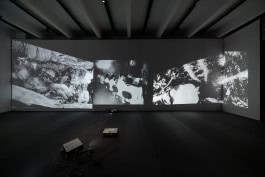
Hamburger Bahnhof is also hosting the first major retrospective of the composer and artist Ryuichi Sakamoto in Europe. Sakamoto was a pioneer of electronic and experimental music, and redefined the boundaries between sound, film, performance, and visual art. Central to his practice was a collaborative approach, developed with multiple creatives of our times. The exhibition presents seven of these works, spanning his career and reflecting on humanity as a whole. From the sound of nature and the rhythm of falling asleep, to the poignant concept of an earthquake playing a piano, seeing sound, hearing time takes us on a journey that will profoundly impact our perception.
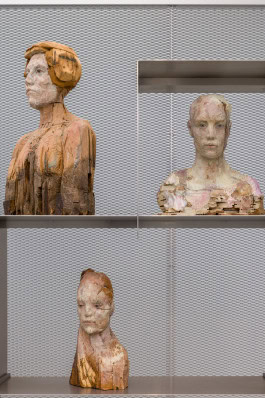
Addressing the same relevant topics is also the exhibition Matter of Care, Care of the Matter, which presents sculptures and site-specific installations by the German collective [ materialistin ]. The group of women artists uses sculpture to take a stand on feminist, social, cultural, and political issues, giving us another powerful insight into how collaboration and solidarity are the first steps in order to restructure a society that really belongs to everyone.


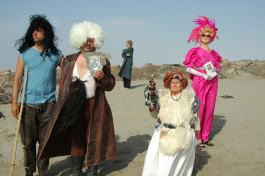
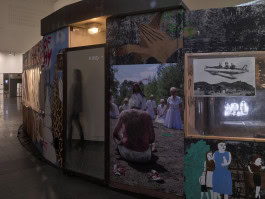
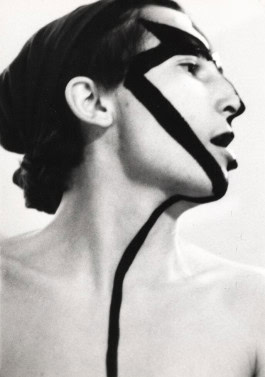
Gropius Bau decided to focus its yearly programme on Germany’s recent history. This October, it opened the poignant exhibition Es ist nicht mehr mein Problem, macht eure Scheiße alleine (It’s not my problem anymore, deal with your own shit), celebrating the visionary and deeply political work of Christoph Schlingensief. Through theatre, film, opera and performance Schlingensief was able to highlight the absurdity of our times with an uncanny gaze at our present. Colonialism, racism, right-wing extremism, and the fragility of democratic societies were addressed ahead of time, through an inclusive practice that remains key to contemporary debates.
Acting in chorus with Schlingensief are the two other exhibitions currently on view. Kreuzberg: Art and Migration since 1960 brings together 130 works from the past and the present to explore experiences of migration, exile, the housing crisis, racism, and exclusion, while celebrating stories of empowerment, resistance, solidarity, and community.
Dabei sein und nicht schweigen (Showing up and Not Remaining Silent) brings together the entire career of Gabriele Stötzer. The artist and activist grappled with questions of justice, self-determination, and gender, while examining societal power relationships. Her art and life have always been deeply intertwined: following her experience of imprisonment and political struggle in the GDR, Stötzer started working in a collaborative and pervasive manner, centering her work on solidarity and exchange while addressing the most pressing topics of our time. With her practice, she challenges categorization and demonstrates how art can act as a catalyst for change.

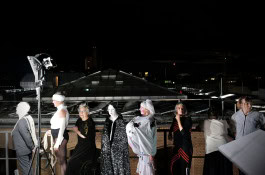
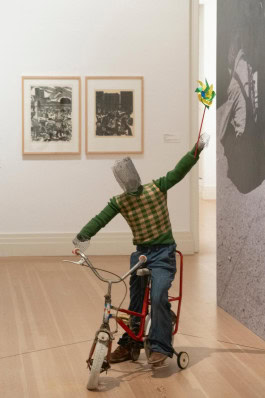
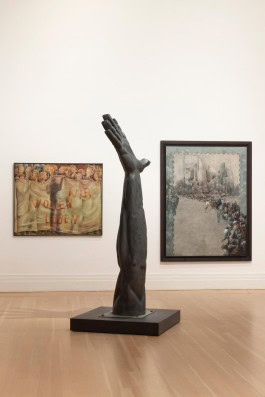
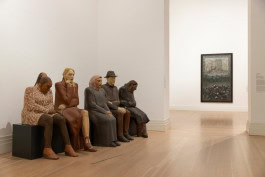
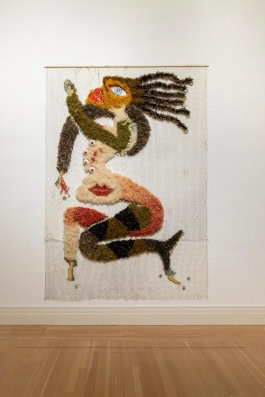


Prater Galerie recently reopened to the public after several years to continue addressing its core values: giving underrepresented voices a space to investigate crucial social and political issues. With Courage: Sisters in Spirit the gallery reverses the historical underrepresentation of women from the GDR era to present a spectrum of artworks created exclusively by women.
Historical and contemporary artworks enter into dialogue to present a nuanced perspective on resistance, memory, and grassroots collective movements. Reflecting on feminism, power structures, exile, repression, and solidarity, the exhibition gives a long-overdue resonating chamber to these topics, highlighting once again the importance of a society where collectivity is made by everyone within it, and which takes the uneasy step to right its past wrongs.


Another choral and relevant exhibition on the most pressing topics of our time is Her Lens: Resilience and Reflection, which opened at Anahita Sadighi Galerie in October. The exhibition, implemented by Candid Foundation, brings together 10 women artists from the MENA region, merging documentary and artistic photography to address a range of human and social realities. The artists explore themes that include conflict, displacement, memory, and resilience, while drawing attention to everyday experiences and intimate moments.
Incredibly poignant is Amira Elnaal’s series, which explores the war-caused blindness of her parents, while reflecting on memory and alternative forms of perception. With her work, Mariam Janini seeks to reconnect with her late mother, using food prepared together with her grandmother as a tool to reclaim what is lost. Amal Moutaouakil travels through a remote landscape, where desert and sea meet, to trace the emotional and physical closeness that binds us together.


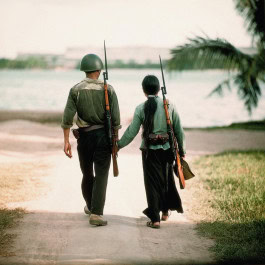
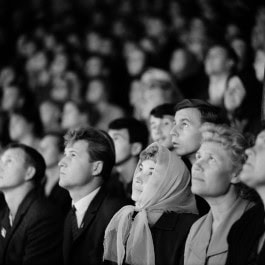
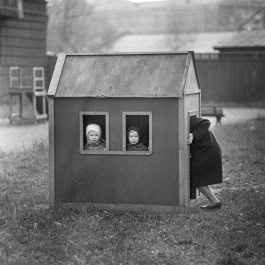

With Eyes Wide Open Fotografiska Berlin presents the work of German photographer Thomas Billhardt. Showcasing key series from several decades, the exhibition highlights the variety of his practice, and the vastness of his work as a photojournalist. Billhardt documented Berlin in GDR times, Vietnam, Cuba, and numerous global flashpoints with the same powerful and intimate perspective. As the exhibition manager, Claire Ducresson-Boët, said: “He remained deeply attuned to both geopolitics and the quiet, poetic fragments of everyday life.” Above all, his work centers on a fundamental and deeply relevant question: How do people preserve their humanity when the structures around them threaten to crush it?
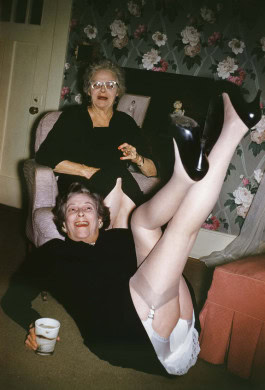
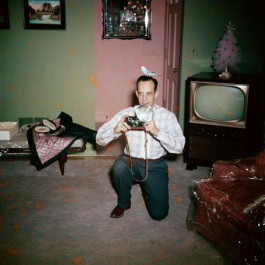
Closing on November 1, is the poignant exhibition No Place Like Home, presented by The Anonymous Project of artist Lee Shulman. Throughout the years, Shulman assembled one of the largest private archives of analogue amateur photography in the world, showcasing it in its immediate resonance with our own personal stories. By presenting images that were never meant for the public, the installation feels like a home, while connecting people from all over the world in a shared, common feeling. In the artist’s words: "What is beautiful about this project is that people feel the images belong to them. That could have been their husband, their wife, their grandparents, their childhood. They claim the photographs as their own. I've shown this project in countries where the culture is completely different — Korea, for instance. And even there, people would come up to me and say: this reminds me of something from my life. I have never once encountered someone who felt like a stranger to these pictures. We all know the moments they contain."
With Social Studies, Lauren Greenfield is addressing another relevant topic of our time: the impact of social media on the lives of young people. Using the personal experiences of three Los Angeles teenagers, the exhibition powerfully investigates the troubling impact of societal expectations and norms on future generations, inviting us to reflect on the role we make them play in our complicated societies.

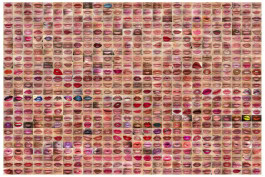


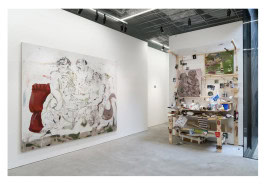
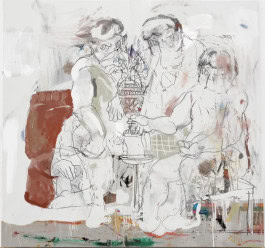
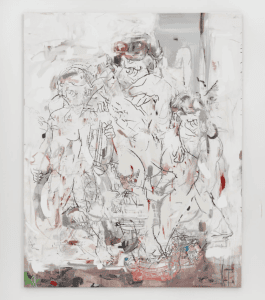
On November 6, DUVE Berlin will open a solo show by Jordan Rubio. Titled I brought you flowers before I knew why, the exhibition lies in the liminal space between feeling and understanding. Rubio’s paintings are populated by a recurring figure, whose repetition gives us a sense of a body being tried rather than portrayed. Meaning appears through proximity: the other components of the paintings – flowers and animals – live in the same liminal space, where we constantly question what we are seeing. Without any direct explanation, the artworks invite us to observe how reality is perpetually shifting, and how it can be altered by our actions and perceptions.
What seemed like some sort of ironic curse actually became a powerful insight into our present. In the face of so many troubling conflicts, social and political disparities, and globally spread polarization, we are shown once again that it is only through solidarity and real proximity that we can make this work. We are all in this together, and art is here to demonstrate it and remind us of it. Don’t miss the chance to visit these inspiring exhibitions, and see where this journey takes you.
Sign up here to subscribe to The Columbist newsletter.
Related Articles:

Sign up here to subscribe to The Columbist newsletter.
Precarity, fake news, political polarization, and social injustice were already relevant themes. A global pandemic and multiple wars throughout the last seven years have certainly proved them to be even more challenging and full of tensions. Art has always had the ability to highlight our issues, while at the same time providing potential solutions. This selection of exhibitions to see in November is here to show us how solidarity, proximity, and community might be the keys to facing them, bridging the distance between us, and acting for a positive change.
For its 30th anniversary, Hamburger Bahnhof has opened a series of impressive exhibitions to dive into our present and try to understand it. On October 9, it was the turn of Next Door, featuring acclaimed artists Tacita Dean, Thomas Demand, Olafur Eliasson, Henrik Håkansson, and Tomás Saraceno. The beauty of the exhibition lies in the connection between past and present. A section of Hamburger Bahnhof, the Rieckhallen, was in fact used in the early 2000s as a complex for artists’ studios. All these incredible artists crossed paths there, working in close proximity to one another. After twenty years, they reunite in the same, yet now transformed, space, bringing together artistic trajectories that have evolved far beyond the walls of their former studios.


Every artwork powerfully shows us the relevant themes of our past, and how they leaked into our present. Henrik Håkansson uses the forced path made by a butterfly inside an artificial environment to reflect on perception and ecology at large. Olafur Eliasson does so using light and sound within a permeating and deeply moving installation. Demand uses his reconstructed environments to discuss pivotal moments of recent history, while subtly highlighting their absurdity. Saraceno presents artworks initiated from his longstanding collaboration with spiders, to address fear as a societal construct and the pressing political issues of our time.
Hamburger Bahnhof is also hosting the first major retrospective of the composer and artist Ryuichi Sakamoto in Europe. Sakamoto was a pioneer of electronic and experimental music, and redefined the boundaries between sound, film, performance, and visual art. Central to his practice was a collaborative approach, developed with multiple creatives of our times. The exhibition presents seven of these works, spanning his career and reflecting on humanity as a whole. From the sound of nature and the rhythm of falling asleep, to the poignant concept of an earthquake playing a piano, seeing sound, hearing time takes us on a journey that will profoundly impact our perception.
Addressing the same relevant topics is also the exhibition Matter of Care, Care of the Matter, which presents sculptures and site-specific installations by the German collective [ materialistin ]. The group of women artists uses sculpture to take a stand on feminist, social, cultural, and political issues, giving us another powerful insight into how collaboration and solidarity are the first steps in order to restructure a society that really belongs to everyone.


Gropius Bau decided to focus its yearly programme on Germany’s recent history. This October, it opened the poignant exhibition Es ist nicht mehr mein Problem, macht eure Scheiße alleine (It’s not my problem anymore, deal with your own shit), celebrating the visionary and deeply political work of Christoph Schlingensief. Through theatre, film, opera and performance Schlingensief was able to highlight the absurdity of our times with an uncanny gaze at our present. Colonialism, racism, right-wing extremism, and the fragility of democratic societies were addressed ahead of time, through an inclusive practice that remains key to contemporary debates.
Acting in chorus with Schlingensief are the two other exhibitions currently on view. Kreuzberg: Art and Migration since 1960 brings together 130 works from the past and the present to explore experiences of migration, exile, the housing crisis, racism, and exclusion, while celebrating stories of empowerment, resistance, solidarity, and community.
Dabei sein und nicht schweigen (Showing up and Not Remaining Silent) brings together the entire career of Gabriele Stötzer. The artist and activist grappled with questions of justice, self-determination, and gender, while examining societal power relationships. Her art and life have always been deeply intertwined: following her experience of imprisonment and political struggle in the GDR, Stötzer started working in a collaborative and pervasive manner, centering her work on solidarity and exchange while addressing the most pressing topics of our time. With her practice, she challenges categorization and demonstrates how art can act as a catalyst for change.


Prater Galerie recently reopened to the public after several years to continue addressing its core values: giving underrepresented voices a space to investigate crucial social and political issues. With Courage: Sisters in Spirit the gallery reverses the historical underrepresentation of women from the GDR era to present a spectrum of artworks created exclusively by women.
Historical and contemporary artworks enter into dialogue to present a nuanced perspective on resistance, memory, and grassroots collective movements. Reflecting on feminism, power structures, exile, repression, and solidarity, the exhibition gives a long-overdue resonating chamber to these topics, highlighting once again the importance of a society where collectivity is made by everyone within it, and which takes the uneasy step to right its past wrongs.


Another choral and relevant exhibition on the most pressing topics of our time is Her Lens: Resilience and Reflection, which opened at Anahita Sadighi Galerie in October. The exhibition, implemented by Candid Foundation, brings together 10 women artists from the MENA region, merging documentary and artistic photography to address a range of human and social realities. The artists explore themes that include conflict, displacement, memory, and resilience, while drawing attention to everyday experiences and intimate moments.
Incredibly poignant is Amira Elnaal’s series, which explores the war-caused blindness of her parents, while reflecting on memory and alternative forms of perception. With her work, Mariam Janini seeks to reconnect with her late mother, using food prepared together with her grandmother as a tool to reclaim what is lost. Amal Moutaouakil travels through a remote landscape, where desert and sea meet, to trace the emotional and physical closeness that binds us together.


With Eyes Wide Open Fotografiska Berlin presents the work of German photographer Thomas Billhardt. Showcasing key series from several decades, the exhibition highlights the variety of his practice, and the vastness of his work as a photojournalist. Billhardt documented Berlin in GDR times, Vietnam, Cuba, and numerous global flashpoints with the same powerful and intimate perspective. As the exhibition manager, Claire Ducresson-Boët, said: “He remained deeply attuned to both geopolitics and the quiet, poetic fragments of everyday life.” Above all, his work centers on a fundamental and deeply relevant question: How do people preserve their humanity when the structures around them threaten to crush it?
Closing on November 1, is the poignant exhibition No Place Like Home, presented by The Anonymous Project of artist Lee Shulman. Throughout the years, Shulman assembled one of the largest private archives of analogue amateur photography in the world, showcasing it in its immediate resonance with our own personal stories. By presenting images that were never meant for the public, the installation feels like a home, while connecting people from all over the world in a shared, common feeling. In the artist’s words: "What is beautiful about this project is that people feel the images belong to them. That could have been their husband, their wife, their grandparents, their childhood. They claim the photographs as their own. I've shown this project in countries where the culture is completely different — Korea, for instance. And even there, people would come up to me and say: this reminds me of something from my life. I have never once encountered someone who felt like a stranger to these pictures. We all know the moments they contain."
With Social Studies, Lauren Greenfield is addressing another relevant topic of our time: the impact of social media on the lives of young people. Using the personal experiences of three Los Angeles teenagers, the exhibition powerfully investigates the troubling impact of societal expectations and norms on future generations, inviting us to reflect on the role we make them play in our complicated societies.


On November 6, DUVE Berlin will open a solo show by Jordan Rubio. Titled I brought you flowers before I knew why, the exhibition lies in the liminal space between feeling and understanding. Rubio’s paintings are populated by a recurring figure, whose repetition gives us a sense of a body being tried rather than portrayed. Meaning appears through proximity: the other components of the paintings – flowers and animals – live in the same liminal space, where we constantly question what we are seeing. Without any direct explanation, the artworks invite us to observe how reality is perpetually shifting, and how it can be altered by our actions and perceptions.
What seemed like some sort of ironic curse actually became a powerful insight into our present. In the face of so many troubling conflicts, social and political disparities, and globally spread polarization, we are shown once again that it is only through solidarity and real proximity that we can make this work. We are all in this together, and art is here to demonstrate it and remind us of it. Don’t miss the chance to visit these inspiring exhibitions, and see where this journey takes you.


Sign up here to subscribe to The Columbist newsletter.
Related Articles:
You need to load content from reCAPTCHA to submit the form. Please note that doing so will share data with third-party providers.
More InformationYou need to load content from Turnstile to submit the form. Please note that doing so will share data with third-party providers.
More InformationYou are currently viewing a placeholder content from Facebook. To access the actual content, click the button below. Please note that doing so will share data with third-party providers.
More InformationYou are currently viewing a placeholder content from Instagram. To access the actual content, click the button below. Please note that doing so will share data with third-party providers.
More InformationYou need to load content from hCaptcha to submit the form. Please note that doing so will share data with third-party providers.
More InformationYou need to load content from reCAPTCHA to submit the form. Please note that doing so will share data with third-party providers.
More InformationYou are currently viewing a placeholder content from Turnstile. To access the actual content, click the button below. Please note that doing so will share data with third-party providers.
More InformationYou are currently viewing a placeholder content from X. To access the actual content, click the button below. Please note that doing so will share data with third-party providers.
More Information