
As always, art is here to help, and this selection of exhibitions to see in Berlin this April wants to explore all the various facets – including the unexpected positive ones – that tension can have.
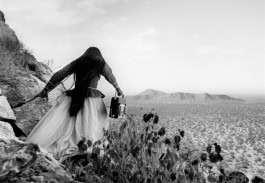
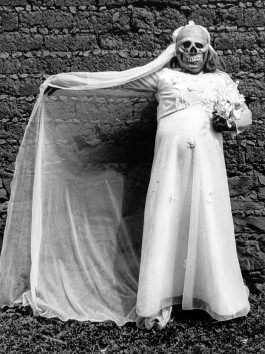
Few photographers have been able to capture tension as poetically and poignantly as Graciela Iturbide. Eyes to Fly With at C/O Berlin marks the first retrospective of the Mexican artist in the city and its title comes from a powerful self-portrait that sums up most of her practice. She depicts herself with two birds in front of her eyes – one is dead, the other alive – summarizing her remarkable and unique ability to explore herself and the world, while addressing humanity’s fundamental questions. The exhibition showcases many different series, examining the role of women, the pain of loss, the rituals and icons we use both to deflect and find answers about ourselves and the world we live in.
The precarious balance between life and death is an extremely important theme to the photographer, who is able to show us its facets through the lives of the various communities she encountered, both in South America and around the world. The tension is palpable, yet her connection with the people and the living beings she photographs is so deep it reaches us immediately.
"Everywhere there are signs of calls to higher powers. I raise my ear to the sky and hope to hear a response. And I do. It is flocks of wings that fill my body and continue to guide me. I have learned to listen to the beaks that open and close as they do now. Birds speak to me from within the pit of myself as much as they do when I photograph them. I know to trust this song.”


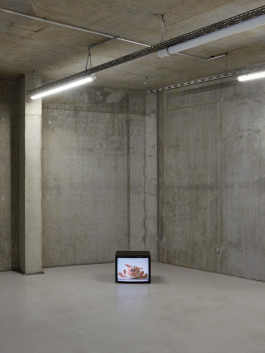
Investigating mankind with a similar curiosity but in a completely different way is the exhibition Archipelago by Dörte Eißfeldt. The artist explores the world around her through fragments, using a wide range of photographic materials and techniques to question our basic conception of reality. Nothing is what it seems, highlighting how life transforms itself constantly, changing us and our perception with it.
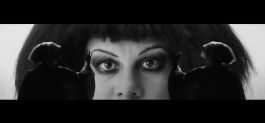
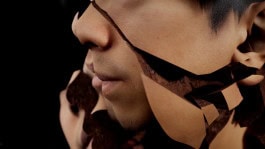
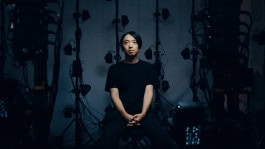
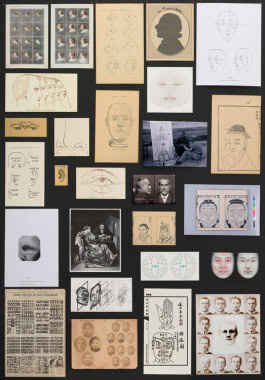
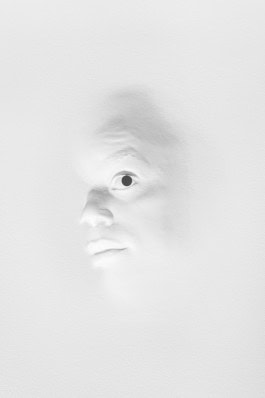
Also currently on view is the exhibition (Inter)faces of Predictions by Sheung Yiu, winner of the C/O Berlin Talent Award 2025. The installation traces how faces have always been used as a tool, connecting old Asian practices and Western theories of physiognomy to contemporary facial recognition technologies. With this unsettling analysis, the artist draws our attention to an urgent matter that involves us all, portraying this rising tension through different media.
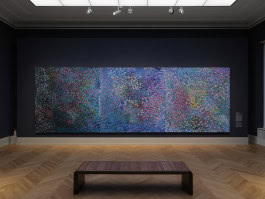
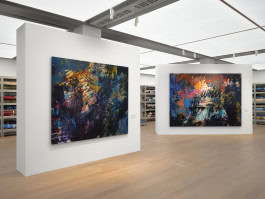
Just a quick S-Bahn ride out of Berlin, in Potsdam, DAS MINSK has opened a stunning new exhibition, Collective Osmosis by Oscar Murrillo. Taking as a starting point the stratified connection between the Colombian-born artist and the work of Impressionist artist Claude Monet, the show is a powerful meditation on themes like visibility, connection, community and landscape.
The underlying thread starts with Monet’s biography, from which we learn that the artist suffered from cataracts later on in his life. Beginning with this input and with the realization of the artist being a vessel – as he is globally recognized by nearly anyone – the exhibition takes shape. The physical shift of perception in Monet’s sight becomes for Murillo an allegory for the blind spots of contemporary society and the chance to explore the tension between seen and unseen, in order to create a new social dimension.
Murillo’s practice gives space to the negatives as well, pairing them with the positives: the focus shifts back to the tool, not only to its result. His work also shows us how important interaction is, and how some things can be so similar and yet so different. The touching series titled Frequencies for example reconnects children from all over the world through a simple yet impactful medium: canvas affixed to their school desks that they are free to write and draw on. The artist then collects them, and the result is a tender and constantly growing installation.
DAS MINSK organized the exhibition in collaboration with the nearby Museum Barberini, which hosts a vast collection of Impressionist artists. The paintings by Monet, alternating and dialoguing with Murillo’s artworks at DAS MINSK, belong to the same collection, the Hasso Plattner Foundation. Furthermore, a new tryptic by Murillo, titled surge (social cataracts) is on view inside Museum Barberini, developing the dialogue between the two artists in another powerful way, and reconnecting once again the past to the present.
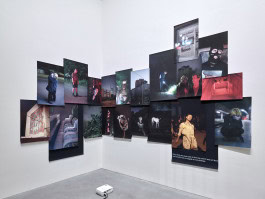
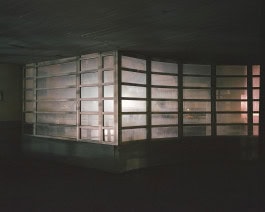
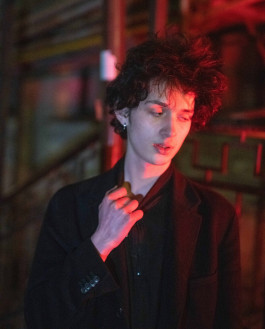
Exploring the tension created by conflicts and the consequences of closed borders, while simultaneously addressing the concept of seeing without actually being able to see, is the exhibition How To Make A Fire Without Smoke? by Tobias Zielony at KOW. In their beautiful new location, just across the street from the previous one, Zielony presents three different series investigating it. The video work giving the exhibition its title is a poignant insight into the lives of people who experience the impact of enforced borders first-hand, reflecting on one of the terrible conflicts of our time: the Russian invasion of Ukraine and its effects on the surrounding countries. The project is in fact based on conversations with various refugees who fled Belarus to live in exile in Lithuania, and the title itself references ways to recognize a spy. The video was also physically shot in extremely low light conditions, creating a pervasive and tense environment for us to understand and empathize with their difficult reality.
With the beautiful piece Electricity / Afterimages, Zielony addresses the same topic, but from the perspective of the people living in Moldova, who were also affected by it through the rise of energy prices and frequent blackouts. Their story is told across a beautiful photographic installation, where the portraits and conversations of young Moldovans tell us of this struggle, showing us the heartbreaking tension that arises when people are forced to live in a terrible new reality, while clinging to a sense of normalcy. The tension is poignant, making us realize how things can often change in the blink of an eye.
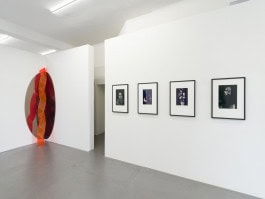
Giving resonance to the people of Iran – another country which is unfortunately currently living through war and terrible circumstances – while powerfully keeping space for hope, is the exhibition Let Us Believe in the Dawn of Spring at Anahita Sadighi. The title refers to the Persian New Year Norouz as a starting point, and pays homage to the celebrated Iranian poet and filmmaker Forough Farrokhzad.
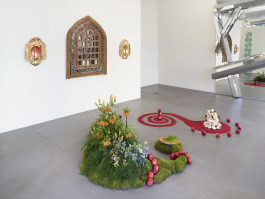
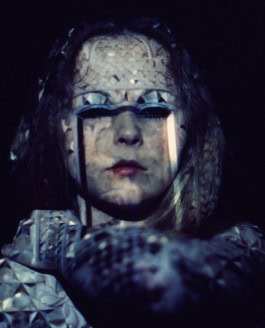
The various artworks travel through time and space, engaging with cultural memory, rituals, and perception. On one wall, we see a beautiful historical Persian window, interacting with a sculptural glass piece by contemporary artist Dieter Detzner and a spatial composition by floral artist Gaja Vicic. Particularly stunning is the series by Hamid S. Neriz, that combines portraiture with suggestive light projections. The pictures almost cross into the realm of performance, and, as the other artworks present in the exhibition, they deliver a message of understanding and empathy, delving into the past and the present, while rooting for better times to come.
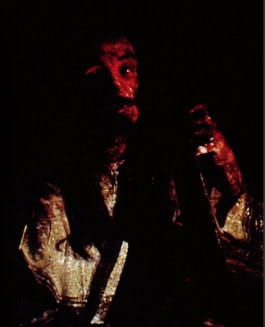
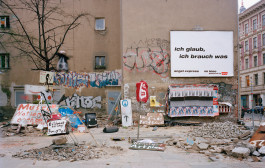
n.b.k. and Künstlerhaus Bethanien joined forces to present the artworks created by the recipients of the Berlin Senate’s 2025 Visual Arts Work Stipend. The artworks, presented at both locations, reflect on the contradictions that lie in our experience of reality. Reunited under the title Memory is a Strange Bell, borrowed from a letter written by American poet Emily Dickinson, the exhibitions are an exploration of memory as an ambivalent and dynamic space, where good and bad cohabit.
Particularly poignant on this matter is the installation at n.b.k. by Markus Draper, dedicated to the Glass House created by the renowned architect Philip Johnson. The building is analyzed through various points of view: from its correlation to the beginning of postwar American modernism to its darkest reflections. The architect, who was in fact linked to Fascism and witnessed WWII in Europe as a war correspondent, cited the ruins of a burning city as the source of inspiration for the house he designed. The terrible reference thus becomes a way to reflect on society’s ambivalence and on the tension it creates.
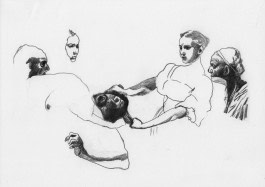
At Künstlerhaus Bethanien are exhibited eight other recipients. Particularly charming is the installation by Sergio Zavallos, who reasons on authoritarian power and rationalized violence through the historical reference of Judith and Holofernes. His beheading is reiterated in the drawing series and reconfigured in various different ways, unfolding Judith’s role in creating an active change.
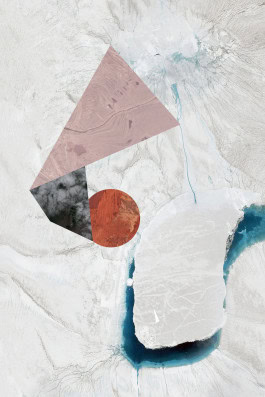
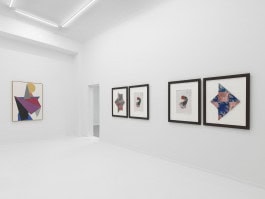
Summarizing the growing tension we are living in, starting from its title, is the exhibition by Katja Strunz, Future Collapses, Past Rises, presented at n.b.k. Showroom. The show features origami-like collages created with satellite images of the Earth, revealing the transformation of its surface while reasoning on movement. “I pursue the intention of setting a process in motion that can develop, unfold and fold up again in all directions. The dynamics arise from the tension between the limits I set and the open possibilities for changes of direction within them.”
Working with collages, but also with sculpture, Strunz tries to understand this tension through theoretical physics – where folding becomes a route to free movement for systems limited in a contained space – but also through philosophical theories like the one by Aleida Assmann. Investigating a new “pathology of time consciousness” the author believes that past trauma can help overcome future polarization, if properly used. The title itself is not meant as a negative reference, but as a way to let go of possible grim outcomes, to delve deeper into our past and use it to affect our present.
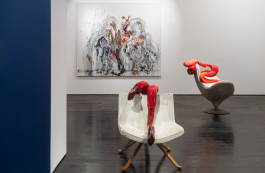
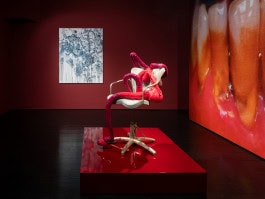
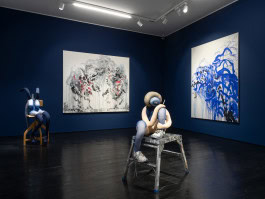
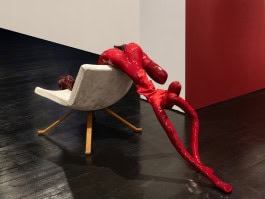
Creating a beautiful conversation on another long-standing tension, the interplay between sex and death, is the exhibition OOO LA LA at Contemporary Fine Arts (CFA). The show brings together two iconic British artists, Sarah Lucas and Maggi Hambling. The artists have similar yet complementary practices, but what adds to the pathos of it all is their long-time friendship.
The exhibition creates a seamless intersection of their works, which are able to dialogue and energize each other. In their own words: “The extraordinary thing is that when you’re in the show, it’s as if we were working at opposite ends of the same studio.” The provocative sculptures that Lucas is known for crawl towards Hambling’s sensual paintings, waltzing us amidst this friction, where love and death perfectly collide.
The political tension surrounding us is certainly pervasive and unsettling, and its consequences are still to be fully understood and processed. Yet, there is also a positive tension that sometimes lies in humanity – the one that urges us to love and fight for what we believe in, that makes us take a stand and address the injustices we are witnessing. These exhibitions are here to prove us that, and to remind us there is always room for balance and understanding. Don’t miss the chance to see these compelling exhibitions, and see where this journey takes you.
Related Articles:

As always, art is here to help, and this selection of exhibitions to see in Berlin this April wants to explore all the various facets – including the unexpected positive ones – that tension can have.
Few photographers have been able to capture tension as poetically and poignantly as Graciela Iturbide. Eyes to Fly With at C/O Berlin marks the first retrospective of the Mexican artist in the city and its title comes from a powerful self-portrait that sums up most of her practice. She depicts herself with two birds in front of her eyes – one is dead, the other alive – summarizing her remarkable and unique ability to explore herself and the world, while addressing humanity’s fundamental questions. The exhibition showcases many different series, examining the role of women, the pain of loss, the rituals and icons we use both to deflect and find answers about ourselves and the world we live in.
The precarious balance between life and death is an extremely important theme to the photographer, who is able to show us its facets through the lives of the various communities she encountered, both in South America and around the world. The tension is palpable, yet her connection with the people and the living beings she photographs is so deep it reaches us immediately.
"Everywhere there are signs of calls to higher powers. I raise my ear to the sky and hope to hear a response. And I do. It is flocks of wings that fill my body and continue to guide me. I have learned to listen to the beaks that open and close as they do now. Birds speak to me from within the pit of myself as much as they do when I photograph them. I know to trust this song.”


Investigating mankind with a similar curiosity but in a completely different way is the exhibition Archipelago by Dörte Eißfeldt. The artist explores the world around her through fragments, using a wide range of photographic materials and techniques to question our basic conception of reality. Nothing is what it seems, highlighting how life transforms itself constantly, changing us and our perception with it.
Also currently on view is the exhibition (Inter)faces of Predictions by Sheung Yiu, winner of the C/O Berlin Talent Award 2025. The installation traces how faces have always been used as a tool, connecting old Asian practices and Western theories of physiognomy to contemporary facial recognition technologies. With this unsettling analysis, the artist draws our attention to an urgent matter that involves us all, portraying this rising tension through different media.


Just a quick S-Bahn ride out of Berlin, in Potsdam, DAS MINSK has opened a stunning new exhibition, Collective Osmosis by Oscar Murrillo. Taking as a starting point the stratified connection between the Colombian-born artist and the work of Impressionist artist Claude Monet, the show is a powerful meditation on themes like visibility, connection, community and landscape.
The underlying thread starts with Monet’s biography, from which we learn that the artist suffered from cataracts later on in his life. Beginning with this input and with the realization of the artist being a vessel – as he is globally recognized by nearly anyone – the exhibition takes shape. The physical shift of perception in Monet’s sight becomes for Murillo an allegory for the blind spots of contemporary society and the chance to explore the tension between seen and unseen, in order to create a new social dimension.
Murillo’s practice gives space to the negatives as well, pairing them with the positives: the focus shifts back to the tool, not only to its result. His work also shows us how important interaction is, and how some things can be so similar and yet so different. The touching series titled Frequencies for example reconnects children from all over the world through a simple yet impactful medium: canvas affixed to their school desks that they are free to write and draw on. The artist then collects them, and the result is a tender and constantly growing installation.
DAS MINSK organized the exhibition in collaboration with the nearby Museum Barberini, which hosts a vast collection of Impressionist artists. The paintings by Monet, alternating and dialoguing with Murillo’s artworks at DAS MINSK, belong to the same collection, the Hasso Plattner Foundation. Furthermore, a new tryptic by Murillo, titled surge (social cataracts) is on view inside Museum Barberini, developing the dialogue between the two artists in another powerful way, and reconnecting once again the past to the present.


Exploring the tension created by conflicts and the consequences of closed borders, while simultaneously addressing the concept of seeing without actually being able to see, is the exhibition How To Make A Fire Without Smoke? by Tobias Zielony at KOW. In their beautiful new location, just across the street from the previous one, Zielony presents three different series investigating it. The video work giving the exhibition its title is a poignant insight into the lives of people who experience the impact of enforced borders first-hand, reflecting on one of the terrible conflicts of our time: the Russian invasion of Ukraine and its effects on the surrounding countries. The project is in fact based on conversations with various refugees who fled Belarus to live in exile in Lithuania, and the title itself references ways to recognize a spy. The video was also physically shot in extremely low light conditions, creating a pervasive and tense environment for us to understand and empathize with their difficult reality.
With the beautiful piece Electricity / Afterimages, Zielony addresses the same topic, but from the perspective of the people living in Moldova, who were also affected by it through the rise of energy prices and frequent blackouts. Their story is told across a beautiful photographic installation, where the portraits and conversations of young Moldovans tell us of this struggle, showing us the heartbreaking tension that arises when people are forced to live in a terrible new reality, while clinging to a sense of normalcy. The tension is poignant, making us realize how things can often change in the blink of an eye.


Giving resonance to the people of Iran – another country which is unfortunately currently living through war and terrible circumstances – while powerfully keeping space for hope, is the exhibition Let Us Believe in the Dawn of Spring at Anahita Sadighi. The title refers to the Persian New Year Norouz as a starting point, and pays homage to the celebrated Iranian poet and filmmaker Forough Farrokhzad.
The various artworks travel through time and space, engaging with cultural memory, rituals, and perception. On one wall, we see a beautiful historical Persian window, interacting with a sculptural glass piece by contemporary artist Dieter Detzner and a spatial composition by floral artist Gaja Vicic. Particularly stunning is the series by Hamid S. Neriz, that combines portraiture with suggestive light projections. The pictures almost cross into the realm of performance, and, as the other artworks present in the exhibition, they deliver a message of understanding and empathy, delving into the past and the present, while rooting for better times to come.


n.b.k. and Künstlerhaus Bethanien joined forces to present the artworks created by the recipients of the Berlin Senate’s 2025 Visual Arts Work Stipend. The artworks, presented at both locations, reflect on the contradictions that lie in our experience of reality. Reunited under the title Memory is a Strange Bell, borrowed from a letter written by American poet Emily Dickinson, the exhibitions are an exploration of memory as an ambivalent and dynamic space, where good and bad cohabit.
Particularly poignant on this matter is the installation at n.b.k. by Markus Draper, dedicated to the Glass House created by the renowned architect Philip Johnson. The building is analyzed through various points of view: from its correlation to the beginning of postwar American modernism to its darkest reflections. The architect, who was in fact linked to Fascism and witnessed WWII in Europe as a war correspondent, cited the ruins of a burning city as the source of inspiration for the house he designed. The terrible reference thus becomes a way to reflect on society’s ambivalence and on the tension it creates.
At Künstlerhaus Bethanien are exhibited eight other recipients. Particularly charming is the installation by Sergio Zavallos, who reasons on authoritarian power and rationalized violence through the historical reference of Judith and Holofernes. His beheading is reiterated in the drawing series and reconfigured in various different ways, unfolding Judith’s role in creating an active change.


Summarizing the growing tension we are living in, starting from its title, is the exhibition by Katja Strunz, Future Collapses, Past Rises, presented at n.b.k. Showroom. The show features origami-like collages created with satellite images of the Earth, revealing the transformation of its surface while reasoning on movement. “I pursue the intention of setting a process in motion that can develop, unfold and fold up again in all directions. The dynamics arise from the tension between the limits I set and the open possibilities for changes of direction within them.”
Working with collages, but also with sculpture, Strunz tries to understand this tension through theoretical physics – where folding becomes a route to free movement for systems limited in a contained space – but also through philosophical theories like the one by Aleida Assmann. Investigating a new “pathology of time consciousness” the author believes that past trauma can help overcome future polarization, if properly used. The title itself is not meant as a negative reference, but as a way to let go of possible grim outcomes, to delve deeper into our past and use it to affect our present.


Creating a beautiful conversation on another long-standing tension, the interplay between sex and death, is the exhibition OOO LA LA at Contemporary Fine Arts (CFA). The show brings together two iconic British artists, Sarah Lucas and Maggi Hambling. The artists have similar yet complementary practices, but what adds to the pathos of it all is their long-time friendship.
The exhibition creates a seamless intersection of their works, which are able to dialogue and energize each other. In their own words: “The extraordinary thing is that when you’re in the show, it’s as if we were working at opposite ends of the same studio.” The provocative sculptures that Lucas is known for crawl towards Hambling’s sensual paintings, waltzing us amidst this friction, where love and death perfectly collide.


The political tension surrounding us is certainly pervasive and unsettling, and its consequences are still to be fully understood and processed. Yet, there is also a positive tension that sometimes lies in humanity – the one that urges us to love and fight for what we believe in, that makes us take a stand and address the injustices we are witnessing. These exhibitions are here to prove us that, and to remind us there is always room for balance and understanding. Don’t miss the chance to see these compelling exhibitions, and see where this journey takes you.
Related Articles:
You need to load content from reCAPTCHA to submit the form. Please note that doing so will share data with third-party providers.
More InformationYou need to load content from Turnstile to submit the form. Please note that doing so will share data with third-party providers.
More InformationYou are currently viewing a placeholder content from Facebook. To access the actual content, click the button below. Please note that doing so will share data with third-party providers.
More InformationYou are currently viewing a placeholder content from Instagram. To access the actual content, click the button below. Please note that doing so will share data with third-party providers.
More InformationYou need to load content from hCaptcha to submit the form. Please note that doing so will share data with third-party providers.
More InformationYou need to load content from reCAPTCHA to submit the form. Please note that doing so will share data with third-party providers.
More InformationYou are currently viewing a placeholder content from Turnstile. To access the actual content, click the button below. Please note that doing so will share data with third-party providers.
More InformationYou are currently viewing a placeholder content from X. To access the actual content, click the button below. Please note that doing so will share data with third-party providers.
More Information