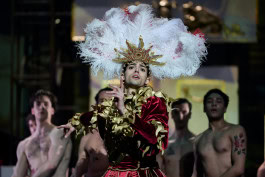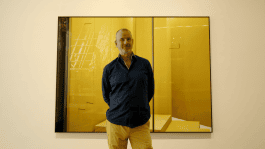


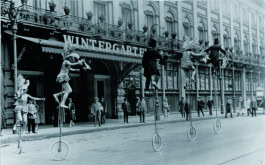
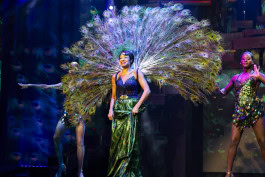
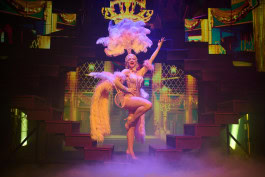
The word itself comes from the French variété, meaning variety and describes a unique form of live entertainment where seemingly unrelated worlds meet on one stage. Acrobatics, music, comedy, dance, illusion, fashion and theatre coexist in one evening, united by one simple promise: surprise.
Few places embody that spirit more than Wintergarten. Its story began in 1888 inside Berlin's magnificent Central Hotel on Friedrichstraße. Within only a few years, Wintergarten had become one of Europe's most celebrated variety theatres and one of almost eighty Varietés that once shaped Berlin's nightlife.
History was written here more than once. In 1895, brothers Max and Emil Skladanowsky presented Germany's first public commercial film screening inside Wintergarten, turning the theatre into one of the birthplaces of cinema. A few decades later, Josephine Baker would electrify its stage, becoming one of the unforgettable symbols of Berlin's Golden Twenties.

Then came war. In 1944, after fifty-six years of performances, the theatre was destroyed during an air raid. For decades, only the legend remained. Until 1992.
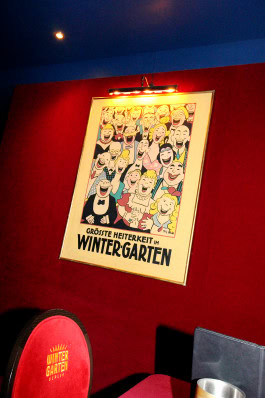
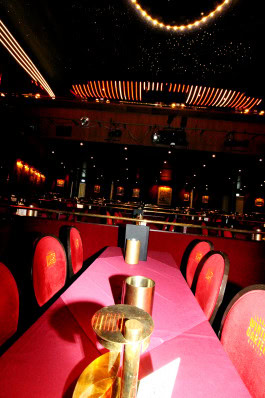
A new Wintergarten opened on Potsdamer Straße, not as a reconstruction, but as a tribute to its historic predecessor. Beneath its famous starry ceiling, surrounded by velvet, brass and candlelight, Berlin rediscovered one of its greatest cultural institutions.
Today, after more than 120 original productions, Wintergarten continues to reinvent itself. Every year, two new productions transform the stage with international artists, fresh ideas and entirely new worlds. Following the curtain call of AHOI – Swing, Dinner & Acrobatics, all eyes are now on the theatre's next september premiere Disco, where yet another chapter of Berlin's most iconic Varieté will begin.
Yet perhaps the most fascinating story inside Wintergarten today isn't the theatre itself. It's the person imagining what comes next.
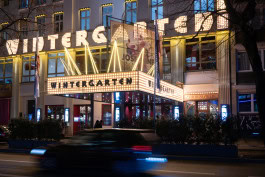

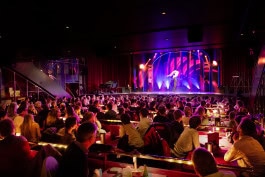
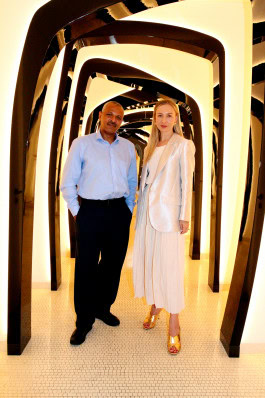
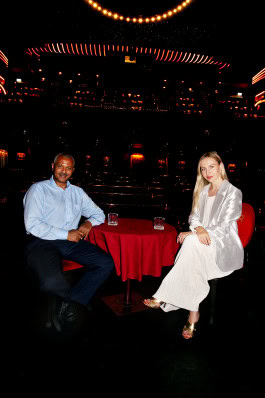
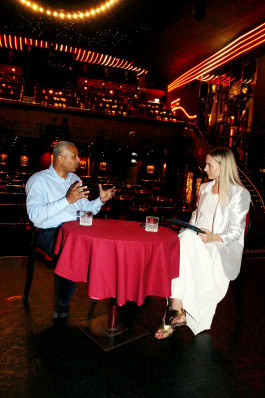
We meet at midday, sitting together on the main stage of Wintergarten. The Saal below us is empty, but up here the atmosphere is still overwhelming- a full 360-degree dive into history and fantasy. Brass catches the light, red velvet softens every corner, and above us stretches the famous ceiling filled with hundreds of tiny stars. It doesn't feel like sitting on an empty stage. It feels like stepping into another world.
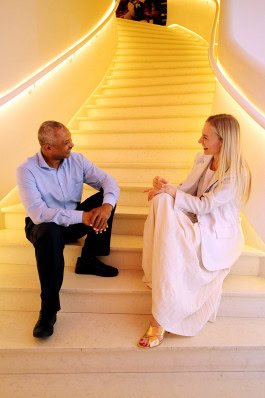
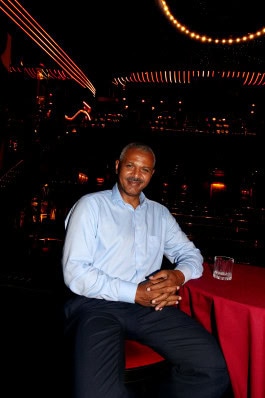
Rodrigue Funke arrives smiling. Warm, energetic and immediately curious, he begins talking - not about himself, but about the artists. Within minutes one thing becomes obvious. Wintergarten isn't simply where he works. It's where he lives.
Sitting there with him, I suddenly remembered one of my favourite childhood books: Pinocchio. Not because he reminded me of the intimidating theatre director, but because he reminded me of Geppetto — the creator. Someone who builds worlds rather than rules them. Someone who believes in potential, patiently shaping talent until it comes alive.
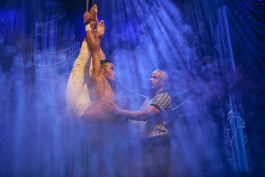
Watching him speak about artists is perhaps the easiest way to understand who he is. He rarely talks about productions. He talks about people. About discovering a young contortionist from Angola through Instagram and helping him build an international career. About bringing together artists from Ukraine, Ethiopia, China and Latin America — not as representatives of different countries, but as one family. About giving young performers opportunities they might never have imagined.
Today, as Artistic and Managing Director, Rodrigue Funke isn't trying to reinvent Wintergarten. He's making sure every new generation falls in love with it for the very first time.
— Wintergarten is much more than a theatre — it is part of Berlin's cultural identity. How would you explain its importance to someone visiting Berlin for the first time?
— Berlin has always been a city of culture, and Wintergarten still carries the unmistakable spirit of the Roaring Twenties, rooted deeply in its own history. The shows we create are always a dialogue between past and present — we draw inspiration from the glamour of the 1920s while interpreting it for a contemporary audience. For anyone visiting Berlin, spending an evening here is almost like taking a journey back in time. It's not only about the performances; it's about the entire experience.
— Wintergarten has witnessed empires, the Golden Twenties, war, division and reunification. Looking back at its remarkable history, what do you think has always remained at its heart?
— Without question, the artists. Variety theatre embraces many different art forms — dance, music, fashion and reflections of the times we live in but at its heart, both a hundred years ago and today, have always been the acrobats and performers. As Artistic Director, my priority is to bring together the very best international talent, and for me, their extraordinary quality is, and always will be, the true heart of Wintergarten.
— Wintergarten carries almost 140 years of history. Every generation leaves its mark on this theatre. What responsibility do you feel as the person leading it today?
— My greatest responsibility is to carry Wintergarten into the next generation. I stood on this stage for the first time when I was fifteen, and I still remember how deeply moved I was — how completely enchanted. My goal is to create that same feeling for today's young audiences, and to hand this theatre over with the same magic, brilliance and beauty I experienced myself.
— Why does live variety still matter in a world filled with unlimited digital entertainment?
— I believe that the more digital our world becomes, the more valuable analogue experiences become. Watching a real person achieve something extraordinary, right in front of you, in that exact moment, is something truly magical. In one recent performance, a nineteen-year-old artist balanced on a four-millimetre wire with one arm while spinning hoops with the other. Moments like that transcend language and culture — everyone shares the same sense of wonder. No matter how digital our world becomes, that kind of genuine human magic will only become more valuable.
— You grew up in East Berlin. What kind of child were you?
— (Laughs.) Today they'd probably have a diagnosis for it and prescribe me Ritalin. I was incredibly hyperactive, always had to move. I began acrobatics at seven because I simply couldn't sit still, and my mother was looking for something that would channel all that energy. I grew up in Prenzlauer Berg, and at seven I was already taking the U-Bahn by myself, with the key to our apartment hanging around my neck. The city was much greyer back then, but places like the Palast der Republik and Friedrichstadt-Palast fascinated me from a very young age.
— What did acrobatics teach you about life?
— Hard work. Perseverance. The beautiful thing about acrobatics is that there are no shortcuts — if you want to master a one-arm handstand, there's only one way to get there: you train for years. You simply cannot cheat the process. Through consistency, discipline and determination, your body eventually becomes capable of things you never believed it could do. That's a beautiful lesson not only for acrobatics, but for life itself.
— Looking back, what experiences shaped you the most as a person?
— Growing up as a Black child in East Berlin had a profound influence on me. My mother always told my sister and me that we would inevitably stand out, so we had to stand out for the right reasons - we had to prove ourselves through quality. I learned early on that if people were going to notice me, I wanted to give them something positive to notice. That mindset became a huge driving force throughout my life.
— Outside the theatre, what inspires you?
— Everything. Nature. Music. Concerts. Children. People. Whenever I begin developing a new production, I spend a lot of time simply observing, taking public transport across Berlin, walking through different neighbourhoods. Berlin itself is a constant source of inspiration, and the city's club culture has shaped the way I think about atmosphere, rhythm and emotion. When I direct a show, it's always a collection of everything I've experienced.
— What still excites you after so many years in theatre?
— Watching artists shine. Seeing performers give everything they have on stage, and then witnessing the audience respond with genuine wonder — that magic created between artist and audience, existing only in that single evening — never gets old for me. It's still one of the most beautiful things I know.
— How does a new Wintergarten production begin?
— Every production begins with a simple question: what excites me, what story do I want to tell, and what will resonate with our audience. For our current show, Ahoi, I wanted to bring back a full live orchestra- fifteen musicians, completely unplugged. Our next production will be Disco, where joy and celebration take centre stage, followed by Fashion, taking audiences through different decades of style. I become completely immersed in an idea until it almost starts developing on its own, sometimes it feels as if Wintergarten itself is telling me what belongs on its stage next.
— Wintergarten works with artists from all over the world. How do you discover new talent?
— There isn't one single way. One of our contortionists, Gildo, first appeared on my Instagram feed when he was fifteen, living in Angola. I followed his progress for years, eventually helped bring him to Wintergarten legally, and today he performs in Paris, Budapest and other international venues. We also attend festivals, watch talent shows like America's Got Talent, and increasingly collaborate with Berlin's own circus and performance scene.
— Beyond technical excellence, what do you look for in an artist?
— Personality. Without question, it's the most important quality- it's what separates an acrobat from an athlete. An athlete performs a skill; an artist uses that skill to make you feel something. At Wintergarten we have only 366 seats, so our audience sits incredibly close to the performers. That closeness means the audience doesn't just watch the artists — they connect with them.
— Can charisma be taught?
— I don't think charisma can be taught, but I do think people can be encouraged to reveal it. I actually believe everyone has charisma, the real question is whether you're willing to lower your own walls and let the audience see who you really are. That takes courage. Because we perform the same production around 140 times, if a performer isn't prepared to be genuinely present every single evening, the show quickly becomes routine. That's exactly what I never want audiences to experience here.
— Do you think Berlin is still a city where artists feel free to experiment?
— If not Berlin, then where? For me, Berlin is still the most exciting city in the world, nowhere else reinvents itself quite like it. As a director, I love discovering artists who surprise even me. When I meet someone with unexpected talents, my first question is always: ‘What else can you do?’ Whatever the answer is, I want to include it in the show. Artists are never one-dimensional, they always have something unexpected to offer.
— Who comes to Wintergarten today, and how has the audience changed?
— Everyone is welcome, but one of my personal goals is to broaden and rejuvenate our audience. For many years Wintergarten had a reputation as a place primarily for West Berliners over sixty,that's changing. We're modernising our productions, expanding on social media and opening the doors to a much more diverse and international audience. Our shows are also becoming less language-dependent; you don't need to speak German to enjoy them. The challenge now is less about changing the theatre than changing its image, once people come inside, they almost always leave saying, ‘I had no idea it was like this.’
— How do you inspire younger generations to discover variety theatre?
— We already have children's productions, and we're thinking about formats specifically for teenagers. We've kept a €35 campus ticket for students, and we host the annual graduation performance of Berlin's State School of Acrobatics, giving young artists a stage before their professional careers begin. Ultimately, though, I believe the show itself has to do the work, if we can persuade someone to visit Wintergarten once, the performance should be so exciting that they leave wanting to come back.
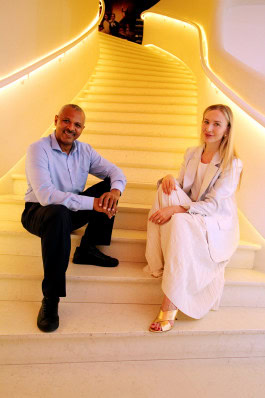
— Artificial intelligence is transforming almost every creative industry. What can AI never replace?
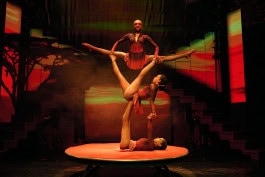
— Human skill. Watching someone throw nine clubs into the air and catch every one, or balance their entire body on one hand, those moments have a magic that no machine can recreate. Comedy is a perfect example too: a comedian reacts to the audience in front of them, and that timing changes every night. Artificial intelligence might analyse those patterns, but it can never truly recreate the chemistry between a performer and a live audience.
— As Artistic and Managing Director, what vision are you bringing to Wintergarten?
— I want Wintergarten to become even more artistically relevant. For me, acrobatics has always been a metaphor for human potential, when I watch someone balancing their entire body on the palm of one hand, it seems almost impossible, and yet every evening I see someone do exactly that. I also want to welcome a much broader and more diverse audience, and give young artists real opportunities, some build entire careers from what began on this stage.
— What kind of theatre do you hope Wintergarten will become over the next ten years?
— I want Wintergarten to be a theatre that is full of life — well attended, innovative and known for setting trends rather than following them. I want us to continue presenting the very best acrobats and variety artists in the world, while helping young performers become the next generation of great artists. Supporting emerging talent from Berlin is incredibly important to me — this city is overflowing with creativity, and I want Wintergarten to become an even more open platform for it.
— When people write the next chapter of Wintergarten's history fifty years from now, what do you hope they'll say about your chapter?
— I hope they'll say that audiences experienced unforgettable evenings here — productions unlike anything they'd seen before. But it's just as important to me that the artists who performed here look back and say, ‘That was one of the happiest contracts of my career.’ If people remember my time here as the period when Wintergarten successfully entered a new era while remaining true to its soul, I'd be very happy.
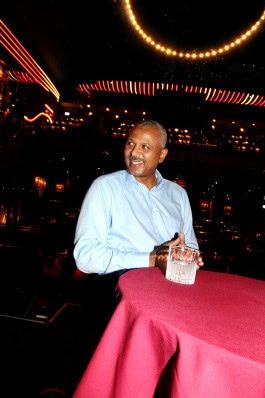
Berlin in one word? Extraordinary.
One place in Berlin that inspires you? Anywhere people come together. Maybe the Hauptbahnhof. Maybe simply the streets. I love watching people. Whenever I see the incredible diversity of Berlin, I think: ‘These are the people I'm creating the next show for.’ That's incredibly inspiring.
One performance everyone should see at least once? Victoria Zubar's hand-balancing act. For me, it has everything — technical brilliance, elegance, personality and genuine emotion. Whether you're interested in variety theatre or not, it captivates everyone.
Morning or night? Night.
Coffee or wine? Coffee.
What's the biggest misconception about variety theatre? That it's dusty and boring.
If Wintergarten were a person, how would you describe it? Open-minded. Tolerant. Warm. Surprising.
What still gives you goosebumps before a premiere? Oddly enough, not before it begins — the goosebumps come during the finale. There's always a moment when you suddenly realise: ‘It's working.’ Only once I feel the audience and the artists breathing together does the emotion finally arrive.
Finally, what would make you say: ‘I've done my job well’? Nothing. That's simply not who I am. I'm a worker. For me, the job is never finished.
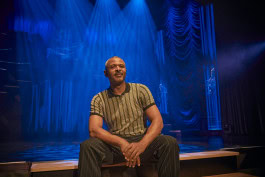
Walking back through the empty theatre after our conversation, one thought stayed with me. What is Rodrigue's secret?
Perhaps it's that, deep down, he is still that restless little boy he describes so vividly when talking about his childhood in East Berlin. The boy who couldn't sit still. The boy whose endless curiosity eventually became acrobatics, then directing, and today carries the responsibility of one of Berlin's greatest cultural institutions. Only now, with decades of experience behind him, that same curious child seems to orchestrate every tiny moving part of Wintergarten. Every artist. Every performance. Every new idea. Every dream waiting to become reality. Perhaps that is exactly why the theatre feels so alive.
Because behind all the history and perfectly choreographed productions stands someone who still approaches every new show with the excitement of discovering something for the very first time. And almost without noticing it, you leave wanting to return. Not simply to watch another variety show, but to discover what Rodrigue Funke will imagine next. To see which new stories, artists and ideas will quietly find their place within a theatre that has carried Berlin's cultural memory for almost 140 years.
The story of Wintergarten is one of loss, revival and reinvention.
Under Rodrigue Funke's direction, it doesn't feel like a museum preserving the past. It feels like a living stage, proudly carrying its history into the future - with curiosity, courage and a quiet sense of joy.
Related Articles:

The word itself comes from the French variété, meaning variety and describes a unique form of live entertainment where seemingly unrelated worlds meet on one stage. Acrobatics, music, comedy, dance, illusion, fashion and theatre coexist in one evening, united by one simple promise: surprise.
Few places embody that spirit more than Wintergarten. Its story began in 1888 inside Berlin's magnificent Central Hotel on Friedrichstraße. Within only a few years, Wintergarten had become one of Europe's most celebrated variety theatres and one of almost eighty Varietés that once shaped Berlin's nightlife.
History was written here more than once. In 1895, brothers Max and Emil Skladanowsky presented Germany's first public commercial film screening inside Wintergarten, turning the theatre into one of the birthplaces of cinema. A few decades later, Josephine Baker would electrify its stage, becoming one of the unforgettable symbols of Berlin's Golden Twenties.

Then came war. In 1944, after fifty-six years of performances, the theatre was destroyed during an air raid. For decades, only the legend remained. Until 1992.
A new Wintergarten opened on Potsdamer Straße, not as a reconstruction, but as a tribute to its historic predecessor. Beneath its famous starry ceiling, surrounded by velvet, brass and candlelight, Berlin rediscovered one of its greatest cultural institutions.
Today, after more than 120 original productions, Wintergarten continues to reinvent itself. Every year, two new productions transform the stage with international artists, fresh ideas and entirely new worlds. Following the curtain call of AHOI – Swing, Dinner & Acrobatics, all eyes are now on the theatre's next september premiere Disco, where yet another chapter of Berlin's most iconic Varieté will begin.
Yet perhaps the most fascinating story inside Wintergarten today isn't the theatre itself. It's the person imagining what comes next.


We meet at midday, sitting together on the main stage of Wintergarten. The Saal below us is empty, but up here the atmosphere is still overwhelming- a full 360-degree dive into history and fantasy. Brass catches the light, red velvet softens every corner, and above us stretches the famous ceiling filled with hundreds of tiny stars. It doesn't feel like sitting on an empty stage. It feels like stepping into another world.
Rodrigue Funke arrives smiling. Warm, energetic and immediately curious, he begins talking - not about himself, but about the artists. Within minutes one thing becomes obvious. Wintergarten isn't simply where he works. It's where he lives.
Sitting there with him, I suddenly remembered one of my favourite childhood books: Pinocchio. Not because he reminded me of the intimidating theatre director, but because he reminded me of Geppetto — the creator. Someone who builds worlds rather than rules them. Someone who believes in potential, patiently shaping talent until it comes alive.
Watching him speak about artists is perhaps the easiest way to understand who he is. He rarely talks about productions. He talks about people. About discovering a young contortionist from Angola through Instagram and helping him build an international career. About bringing together artists from Ukraine, Ethiopia, China and Latin America — not as representatives of different countries, but as one family. About giving young performers opportunities they might never have imagined.
Today, as Artistic and Managing Director, Rodrigue Funke isn't trying to reinvent Wintergarten. He's making sure every new generation falls in love with it for the very first time.

— Wintergarten is much more than a theatre — it is part of Berlin's cultural identity. How would you explain its importance to someone visiting Berlin for the first time?
— Berlin has always been a city of culture, and Wintergarten still carries the unmistakable spirit of the Roaring Twenties, rooted deeply in its own history. The shows we create are always a dialogue between past and present — we draw inspiration from the glamour of the 1920s while interpreting it for a contemporary audience. For anyone visiting Berlin, spending an evening here is almost like taking a journey back in time. It's not only about the performances; it's about the entire experience.
— Wintergarten has witnessed empires, the Golden Twenties, war, division and reunification. Looking back at its remarkable history, what do you think has always remained at its heart?
— Without question, the artists. Variety theatre embraces many different art forms — dance, music, fashion and reflections of the times we live in but at its heart, both a hundred years ago and today, have always been the acrobats and performers. As Artistic Director, my priority is to bring together the very best international talent, and for me, their extraordinary quality is, and always will be, the true heart of Wintergarten.
— Wintergarten carries almost 140 years of history. Every generation leaves its mark on this theatre. What responsibility do you feel as the person leading it today?
— My greatest responsibility is to carry Wintergarten into the next generation. I stood on this stage for the first time when I was fifteen, and I still remember how deeply moved I was — how completely enchanted. My goal is to create that same feeling for today's young audiences, and to hand this theatre over with the same magic, brilliance and beauty I experienced myself.
— Why does live variety still matter in a world filled with unlimited digital entertainment?
— I believe that the more digital our world becomes, the more valuable analogue experiences become. Watching a real person achieve something extraordinary, right in front of you, in that exact moment, is something truly magical. In one recent performance, a nineteen-year-old artist balanced on a four-millimetre wire with one arm while spinning hoops with the other. Moments like that transcend language and culture — everyone shares the same sense of wonder. No matter how digital our world becomes, that kind of genuine human magic will only become more valuable.


— You grew up in East Berlin. What kind of child were you?
— (Laughs.) Today they'd probably have a diagnosis for it and prescribe me Ritalin. I was incredibly hyperactive, always had to move. I began acrobatics at seven because I simply couldn't sit still, and my mother was looking for something that would channel all that energy. I grew up in Prenzlauer Berg, and at seven I was already taking the U-Bahn by myself, with the key to our apartment hanging around my neck. The city was much greyer back then, but places like the Palast der Republik and Friedrichstadt-Palast fascinated me from a very young age.
— What did acrobatics teach you about life?
— Hard work. Perseverance. The beautiful thing about acrobatics is that there are no shortcuts — if you want to master a one-arm handstand, there's only one way to get there: you train for years. You simply cannot cheat the process. Through consistency, discipline and determination, your body eventually becomes capable of things you never believed it could do. That's a beautiful lesson not only for acrobatics, but for life itself.
— Looking back, what experiences shaped you the most as a person?
— Growing up as a Black child in East Berlin had a profound influence on me. My mother always told my sister and me that we would inevitably stand out, so we had to stand out for the right reasons - we had to prove ourselves through quality. I learned early on that if people were going to notice me, I wanted to give them something positive to notice. That mindset became a huge driving force throughout my life.
— Outside the theatre, what inspires you?
— Everything. Nature. Music. Concerts. Children. People. Whenever I begin developing a new production, I spend a lot of time simply observing, taking public transport across Berlin, walking through different neighbourhoods. Berlin itself is a constant source of inspiration, and the city's club culture has shaped the way I think about atmosphere, rhythm and emotion. When I direct a show, it's always a collection of everything I've experienced.
— What still excites you after so many years in theatre?
— Watching artists shine. Seeing performers give everything they have on stage, and then witnessing the audience respond with genuine wonder — that magic created between artist and audience, existing only in that single evening — never gets old for me. It's still one of the most beautiful things I know.

— How does a new Wintergarten production begin?
— Every production begins with a simple question: what excites me, what story do I want to tell, and what will resonate with our audience. For our current show, Ahoi, I wanted to bring back a full live orchestra- fifteen musicians, completely unplugged. Our next production will be Disco, where joy and celebration take centre stage, followed by Fashion, taking audiences through different decades of style. I become completely immersed in an idea until it almost starts developing on its own, sometimes it feels as if Wintergarten itself is telling me what belongs on its stage next.
— Wintergarten works with artists from all over the world. How do you discover new talent?
— There isn't one single way. One of our contortionists, Gildo, first appeared on my Instagram feed when he was fifteen, living in Angola. I followed his progress for years, eventually helped bring him to Wintergarten legally, and today he performs in Paris, Budapest and other international venues. We also attend festivals, watch talent shows like America's Got Talent, and increasingly collaborate with Berlin's own circus and performance scene.
— Beyond technical excellence, what do you look for in an artist?
— Personality. Without question, it's the most important quality- it's what separates an acrobat from an athlete. An athlete performs a skill; an artist uses that skill to make you feel something. At Wintergarten we have only 366 seats, so our audience sits incredibly close to the performers. That closeness means the audience doesn't just watch the artists — they connect with them.
— Can charisma be taught?
— I don't think charisma can be taught, but I do think people can be encouraged to reveal it. I actually believe everyone has charisma, the real question is whether you're willing to lower your own walls and let the audience see who you really are. That takes courage. Because we perform the same production around 140 times, if a performer isn't prepared to be genuinely present every single evening, the show quickly becomes routine. That's exactly what I never want audiences to experience here.


— Do you think Berlin is still a city where artists feel free to experiment?
— If not Berlin, then where? For me, Berlin is still the most exciting city in the world, nowhere else reinvents itself quite like it. As a director, I love discovering artists who surprise even me. When I meet someone with unexpected talents, my first question is always: ‘What else can you do?’ Whatever the answer is, I want to include it in the show. Artists are never one-dimensional, they always have something unexpected to offer.
— Who comes to Wintergarten today, and how has the audience changed?
— Everyone is welcome, but one of my personal goals is to broaden and rejuvenate our audience. For many years Wintergarten had a reputation as a place primarily for West Berliners over sixty,that's changing. We're modernising our productions, expanding on social media and opening the doors to a much more diverse and international audience. Our shows are also becoming less language-dependent; you don't need to speak German to enjoy them. The challenge now is less about changing the theatre than changing its image, once people come inside, they almost always leave saying, ‘I had no idea it was like this.’
— How do you inspire younger generations to discover variety theatre?
— We already have children's productions, and we're thinking about formats specifically for teenagers. We've kept a €35 campus ticket for students, and we host the annual graduation performance of Berlin's State School of Acrobatics, giving young artists a stage before their professional careers begin. Ultimately, though, I believe the show itself has to do the work, if we can persuade someone to visit Wintergarten once, the performance should be so exciting that they leave wanting to come back.


— Artificial intelligence is transforming almost every creative industry. What can AI never replace?
— Human skill. Watching someone throw nine clubs into the air and catch every one, or balance their entire body on one hand, those moments have a magic that no machine can recreate. Comedy is a perfect example too: a comedian reacts to the audience in front of them, and that timing changes every night. Artificial intelligence might analyse those patterns, but it can never truly recreate the chemistry between a performer and a live audience.
— As Artistic and Managing Director, what vision are you bringing to Wintergarten?
— I want Wintergarten to become even more artistically relevant. For me, acrobatics has always been a metaphor for human potential, when I watch someone balancing their entire body on the palm of one hand, it seems almost impossible, and yet every evening I see someone do exactly that. I also want to welcome a much broader and more diverse audience, and give young artists real opportunities, some build entire careers from what began on this stage.
— What kind of theatre do you hope Wintergarten will become over the next ten years?
— I want Wintergarten to be a theatre that is full of life — well attended, innovative and known for setting trends rather than following them. I want us to continue presenting the very best acrobats and variety artists in the world, while helping young performers become the next generation of great artists. Supporting emerging talent from Berlin is incredibly important to me — this city is overflowing with creativity, and I want Wintergarten to become an even more open platform for it.
— When people write the next chapter of Wintergarten's history fifty years from now, what do you hope they'll say about your chapter?
— I hope they'll say that audiences experienced unforgettable evenings here — productions unlike anything they'd seen before. But it's just as important to me that the artists who performed here look back and say, ‘That was one of the happiest contracts of my career.’ If people remember my time here as the period when Wintergarten successfully entered a new era while remaining true to its soul, I'd be very happy.

Berlin in one word? Extraordinary.
One place in Berlin that inspires you? Anywhere people come together. Maybe the Hauptbahnhof. Maybe simply the streets. I love watching people. Whenever I see the incredible diversity of Berlin, I think: ‘These are the people I'm creating the next show for.’ That's incredibly inspiring.
One performance everyone should see at least once? Victoria Zubar's hand-balancing act. For me, it has everything — technical brilliance, elegance, personality and genuine emotion. Whether you're interested in variety theatre or not, it captivates everyone.
Morning or night? Night.
Coffee or wine? Coffee.
What's the biggest misconception about variety theatre? That it's dusty and boring.
If Wintergarten were a person, how would you describe it? Open-minded. Tolerant. Warm. Surprising.
What still gives you goosebumps before a premiere? Oddly enough, not before it begins — the goosebumps come during the finale. There's always a moment when you suddenly realise: ‘It's working.’ Only once I feel the audience and the artists breathing together does the emotion finally arrive.
Finally, what would make you say: ‘I've done my job well’? Nothing. That's simply not who I am. I'm a worker. For me, the job is never finished.

Walking back through the empty theatre after our conversation, one thought stayed with me. What is Rodrigue's secret?
Perhaps it's that, deep down, he is still that restless little boy he describes so vividly when talking about his childhood in East Berlin. The boy who couldn't sit still. The boy whose endless curiosity eventually became acrobatics, then directing, and today carries the responsibility of one of Berlin's greatest cultural institutions. Only now, with decades of experience behind him, that same curious child seems to orchestrate every tiny moving part of Wintergarten. Every artist. Every performance. Every new idea. Every dream waiting to become reality. Perhaps that is exactly why the theatre feels so alive.
Because behind all the history and perfectly choreographed productions stands someone who still approaches every new show with the excitement of discovering something for the very first time. And almost without noticing it, you leave wanting to return. Not simply to watch another variety show, but to discover what Rodrigue Funke will imagine next. To see which new stories, artists and ideas will quietly find their place within a theatre that has carried Berlin's cultural memory for almost 140 years.
The story of Wintergarten is one of loss, revival and reinvention.
Under Rodrigue Funke's direction, it doesn't feel like a museum preserving the past. It feels like a living stage, proudly carrying its history into the future - with curiosity, courage and a quiet sense of joy.
Related Articles:
You need to load content from reCAPTCHA to submit the form. Please note that doing so will share data with third-party providers.
More InformationYou need to load content from Turnstile to submit the form. Please note that doing so will share data with third-party providers.
More InformationYou are currently viewing a placeholder content from Facebook. To access the actual content, click the button below. Please note that doing so will share data with third-party providers.
More InformationYou are currently viewing a placeholder content from Instagram. To access the actual content, click the button below. Please note that doing so will share data with third-party providers.
More InformationYou need to load content from hCaptcha to submit the form. Please note that doing so will share data with third-party providers.
More InformationYou need to load content from reCAPTCHA to submit the form. Please note that doing so will share data with third-party providers.
More InformationYou are currently viewing a placeholder content from Turnstile. To access the actual content, click the button below. Please note that doing so will share data with third-party providers.
More InformationYou are currently viewing a placeholder content from X. To access the actual content, click the button below. Please note that doing so will share data with third-party providers.
More Information