

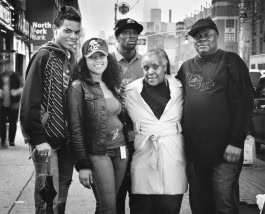
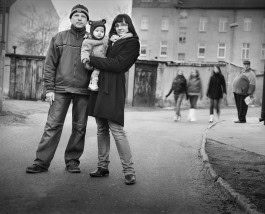
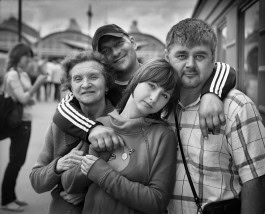
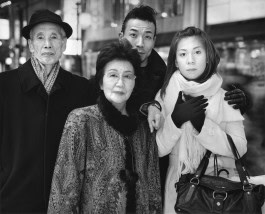
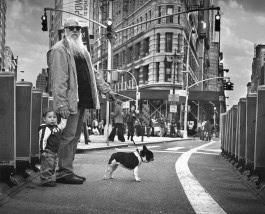
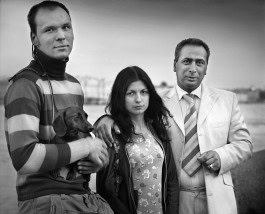
Von Reiswitz decided to approach this in a fascinating way: staging family portraits by connecting complete strangers on the street. Taken all over the world, throughout the course of more than 15 years, the pictures are a powerful exploration of what a family is perceived and of what it could be, prompting us to reflect on our personal connection to it on both an intimate and a collective level.
The book presentation will take place on June 6 at 8 pm at the Roter Salon der Volksbühne in Berlin as part of Parole Text:Buch. The premiere will feature not only the photographer, but many of the authors involved in the project. What is stunning about the book is indeed the close intertwining between image and language. Twenty-three renowned authors took the analog black and white pictures and inscribed fictional biographies in them. With this beautiful and contradictory overlap, the project creates parallel worlds for us to dive into and experience deeply.
— How did the project start? What has drawn you to the concept of family and what does it mean to you?
— Family is never just a social fact; it is also, and perhaps above all, an idea shaped by images. Family pictures rarely simply show reality. They arrange, beautify, and assert belonging. Strictly speaking, they have always been stagings. In that respect, not much has changed over the last three thousand years.
What interested me was the idea of family that people carry within themselves today, and what happens when you confront them with it unexpectedly in the street — by offering them, for a brief moment, the possibility of imagining themselves into a different fate.
This is how Catching Strangers began: as a kind of long-term photographic experiment. My rules were simple. None of the participants was allowed to know the others beforehand, but all of them had to be in the same place at the same time purely by chance. I would then approach them one by one and ask them to stand together as a family for a moment. What interested me was what a family picture looks like when it does not arise from habit, obligation, or biography, but from a voluntary, spontaneous agreement.
But another origin of the project goes back even further, to a childhood memory. As a child, I saw my father replace a missing photograph of my great-grandmother with the portrait of an unknown woman he had bought at a flea market. Suddenly, this stranger had a fixed place in our family history. Perhaps Catching Strangers began at that very moment.


— What I think is stunning is that families are staged in this case, recreated by taking strangers from the streets. Can you tell us a bit about the process and the dynamics that arose from this? What have you learned while doing the project?
— I generally like to think of my photographic work as a shared improvisation with the person or animal in front of me — always with an open outcome. The possibility of failure is almost always part of it.
With Catching Strangers, however, something surprised me from the very beginning: as soon as I managed to stop someone in the street and explain the project, a spontaneous familiarity often set in very quickly. For the first person I approached, it often seemed obvious and self-evident that the other family members now urgently had to be found, so that the picture could come into being at all. That sense of urgency always confirmed to me that they were taking their responsibility within their new role very seriously.
There were rarely any polite formalities. Sometimes, before I even knew the first name of the person I was speaking to, I already knew something about family conflicts, separations, losses, or upcoming weddings. In that moment, I became a little part of their real family as well.
Family does not have to be explained; people simply talk about it quite naturally. That was similar across very different countries and cultures.
Only once did the ideas of what kind of family should be created diverge so radically that I had to stop the process immediately, out of fear that it might turn into a fight.
If I had to say what I learned from the project, it would be this: belonging can arise very quickly, and it depends far less on truth than on silent agreement. The boundaries between social reality and social imagination disappear quickly when people are willing, for a short moment, to step into a role and determine their own familial surroundings.
And there is something else I learned about smiling. In photography, smiling has a very bad reputation; photographers often view it with suspicion, except perhaps in wedding photography or advertising. One becomes used to suppressing a reflexive smile, because it can seem artificial or superficial. Through this project, I realized how honest and beautiful a smile can also be.
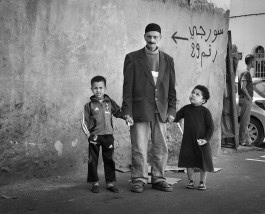
— The Family Constellations were taken all over the world, over the course of more than 15 years. Did you notice any specific differences or similarities? How do you think things have changed throughout the years also in relation to the history of photography? I am thinking of the hierarchical settings of family portraits in the past and how that might have changed for example, but also of how common it became in the last decade to document these moments with smart phones.
— Many certainties in politics and society have been turned upside down since 2005, when I began the project. The world has changed dramatically in that time, and I believe you can feel that on the street as well. Perhaps people’s basic trust in one another has become a little weaker.
And yet, over the years and in very different countries, there was something remarkable that remained almost constant: I hardly ever had to explain the idea of making a family portrait with strangers. Almost everywhere, people immediately understood what I meant when I said that for a picture I was still looking for a father, a daughter, a grandmother, or a lost son. What varied from place to place was rather the kind of hesitation, the degree of physical ease, the sense of shame, or the openness to entering such a game.
Family pictures have always made a very similar claim: they organize belonging. Long before photography, they often did so in a hierarchical, representative, and solemn way. Since the invention of photography, the family picture has become more and more democratic — and of course this has become even more extreme since smartphones began documenting our lives almost continuously, as if everything were even more beautiful than yesterday.
During the entire period in which Catching Strangers was made, photography itself also underwent the decisive transition from analogue to digital. I began the project on film with a medium-format camera and continued to use the same camera until the very end. Precisely at a time when images were becoming ever faster and more easily manipulated, the question of authenticity became more important to me than ever — even, or perhaps especially, in a project about invented families. What mattered to me was to preserve and make visible the real commitment of a single photographic moment.
But these pictures still tend to say the same thing: Look, this is how beautiful it was, this is how we belonged together, this is how important this moment was. In that sense, they remain stagings, just as they already were more than three thousand years ago, when the Egyptian king Akhenaten had himself carved in stone together with Nefertiti and their three daughters — as royal propaganda meant to promote a new religious order. Or today, when an influencer stages a product on TikTok between a beautiful partner and a cute pet in such a way that it appears casual and natural.
After Catching Strangers was published as a book, I was often told that its subject feels surprisingly current, because it touches social assumptions that we usually take for granted and quietly puts them into question. Perhaps the project does feel more timely today than it would have twenty years ago, because questions of belonging, otherness, self-determination, and attribution have become much more open and conflict-ridden.
During the project, I was repeatedly corrected myself: once I was told not to think in such binary terms, another time I was told, quite firmly, to respect the rules of a particular culture. That interested me a great deal. Even an improvised family picture immediately reaches into social reality.
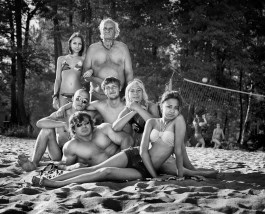
— Can you share with us one story or a particular episode while realizing the project that stayed with you?
— It was night, and the shop windows were throwing their light onto the street. I had already found a woman and two children — only the father was missing. Then a small man passed by. I asked him if he would step in for a moment. He said he actually had no time because he was supposed to meet someone there, but he agreed anyway.
The moment this improvised family was in position, his face changed. He turned pale, smiled in a strained way, and kept looking over his shoulder. Then I saw why: his actual wife was standing in the crowd, watching us without moving.
In that moment, his face was trying to express only one sentence: It’s not what it looks like. While his false family was still embracing him tenderly, I could only think: I would much rather be somewhere in Antarctica photographing penguins.
— I think what is also deeply moving is the power that photography has to keep the people we have lost with us. Do you think that has applied to and influenced your practice?
— That is a very beautiful and powerful thought. It was not something that consciously occupied me while working on Catching Strangers, simply because I was dealing with invented families. In real family albums, this aspect is of course very important — because photographs allow us to form an image of our actual ancestors, and because in mourning they can help us keep looking at someone who is no longer there. In my case, that does not really apply.
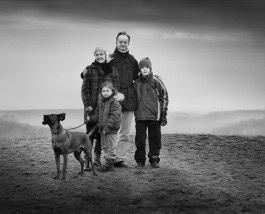
— Can you tell us how the book was conceived? Can you tell us a bit more about the various acclaimed authors that were involved and will be part of the book presentation as well?
— After the first family portraits, I already came to the conclusion that the image could not be the end of the story. The fact that none of these families had actually existed troubled me from the beginning as well. Although I had invented them myself, I could not let go of the feeling that the people depicted somehow still belonged together. They stood before the camera with such credibility and honesty, and later looked back at me from the photograph with such intensity, that the whole process still felt incomplete to me — as if these families were left hanging in the air with a questioning “so, what?”
This is how the idea emerged to invite writers to choose one family each and place its members retrospectively in a living context, giving them story, memory, everyday life — in other words, breathing life into them.
Over the years, twenty-three authors agreed to take part in this experiment and wrote a text in response to one image each. The resulting book was published in both English and German. The literary concept and the coordination with the authors were developed by the Frankfurt-based publicist Florian Koch, who had followed the project for many years and made it possible for me to get in touch with the following writers: Matthias Altenburg, Zsuzsa Bank, Marcel Beyer, Britta Boerdner, John Burnside, Ulrike Draesner, Nadja Einzmann, Marjana Gaponenko, Lena Gorelik, Anna Katharina Hahn, Danielle Hoffelt, Felicitas Hoppe, Verena Jütte, Ulla Lenze, Mariana Leky, Nicol Ljubić, Muepu Muamba, Ulli Nois, Angelika Overath, Rosa Ribas, Nis-Momme Stockmann, Christian Stahlhut, and Vincenzo Todisco.
Related Articles:

Von Reiswitz decided to approach this in a fascinating way: staging family portraits by connecting complete strangers on the street. Taken all over the world, throughout the course of more than 15 years, the pictures are a powerful exploration of what a family is perceived and of what it could be, prompting us to reflect on our personal connection to it on both an intimate and a collective level.
The book presentation will take place on June 6 at 8 pm at the Roter Salon der Volksbühne in Berlin as part of Parole Text:Buch. The premiere will feature not only the photographer, but many of the authors involved in the project. What is stunning about the book is indeed the close intertwining between image and language. Twenty-three renowned authors took the analog black and white pictures and inscribed fictional biographies in them. With this beautiful and contradictory overlap, the project creates parallel worlds for us to dive into and experience deeply.
— How did the project start? What has drawn you to the concept of family and what does it mean to you?
— Family is never just a social fact; it is also, and perhaps above all, an idea shaped by images. Family pictures rarely simply show reality. They arrange, beautify, and assert belonging. Strictly speaking, they have always been stagings. In that respect, not much has changed over the last three thousand years.
What interested me was the idea of family that people carry within themselves today, and what happens when you confront them with it unexpectedly in the street — by offering them, for a brief moment, the possibility of imagining themselves into a different fate.
This is how Catching Strangers began: as a kind of long-term photographic experiment. My rules were simple. None of the participants was allowed to know the others beforehand, but all of them had to be in the same place at the same time purely by chance. I would then approach them one by one and ask them to stand together as a family for a moment. What interested me was what a family picture looks like when it does not arise from habit, obligation, or biography, but from a voluntary, spontaneous agreement.
But another origin of the project goes back even further, to a childhood memory. As a child, I saw my father replace a missing photograph of my great-grandmother with the portrait of an unknown woman he had bought at a flea market. Suddenly, this stranger had a fixed place in our family history. Perhaps Catching Strangers began at that very moment.


— What I think is stunning is that families are staged in this case, recreated by taking strangers from the streets. Can you tell us a bit about the process and the dynamics that arose from this? What have you learned while doing the project?
— I generally like to think of my photographic work as a shared improvisation with the person or animal in front of me — always with an open outcome. The possibility of failure is almost always part of it.
With Catching Strangers, however, something surprised me from the very beginning: as soon as I managed to stop someone in the street and explain the project, a spontaneous familiarity often set in very quickly. For the first person I approached, it often seemed obvious and self-evident that the other family members now urgently had to be found, so that the picture could come into being at all. That sense of urgency always confirmed to me that they were taking their responsibility within their new role very seriously.
There were rarely any polite formalities. Sometimes, before I even knew the first name of the person I was speaking to, I already knew something about family conflicts, separations, losses, or upcoming weddings. In that moment, I became a little part of their real family as well.
Family does not have to be explained; people simply talk about it quite naturally. That was similar across very different countries and cultures.
Only once did the ideas of what kind of family should be created diverge so radically that I had to stop the process immediately, out of fear that it might turn into a fight.
If I had to say what I learned from the project, it would be this: belonging can arise very quickly, and it depends far less on truth than on silent agreement. The boundaries between social reality and social imagination disappear quickly when people are willing, for a short moment, to step into a role and determine their own familial surroundings.
And there is something else I learned about smiling. In photography, smiling has a very bad reputation; photographers often view it with suspicion, except perhaps in wedding photography or advertising. One becomes used to suppressing a reflexive smile, because it can seem artificial or superficial. Through this project, I realized how honest and beautiful a smile can also be.

— The Family Constellations were taken all over the world, over the course of more than 15 years. Did you notice any specific differences or similarities? How do you think things have changed throughout the years also in relation to the history of photography? I am thinking of the hierarchical settings of family portraits in the past and how that might have changed for example, but also of how common it became in the last decade to document these moments with smart phones.
— Many certainties in politics and society have been turned upside down since 2005, when I began the project. The world has changed dramatically in that time, and I believe you can feel that on the street as well. Perhaps people’s basic trust in one another has become a little weaker.
And yet, over the years and in very different countries, there was something remarkable that remained almost constant: I hardly ever had to explain the idea of making a family portrait with strangers. Almost everywhere, people immediately understood what I meant when I said that for a picture I was still looking for a father, a daughter, a grandmother, or a lost son. What varied from place to place was rather the kind of hesitation, the degree of physical ease, the sense of shame, or the openness to entering such a game.
Family pictures have always made a very similar claim: they organize belonging. Long before photography, they often did so in a hierarchical, representative, and solemn way. Since the invention of photography, the family picture has become more and more democratic — and of course this has become even more extreme since smartphones began documenting our lives almost continuously, as if everything were even more beautiful than yesterday.
During the entire period in which Catching Strangers was made, photography itself also underwent the decisive transition from analogue to digital. I began the project on film with a medium-format camera and continued to use the same camera until the very end. Precisely at a time when images were becoming ever faster and more easily manipulated, the question of authenticity became more important to me than ever — even, or perhaps especially, in a project about invented families. What mattered to me was to preserve and make visible the real commitment of a single photographic moment.
But these pictures still tend to say the same thing: Look, this is how beautiful it was, this is how we belonged together, this is how important this moment was. In that sense, they remain stagings, just as they already were more than three thousand years ago, when the Egyptian king Akhenaten had himself carved in stone together with Nefertiti and their three daughters — as royal propaganda meant to promote a new religious order. Or today, when an influencer stages a product on TikTok between a beautiful partner and a cute pet in such a way that it appears casual and natural.
After Catching Strangers was published as a book, I was often told that its subject feels surprisingly current, because it touches social assumptions that we usually take for granted and quietly puts them into question. Perhaps the project does feel more timely today than it would have twenty years ago, because questions of belonging, otherness, self-determination, and attribution have become much more open and conflict-ridden.
During the project, I was repeatedly corrected myself: once I was told not to think in such binary terms, another time I was told, quite firmly, to respect the rules of a particular culture. That interested me a great deal. Even an improvised family picture immediately reaches into social reality.

— Can you share with us one story or a particular episode while realizing the project that stayed with you?
— It was night, and the shop windows were throwing their light onto the street. I had already found a woman and two children — only the father was missing. Then a small man passed by. I asked him if he would step in for a moment. He said he actually had no time because he was supposed to meet someone there, but he agreed anyway.
The moment this improvised family was in position, his face changed. He turned pale, smiled in a strained way, and kept looking over his shoulder. Then I saw why: his actual wife was standing in the crowd, watching us without moving.
In that moment, his face was trying to express only one sentence: It’s not what it looks like. While his false family was still embracing him tenderly, I could only think: I would much rather be somewhere in Antarctica photographing penguins.
— I think what is also deeply moving is the power that photography has to keep the people we have lost with us. Do you think that has applied to and influenced your practice?
— That is a very beautiful and powerful thought. It was not something that consciously occupied me while working on Catching Strangers, simply because I was dealing with invented families. In real family albums, this aspect is of course very important — because photographs allow us to form an image of our actual ancestors, and because in mourning they can help us keep looking at someone who is no longer there. In my case, that does not really apply.


— Can you tell us how the book was conceived? Can you tell us a bit more about the various acclaimed authors that were involved and will be part of the book presentation as well?
— After the first family portraits, I already came to the conclusion that the image could not be the end of the story. The fact that none of these families had actually existed troubled me from the beginning as well. Although I had invented them myself, I could not let go of the feeling that the people depicted somehow still belonged together. They stood before the camera with such credibility and honesty, and later looked back at me from the photograph with such intensity, that the whole process still felt incomplete to me — as if these families were left hanging in the air with a questioning “so, what?”
This is how the idea emerged to invite writers to choose one family each and place its members retrospectively in a living context, giving them story, memory, everyday life — in other words, breathing life into them.
Over the years, twenty-three authors agreed to take part in this experiment and wrote a text in response to one image each. The resulting book was published in both English and German. The literary concept and the coordination with the authors were developed by the Frankfurt-based publicist Florian Koch, who had followed the project for many years and made it possible for me to get in touch with the following writers: Matthias Altenburg, Zsuzsa Bank, Marcel Beyer, Britta Boerdner, John Burnside, Ulrike Draesner, Nadja Einzmann, Marjana Gaponenko, Lena Gorelik, Anna Katharina Hahn, Danielle Hoffelt, Felicitas Hoppe, Verena Jütte, Ulla Lenze, Mariana Leky, Nicol Ljubić, Muepu Muamba, Ulli Nois, Angelika Overath, Rosa Ribas, Nis-Momme Stockmann, Christian Stahlhut, and Vincenzo Todisco.
Related Articles:
You need to load content from reCAPTCHA to submit the form. Please note that doing so will share data with third-party providers.
More InformationYou need to load content from Turnstile to submit the form. Please note that doing so will share data with third-party providers.
More InformationYou are currently viewing a placeholder content from Facebook. To access the actual content, click the button below. Please note that doing so will share data with third-party providers.
More InformationYou are currently viewing a placeholder content from Instagram. To access the actual content, click the button below. Please note that doing so will share data with third-party providers.
More InformationYou need to load content from hCaptcha to submit the form. Please note that doing so will share data with third-party providers.
More InformationYou need to load content from reCAPTCHA to submit the form. Please note that doing so will share data with third-party providers.
More InformationYou are currently viewing a placeholder content from Turnstile. To access the actual content, click the button below. Please note that doing so will share data with third-party providers.
More InformationYou are currently viewing a placeholder content from X. To access the actual content, click the button below. Please note that doing so will share data with third-party providers.
More Information